Southern Esoteric Buddhism
| Part of a series on |
| Theravāda Buddhism |
|---|
 |
| Buddhism |
Southern Esoteric Buddhism and Borān Kammaṭṭhāna are terms used to refer to a collection of esoteric practices, views, and texts within Theravada Buddhism. Often known as Esoteric Theravada or Tantric Theravada, these labels highlight its parallel with tantric traditions—though it does not employ actual tantras.
L.S. Cousins defines this phenomenon as "a type of Southern Buddhism which links magical and ritual practices to a theoretical systematisation of the Buddhist path itself."[1][2]
In the West, the study of Southern Esoteric Buddhism was pioneered by professor François Bizot and his colleagues at the École française d'Extrême-Orient. Their research, especially focusing on material discovered at Angkor, has been instrumental in revealing the complex interplay between orthodox Theravada doctrines and these esoteric practices.[3]
Over the past two centuries, the Boran tradition has been marginalized by colonial governments and by the "Protestant Buddhist" movement—reformers who promote a strict "Pali Tipitaka only" sola scriptura approach and dismiss local practices as deviations from orthodox scriptural teachings.[4] As such, the tradition stands in opposition to Buddhist modernism and Secular Buddhism.
Etymology
[edit]As a term, Borān Kammaṭṭhāna is a combination of the Tai-Khmer word បុរាណ pronounced [boːraːn] meaning ancient or outdated, derived from the Sanskrit word "Purāṇa" along with the Pali word Kammaṭṭhāna meaning "place of work". Essentially, it refers to outdated and ancient spiritual practices.[5][6]
Borān Kammaṭṭhāna specifically constitutes Theravada Buddhism that has blended into a distinct form with the ancient folk practices and esoteric spiritual traditions of the Tai-Khmer peoples of Thailand, Laos, Shan State in Myanmar, Cambodia, and the Sipsongpanna district of Yunnan province in China.[7]
However, other parts of the Theravada world also have their own versions of esotericism.
History
[edit]Beginnings
[edit]-
 Abhayagiri Dagoba at Anuradhapura built in the 2nd Century BC
 -
 Bodhisattva Avalokiteśvara, venerated in Lanka today as Natha deva.
 -
 Ratnamali Yantra


Historically, monks of the Abhayagiri and Jetavanaramaya fraternities in Sri Lanka are known to have incorporated Bodhisattva vows and Tantric rituals into their practices,[1] which may have later influenced Southeast Asia through their missionary activities in Java. According to L. S. Cousins, elements of Southern Esoteric Buddhism might have developed within the mainstream Mahavihara tradition of Sri Lanka. He notes that the 5th-century scholar Buddhaghosa referred to “secret texts” (gulhagantham)—teachings transmitted only through a guru-disciple relationship—alongside other references to esoteric material in the Pali commentaries. This suggests that esoteric traditions were already present within Theravāda Buddhism before the 5th century CE.[8]
The practice of Paritta (protective chanting) in Sri Lanka may also trace its origins to tantric influences from mendicants of the Abhayagiri Vihara.[9] Paritta chanting plays a central role in Sri Lankan religious and social life, functioning both as a communal ceremony and a form of protection. The Sri Lankan Theravāda tradition is unique for maintaining paritta bhāṇaka (reciter) lineages dedicated to preserving these chants orally. While earlier oral lineages for transmitting the Vinaya, Sutta, and Abhidhamma Piṭaka texts have largely disappeared, paritta transmission lineages have survived because oral transmission is believed to empower the texts with spiritual efficacy.[10]
The use of Yantra diagrams as meditation aids within the Theravāda tradition is also thought to have originated among members of the Abhayagiri community.[11]
Theravāda Buddhism in Southeast Asia was also shaped by the influence of Vajrayāna, which flourished in the region during the Khmer Empire and Srivijaya periods. However, esoteric practices may have already been present due to the broader Indianization of Southeast Asia. Ari Buddhism—practiced in the Bagan Kingdom of Myanmar (Burma)—combined Tantric elements from India with local traditions of spirit and Nāga worship. Scholars such as François Bizot have proposed that the Buddhism of the Mon people may have influenced the later Yogāvacara tradition.[3]
Cousins concludes that “it is quite possible that present-day Southern Esoteric Buddhism contains ideas and practices deriving from more than one of these sources. Nevertheless, it is certainly premature to assume that it has its origins in solely unorthodox circles.”[1]
Flowering
[edit]-
 Cambodia Vajra
 -
 Hevajra, from the reign of Jayavarman 7th of Khmer Empire
_LACMA_M.91.232.5.jpg)

The Yogāvacara tradition remained a mainstream Buddhist practice in Cambodia, Laos, and Thailand well into the modern era. Evidence of its early presence includes the Phitsanulok Dhammakaya inscription from northern Thailand, which contains esoteric elements and dates to the Sukhothai Kingdom (16th century). According to scholar Kate Crosby, this inscription attests to an esoteric tradition older than any other living meditation tradition in the contemporary Theravada world.[12]
During the reign of Rama I, the Thai Yogāvacara master Kai Thuean (1733–1823) was invited to Bangkok to lead the meditation tradition there. He was later appointed Sangharaja (supreme patriarch) by Rama II of Siam in 1820.[3] In Sri Lanka, a revival of Buddhist meditation in the 1750s led to the proliferation of Yogāvacara teachings and texts by Thai monks from the Ayutthaya Kingdom, including the Yogāvacara's manual.[13]
Following the re-establishment of the Sri Lankan sangha by Upali Thera, monks of the Siam Nikaya practiced and disseminated these teachings, establishing monasteries around Kandy. Yogāvacara practices, such as the rapid repetition of Araham, were still observed in Sri Lanka as late as the 1970s.[3]
Decline (19th–20th century)
[edit]-
 Seal of the Dhammayuttika Nikaya monastic order
 -
 King Mongkut in the white robes of a lay renunciant
 -
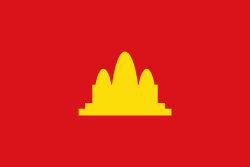 Flag of Democratic Kampuchea


The decline of Southern Esoteric Buddhism began in the 19th century with the rise of reformed Buddhism, particularly the establishment of the Dhammayuttika Nikaya by King Rama IV (1851–1868) of the Thai Rattanakosin Kingdom in 1833. This reform movement emphasized the Pali Canon as the main authority for monastic practices and sought to eliminate superstitious and folk religious elements.[14] The Dhammayuttika Nikaya was later introduced into Cambodia, then a protectorate of the Thai kingdom, further contributing to the decline of esoteric traditions.[3]
The textual foundation of this reform movement was rooted in the Sri Lankan Mahavihara school, which had undergone its own reforms in the 12th century under Parakramabahu I. This school, heavily influenced by the works of the 5th-century scholar Buddhaghosa, was regarded as the orthodox interpretation of Theravāda Buddhism and viewed other Buddhist practices as unorthodox.[3] The reforms reinforced strict monastic obedience to Mahavihara orthodoxy, leading to a decline in esoteric Buddhist practices and the production of non-canonical texts.
Further suppression occurred under the French colonial empire, which ruled Cambodia and continued the policy of marginalizing pre-reform Cambodian Buddhism. Despite these efforts, traditional esoteric practices persisted in rural areas. However, the devastation caused by the Khmer Rouge in Cambodia and religious repression in Communist Laos inflicted additional damage on these traditions.[15]
Legacy
[edit]-
 Logo of the Samatha Trust
 -
 Logo of the Dhammakaya movement
 -
 Offering ceremony at Wat Paknam Bhasicharoen


Category:Boran Theravada temples
One of the last monks believed to have received initiation into the traditional Boran lineage in Sri Lanka was a monk named Doratiyāveye Thera, who lived around the turn of the 20th century.[16] His life marks one of the last recorded links to the Boran or “ancient” meditation traditions that once thrived in Theravāda monasteries across the region. Some contemporary Buddhist movements in Southeast Asia are thought to preserve echoes of this heritage. Scholars suggest that elements of Yogāvacara practice have influenced modern Thai traditions such as the Dhammakaya movement.[17][18][19] The movement’s mother temple, Wat Paknam Bhasicharoen, and its associated online centers such as the Vijja Meditation Center, continue to promote systematic forms of concentration and visualization practice.[20]
Throughout the region, temples integrate meditation, ritual, and popular devotional culture. Many monasteries engage lay followers through both Dhamma instruction and the sale of sacred items such as amulets, yantra cloth (Pha Yant), and protective tattoos. Temples like Wat Bang Phra are known for their sak yant tattoo rituals, while others, such as Wat Tha Sung, are celebrated for their elaborate ceremonies and meditative teachings.[21][22]
Outside Asia, the older Samatha methods have also been maintained. The Samatha Trust in the UK represents one such organization dedicated to teaching and preserving these early meditative traditions in the West along with the traditional Tai-Khmer knowledge of bijas.[23][24]
Practices and concepts
[edit]-
 Buddhist prayer beads used for mantra recitation.
 -
 Trinisinghe Yantra
 -
 Buddha amulets from Thailand
 -
 A Baci ceremony in Vientiane, Laos


.jpg)

Although it lacks tantric scriptures, Boran Kammatthāna preserves an extensive body of esoteric meditation manuals and ritual practices. Scholars describe Southern Esoteric Buddhism as a symbolic and mystical system that links the body, cosmos, and spiritual knowledge through correspondences involving sound, gesture, and number.[1][3]
Core elements of the Yogāvacara or Boran Kammatthāna tradition include mantra recitation, protective and merit-making rituals, and symbolic meditation methods. These practices combine canonical Buddhism with local ritual culture, incorporating Paritta chanting, devotion to Buddhas and deities, and popular ceremonies such as the Vessantara Festival and Royal Ploughing Ceremony.[25]
Esoteric teachings emphasize inner visualization, sacred syllables, subtle-body imagery, and spiritual “alchemy” aimed at purification and transformation. Protective magic, amulets, and yantras in tattoo form such as Sak Yant and cloth form part of the same ritual framework. Initiation between teacher and disciple (abhiseka) remains a key aspect of transmission.[3][26]
Research by François Bizot identifies a “rebirth” ritual in which meditation and visualization are modeled on embryonic development, culminating in the realization of the Dhammakaya or “body of Dhamma.”[3] Other practices involve yantras inscribed with Pali syllables and colored-light visualizations culminating in visions of the Buddha or Mount Sumeru.[3]
Traces of these traditions persist among modern Southeast Asian Buddhists, including Thai forest monks such as Ajahn Lee Dhammadharo, whose text The Divine Mantra reflects similar esoteric influences.[27] Overall, Boran Kammatthāna represents a distinctive Theravāda esoteric system that blends meditation, ritual, and symbolic cosmology within a tantric influenced framework.[3]
Mūlakammaṭṭhāna
[edit]In the Pali commentarial tradition, the term mūlakammaṭṭhāna is traditionally rendered as "basic meditation subject" or "root meditation theme." Within the classical Theravāda tradition articulated in exegetical commentaries and meditation manuals, it denotes the primary object of focus selected by a practitioner to cultivate samatha (tranquility) and develop samādhi. Common examples include mindfulness of breathing (ānāpānasati), contemplation of the body (kāyagatāsati), or visualization of a kasina (a colored disk or totality). These foundational practices serve as preparatory stages for attaining deeper meditative absorptions, or jhāna.
By contrast, the Tai-Khmer Yogāvacara tradition interprets mūlakammaṭṭhāna through a distinct esoteric framework. Here, the concept encompasses a highly ritualized system integrating meditation with elements such as sacred Khmer seed syllables, mantra recitation, the activation of symbolic bodily points ("body loci"), and the visualization of yantra-like diagrams. Unlike the canonical emphasis on mental stabilization, this approach seeks to catalyze the awakening of latent spiritual energies, reflecting a tantric-inflected methodology that extends significantly beyond conventional Theravāda exegesis.[26]
Mantras and Generative Grammar
[edit]-
 Various symbolisms and meanings of the syllables of NAMO BUDDHAYA.
 -
 Various symbolisms and meanings of the syllables of MA A U.
 -
 Various symbolisms and meanings of the syllables of SAMVIDHA PUKAYAPA.


In the Yogāvacara tradition, sacred mantras such as "Namo Buddhaya" ("Homage to the Buddha") and "Araham" ("Worthy One") are central to meditation practice.[3] These mantras, also found in Classical Theravada, are imbued with esoteric interpretations, with each syllable assigned deeper, symbolic meanings.
For example, the mantra "Namo Buddhaya" is analyzed esoterically, with its syllables associated with familial and societal virtues.[1]
- NA – the twelve virtues of the mother
- MO – the twenty-one virtues of the father
- BU – the six virtues of the king
- DDHA – the seven virtues of the family
- YA – the ten virtues of the teacher
Robert Percival, who was in Ceylon from 1796 to 1800, described Buddhist mantra meditation as follows: "To their girdles they wear suspended strings of beads made of a brownish or black wood; and mutter prayers as they go along."[3]
These esoteric practices remain most prevalent in Northern Thai and Cambodian Buddhism, where they integrate elements of Theravada and esoteric Buddhist traditions.[28]
Visualizations
[edit]In one text studied by Bizot, meditation includes visualization of colored lights paired with sacred syllables within the body, along with visions of the Buddha and a stupa atop Mount Sumeru.[3] Another text, the Ratanamala, uses the itipi so formula for various purposes, including:
- Spiritual protection
- Magical 'worldly' applications ("left-hand path")
- Transformation of the body into a kayasiddhi, a spiritual body
- The pursuit of nirvana ("right-hand path")[3]
The Saddavimala, a widely circulated Yogāvacara text, describes how practitioners rebuild themselves spiritually by internalizing Dhamma as bodily components, forming a new, immortal spiritual body that replaces the physical form at death.[3] This process involves several key steps, which the yogavacara must undertake:
- Memorise the stages of the embryonic development (with their alphabetic equivalents) which form the stages of his own formation;
- Through these stages, build himself another body using the organs and constituents that are the letters, i.e. the portions of the Dhamma;
- Become conscious that this new body, which he is going to produce outside of himself, first takes form within him, in his stomach at the level of the navel, taking the form of a Buddha the height of a thumb;
- Pursue and achieve in this life the construction of this immortal vehicle, because it leads the person who possesses it to Nibbana, in that it takes the place of the spent physical form at the moment of death.
Devotionalism
[edit]Prayers and worship of deities in Theravada Buddhism is rooted in sutta-based textual information such as the Nandiya Sutta and Pataligama Sutta which advise lay practitioners to provide offering of food in order to receive honors and mendicants to recollect the virtues of the devas in order to emulate their qualities.[29][30] Whereas classical Theravada includes parittas from the Pali Canon directed towards gods, the esoteric tradition involves lay and monastic acharyas who often compose their own gathas praising the qualities of a particular deity or deities and calling upon them in times of need.[31]
Rituals and Ritual Implements
[edit]
One ritual that is a part of the esoteric tradition of Theravada is the Naga ordination ceremony, sometimes a golden hat known as the Kratham Hua is worn.[32] Whereas Classical Theravada makes use of wrathful practices such as the invocation of the Atanatiya Paritta for exorcisms, the esoteric tradition makes use of ritual implements such as the Mitmor Knife as a conduit for the channeling of maha-metta and protection from dark forces.[33] This is similar to the use of phurba and karthika in tantric traditions.
Roles
[edit]Acharyas
[edit]Lay and monastic masters of esoteric arts in Thai culture are referred to as Geji Ajahn. A regional subsect of Geji Ajahn in the Lanna region of Thailand are referred to with the title of Kruba Ajahn.[34]
In Cambodia and Laos, the geji ajahns (respected forest masters) are renowned for their mastery of esoteric disciplines. They are widely believed to possess supernormal abilities such as the divine eye and communication with spirits. These powers are cultivated through intensive practices including Kasina meditation, mantra recitation, and ascetic observances (dhutanga).
Today, their influence remains especially strong along the banks of the Mekong, where monks and magicians following these traditions continue to attract devotees seeking spiritual protection, healing, and guidance.
Hermits
[edit]-
 An altar depicting nats and weizza (Taw Bo Bo Aung, Bodaw Aung Mingaung), Mount Popa, Myanmar
 -
![A statue of a Ruesi at Wat Suan Tan in [Nan, Thailand]](//upload.wikimedia.org/wikipedia/commons/thumb/4/4d/2013_Wat_Suan_Tan_02.jpg/120px-2013_Wat_Suan_Tan_02.jpg) A statue of a Ruesi at Wat Suan Tan in [Nan, Thailand]
A statue of a Ruesi at Wat Suan Tan in [Nan, Thailand]

![A statue of a Ruesi at Wat Suan Tan in [Nan, Thailand]](/wiki/File:2013_Wat_Suan_Tan_02.jpg)
In the Isigili Sutta, a well known paritta, the Buddha recollects the virtuous qualities of the paccekabuddha rishis such as the Vedic sage Bharadvaja.[35] The practices of the Burmese Buddhist Weizza ("Wizards") and Thai Ruesi, who follow an esoteric system of occult practices (such as recitation of spells, samatha and alchemy) believed to lead to supernormal powers and even immortality, might also be related to Southern Esoteric Buddhism.
Brahmins
[edit].jpg)
For centuries, Brahmins have played an important role in the royal and religious life of Southeast Asia, working alongside Buddhist monks in state ceremonies, coronations, and calendrical rituals. From the courts of Angkor and Ayutthaya to present-day Bangkok, this collaboration gave rise to a distinctive blend of Buddhist and Brahmanical traditions that shaped the ritual life of the region.[36][37]
Studies of the borān meditation and ritual traditions suggest that Buddhist and Brahmanical elements often coexisted within the same cultural sphere. Practices such as the recitation of mantras, the use of yantra diagrams, and invocations of protective deities were integrated into Buddhist frameworks of meditation, merit-making, and spiritual protection. The boundaries between monastic and lay ritual specialists—including Brahmins—were therefore often fluid, reflecting a shared understanding of ritual efficacy across traditions.[38][39]
In contemporary Thailand and Cambodia, elements of this synthesis remain visible in ceremonies such as royal consecrations, paritta (protective) chanting, and the creation of consecrated cloths and amulets. In these contexts, monks and Brahmins may still collaborate or draw from similar ritual repertoires. Although modern reform movements have sometimes emphasized clearer distinctions between “orthodox” Theravāda Buddhism and Brahmanical practices, the two traditions continue to intersect in the lived religious life of the region.[40][41]
The current Chief Royal Brahmin of Thailand is Chawin Rangsipramanakul.
Texts
[edit]
Category:Boran Theravada texts
Across the Theravāda Buddhist world, numerous texts exist outside the standardized Pāli Tipiṭaka yet hold importance within regional traditions. These works, often preserved through oral transmission or local manuscripts, continue to influence devotional practices, storytelling, and meditation methods across Southeast Asia.
Among the well-known narrative compositions are the Ramakien—a Thai adaptation of the Hindu Ramayana rendered in a Buddhist context[42]—and the Paññāsa Jātaka, a compilation of fifty Jātaka tales found primarily in Thai and Lao traditions.[43] These collections often reinterpret the Buddha’s previous lives through local geographical, cultural, and moral perspectives.
Esoteric and meditative manuals form another important body of regional literature. Texts such as the Yogāvacara's manual[44] and the Phuttha Rangsi Thrisdi Yan[45] provide detailed instruction in concentration, visualization, and mantra-based practices. Other examples, including the Kammatthāna Majjhima Baeb Lamdub[46] and the Cambodian Phlōv Preah Dhammalaṅkāra,[47] reflect the diversity of regional meditation systems and the persistence of premodern lineages.
Protective and ritual texts occupy a prominent role in everyday religious practice. Works such as the Jinapañjara Gāthā,[48] Dhammakāyānussati Gāthā, and Itipiso Ratanamala are recited for spiritual protection and merit. In Sri Lanka, the Piruwana Poth Wahanse[49] compiles paritta verses along with rare yantras and associated ritual instructions, while Tamil hymns such as the Tiruvempavai and Tiruppavai are performed in Thai royal ceremonies. These examples highlight the shared ritual and devotional networks across linguistic and cultural boundaries.
Regional doctrinal and philosophical works, including Narai Sip Pang,[50] Trai Phum Phra Ruang, and Kappālaṅkāra, offer interpretations of Buddhist cosmology and ethics specific to local contexts. Apocryphal suttas such as the Uṇhissavijaya Sutta[51] and Mahāmegha Sutta appear in the Lao and Khmer canons, suggesting fluid boundaries between canonical and regional corpora.
Additional collections such as the Sipsongpanna Pattra Buddhist Canon maintained by the Dai people[52][53] further demonstrate the extensive manuscript traditions of Theravāda communities. Collectively, these regional and extra-canonical works show the adaptability of Theravāda Buddhism while preserving its fundamental doctrinal principles.
Buddhas, Deities and Spirits
[edit]This is a list of Buddhas, deities, dharmapālas, and spirits emphasized in local or folk traditions of Boran and popular Theravāda Buddhism. These figures are not often not emphasized in canonical Pali Tipitaka texts but are widely venerated through oral traditions, protective rites, and devotional practices in Southeast Asia.


Buddhas, Bodhisattas and Arahants
[edit]- Avalokiteśvara – Known as Kwan Im in Thailand, Natha Deva in Sri Lanka, and Lawka Nat (လောကနတ်) in Myanmar.
- Bhaisajyaguru – The Medicine Buddha; known as Phra Kring in Thai tradition.
- Samantabhadra – Revered in Sri Lanka under the name Sumana Saman.
- Phra Setthi Navagotta
- Phra Sangkajai – Known for his wisdom and corpulent appearance, sometimes mistaken for the Chinese Laughing Buddha.
- Gavampati - Known as Phra Pidta in Thailand.
- Upagupta – A prominent figure in Southeast Asian folklore; called Shin Upagutta in Burma and invoked for protection against evil.
- Sīvali – Venerated for his unmatched merit and blessings to attract wealth and fortune.
- Phra Malai – A mythical monk who journeyed to heaven and hell; widely featured in apocalyptic and visionary literature like the Phra Malai Klon Suat. Considered to have qualities similar to Kṣitigarbha.
Rishis
[edit]- Jīvaka - Revered in the Wai khru ceremony.
- Zawgyi – Semi-mythical alchemist and forest wizard, prominent in Burmese folklore.
- Ta Eisey - Cambodian equivalent of Bharata Muni
Supraregional Gods
[edit]- Indra - King of Tavatimsa heaven, appears in the unique form of Sihuhata in the Lanna region of Thailand. Known as Thagyamin in Burma and can appear in his Bo Bo Gyi form.
- Pajjuna - Thunderer god appealed to for rain.
- Four Heavenly Kings – Protective deities who guard the four cardinal directions in Buddhist cosmology.
- Hanuman – Avatar of Shiva and devotee of Rama; incorporated in Buddhist and folk rituals.
- Shiva – Known in Thai Buddhism as Phra Isuan, sometimes identified with guardian roles.
- Ganesha – Called Phra Phikanet in Thailand; invoked for wisdom and obstacle removal.
- Bhairava – Fierce protective deity venerated by Muay Thai fighters and tantric adepts.[54] Though he is depicted in Thailand with iconography of the rakshasa Viradha.
Sri Lankan Deities and Figures
[edit]Category:Sinhalese Buddhist deities
- Dedimunda deviyo – Warrior deity believed to be an attendant of Vessavana.
- Suniyam – Protective deity invoked in exorcism and justice rituals.
Thai Deities and Spirits
[edit]- Phosop – Rice goddess, often equated with Lakshmi in Thai folklore.
- Nang Kwak – Household deity believed to bring luck and commercial success.
- Phra Mae Thorani – Earth goddess who aided the Buddha; invoked in merit-making.
Burmese Nats
[edit]- 37 Great Nats – Burmese spirit deities incorporated into local Buddhist cosmology.
- Popa Medaw – Protective yakshini of Mount Popa; venerated in nat shrines.
Cambodian deities
[edit]- Yeay Mao – Cambodian spirit guardian of travelers and protector of the land.
- Khleang Moeung - Village protector deity.
Major figures in Borān Kammaṭṭhāna
[edit]Here is a list of figures that have been praised in local Theravada Buddhist traditions on account of their extraordinary saintliness and powers as well as scholars of the traditions.
-
 Statue of Bo Bo Aung, a famed Burmese Weizza or spiritual adept.
 -
 The Kyaikhtisaung Sayadaw delivering a Dhamma talk.
 -
 Somdej Phra Buddhacarya (Toh Brahmaramsi), an influential Thai monk.
 -
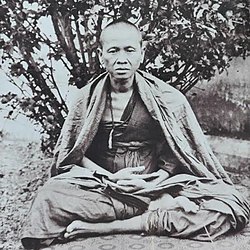 Khruba Siwichai, saint of Northern Thai Buddhism.


.jpg)

Scholars
[edit]Burmese Mystics and Ascetics
[edit]Myanmars spiritual landscape includes many holy men who practiced extreme asceticism or alchemical meditation:
- Shin Iza Gawna – Mystic who lived in mountain caves and transmitted meditation teachings.
- Bo Bo Aung – Famed Weizza (esoteric adept) believed to have achieved supernatural longevity.
- Bo Min Gaung – Spiritual successor of Bo Bo Aung; claimed to have performed miracles.
- U Khandi – Hermit monk who helped rebuild pagodas and was highly respected by both laypeople and royals.
Thai Buddhist Masters
[edit]These Thai monks and acharyas are revered for their meditative attainments and for founding meditation schools and temples:
- Luang Pu Thuat – Semi-legendary monk known for miraculous deeds such as turning seawater into fresh water.
- Kai Thuean – Author of the Kammatthāna Majjhima Baeb Lamdub and former Supreme Patriarch of Thailand.
- Somdej Toh – Popularized the Jinapanjara Gatha; famous for his amulets and deep scriptural knowledge.
- Luang Pu Sodh Candasaro – Reviver of the Dhammakaya meditation tradition in central Thailand.
- Khruba Siwichai – Iconic reformer and builder monk who renovated temples across northern Thailand.
See also
[edit]- Luang Por
- Pali literature
- Kammaṭṭhāna
- Vajrayana
- Tantra
- Achar (Buddhism)
- Indonesian Esoteric Buddhism
- Azhaliism
- Traditional Cambodian medicine
References
[edit]- ^ a b c d e Cousins, L.S. (1997), Archived 2015-05-21 at the Wayback Machine, in Peter Connolly and Sue Hamilton (eds.), *Indian Insights: Buddhism, Brahmanism and Bhakd Papers from the Annual Spalding Symposium on Indian Religions*, Luzac Oriental, London: 185–207, 410. ISBN 1-898942-153
- ^ Cousins LS, 1997a 'Buddhism' pp.369–444 in JR Hinnells (ed.) *A New Handbook of Living Religions* Oxford: Blackwell Publishers, cited in Mackenzie, Rory (2007), *New Buddhist Movements in Thailand: Towards an understanding of Wat Phra Dhammakaya and Santi Asoke*, Abingdon: Routledge, ISBN 0-203-96646-5
- ^ a b c d e f g h i j k l m n o p Crosby, Kate (2000). *Tantric Theravada: A Bibliographic Essay on the Writings of Francois Bizot and others on the Yogavacara-Tradition*, Contemporary Buddhism 1 (2), 141–198
- ^ Abeysekara, Ananda (2019). "Protestant Buddhism and "Influence": The Temporality of a Concept". Qui Parle. 28 (1): 1–75. doi:10.1215/10418385-7522565.
- ^ ""Provides definitions in Khmer and English – entry for [បុរាណ]"". Khmer Online Dictionary (Tovnah). Society for Better Books in Cambodia. Retrieved 2025-08-20.
- ^ ""Kammatthana — 8 definitions" (glossary entry)". Wisdom Library. Wisdom Library. Retrieved 2025-08-20.
- ^ "What Exactly is Borān Kammaṭṭhāna?". Esoteric Theravāda. 25 June 2024. Retrieved 2025-07-29.
- ^ Cousins, L. S. "Aspects of Esoteric Southern Buddhism" (PDF). Unpublished Article Archive. A Handful of Leaves. Retrieved 1 August 2025.
- ^ Chandawimala, Venerable. "Tantric Buddhist Influence on Sri Lankan Pirit (Paritta)". Academia.edu. Retrieved 24 March 2025.
- ^ Chandawimala, Venerable. "Tantric Buddhist Influence on Sri Lankan Pirit (Paritta)." Buddhist and Pali Studies in Honour of the Venerable Professor Kakkapalliye Anuruddha, edited by Bhikkhuni Suvimalee, Singapore: Buddhist and Pali College of Singapore, 2010, p. 2.
- ^ Chandawimala, Venerable. "Tantric Buddhist Influence on Sri Lankan Pirit (Paritta)." Buddhist and Pali Studies in Honour of the Venerable Professor Kakkapalliye Anuruddha, edited by Bhikkhuni Suvimalee, Singapore: Buddhist and Pali College of Singapore, 2010, p. 4.
- ^ Crosby, Kate (2013). Traditional Theravada Meditation and its Modern-Era Suppression. Buddha Dharma Centre of Hong Kong. ISBN 978-9881682024.
- ^ Crosby, Kate; Skilton, Andrew; Gunasena, Amal (2012). "The Sutta on Understanding Death in the Transmission of Boran Meditation From Siam to the Kandyan Court". Journal of Indian Philosophy. 40 (2): 177–198.
- ^ Ratanakosin Period, Buddhism in Thailand, Dhammathai |website=Buddhist Information Network
- ^ Kate Crosby, Traditional Theravada Meditation and its Modern-Era Suppression Hong Kong: Buddha Dharma Centre of Hong Kong, 2013, ISBN 978-9881682024
- ^ Igunma, Jana (January 2021). "Illustrated Yogāvacara Meditation Manuals from Thailand and Laos". Academia.edu. Archived from the original on 2025-03-09. Retrieved 2025-03-09.
- ^ Williams, Paul. Mahayana Buddhism: The Doctrinal Foundations. Routledge, p. 327.
- ^ Mettanando Bhikkhu (1999). Meditation and Healing in the Theravāda Buddhist Order of Thailand and Laos. PhD thesis, University of Hamburg.
- ^ Mackenzie, Rory (2007). New Buddhist Movements in Thailand: Towards an Understanding of Wat Phra Dhammakaya and Santi Asoke (PDF). Routledge. ISBN 0-203-96646-5.
- ^ "On-Line Vijja Meditation Center – Meditation101.org". Meditation101.org. Vijja Meditation Center (Online). Retrieved 2025-08-20.
- ^ Drouyer, Isabel Azevedo & Rene Drouyer. Thai Magic Tattoos: The Art and Influence of Sak Yant. River Books, 2013.
- ^ Swearer, Donald K. The Buddhist World of Southeast Asia. SUNY Press, 2010.
- ^ "Samatha Meditation in the UK – Context and History of Samatha-Vipassanā Teaching in Britain". ITIPISO – International Tipiṭaka Studies Organization. ITIPISO. Retrieved 2025-08-20.
- ^ https://itipiso.org/syllables-and-yantras.html
- ^ McDaniel, Justin Thomas. The Lovelorn Ghost and the Magical Monk: Practicing Buddhism in Modern Thailand.
- ^ a b Bizot, François (1994). The Gate of Liberation [Le Portail du Cœur]. Silkworm Books. Cite error: The named reference "Bizot" was defined multiple times with different content (see the help page).
- ^ Ajaan Lee (2006), *The Divine Mantra*
- ^ Kate Crosby, Andrew Skilton, Amal Gunasena; The Sutta on Understanding Death in the Transmission of Boran Meditation From Siam to the Kandyan Court.
- ^ Bhikkhu, Thanissaro (1997). "Pāṭaligāma Sutta: At Pāṭaligāma (Ud 8.6)". Access to Insight. Access to Insight. Retrieved 1 August 2025.
- ^ Bhikkhu Sujato, Brahmali. "AN 11.13 Nandiya Sutta: To Nandiya". SuttaCentral. SuttaCentral. Retrieved 1 August 2025.
- ^ "Pra Kata Mantras for Chanting – Thailand-Amulet.net". Thailand Amulet. Retrieved 1 August 2025.
- ^ "Buat Nak: Rituals before Monkhood". Thailand Foundation. Thailand Foundation. 2021. Retrieved 20 August 2025.
- ^ "Kata Mitmor LP Derm Wat Nong Po – Thailand Amulet". Retrieved 2025-08-07.
- ^ "What are the Basic Differences Between Vajrayāna and Esoteric Theravāda?"
- ^ "Majjhima-nikāya 116 (Isigili Sutta): English translation by Bhikkhu Sujato". SuttaCentral. Retrieved 2025-08-14.
- ^ H. G. Quaritch Wales, Siamese State Ceremonies: Their History and Function (London: Bernard Quaritch, 1931; repr. 1968).
- ^ Barend Jan Terwiel, Monks and Magic: An Analysis of Religious Ceremonies in Central Thailand (Bangkok: White Lotus, 1994 [1975]).
- ^ François Bizot, The Gate of Liberation (trans. Donald K. Swearer) (Chiang Mai: Silkworm Books, 1994).
- ^ Kate Crosby, Esoteric Theravada: The Story of the Forgotten Meditation Tradition (New Haven: Yale University Press, 2020).
- ^ Justin Thomas McDaniel, The Lovelorn Ghost and the Magical Monk: Practicing Buddhism in Modern Thailand (New York: Columbia University Press, 2011).
- ^ Peter Skilling, “Brahmanical Gods in Theravāda Buddhism,” in John Holt, Jacob Kinnard, and Jonathan Walters (eds.), Constituting Communities: Theravāda Buddhism and the Religious Cultures of South and Southeast Asia (Albany: SUNY Press, 2003), pp. 157–175.
- ^ Shastri, Satya Vrat (1989). Ramakirti Mahakavya (in Sanskrit). International Academy of Indian Culture.
- ^ Jaini, S. Padmanabh (1981). Paññāsa Jātaka. Pali Text Society.
- ^ "Manual of Mystic" (PDF). Internet Archive. Retrieved 2025-03-25.
- ^ หนังสือพุทธรังษีธฤษดีญาณสมถเลวิปัสสนากัมมัฏฐาน ๔ ยุค. Internet Archive. Retrieved 2025-08-23.
- ^ หลวงพ่อสุก. คู่มือสมถะวิปัสสนากรรมฐานมัชฌิมาแบบลําดับ. Internet Archive. Retrieved 2025-08-24.
- ^ "ផ្លូវព្រះធម្មលង្ការ". eLibrary of Cambodia (បណ្ណាល័យអេឡិចត្រូនិចខ្មែរ) (in Khmer). Retrieved 26 August 2025.
- ^ Ṭhānissaro, Bhikkhu. "Chanting Guide – The Divine Mantra". Dhammatalks.org. Retrieved 2025-03-25.
- ^ "Piruwana Poth Wahanse". Internet Archive. Retrieved 2025-06-18.
- ^ "Narai Sip Pang". archive.org. Retrieved 18 August 2025.
- ^ Kourilsky, Gregory. "The Uṇhissa-vijaya-sutta in Thailand and Laos: A Philological Approach". Academia.edu. Retrieved 2025-03-25.
- ^ "《中国贝叶经全集》新闻发布会暨出版座谈会_华人佛教_凤凰网". Fo.ifeng.com. Retrieved 14 October 2012.
- ^ "The Complete Chinese Pattra Buddhist Scripture《中国贝叶经全集》". China. Retrieved 17 August 2025.
- ^ "Pra Pirab". Thailand Amulet. Retrieved 2025-03-25.
Sources
[edit]- Mettanando Bhikkhu (1999), Meditation and Healing in the Theravada Buddhist Order of Thailand and Laos, Hamburg (Ph.D. thesis).
- Woodward, EL. (1916), Manual of a Mystic being a translation from the Pali and Sinhalese Work entitled The Yogavachara's Manual, Pali Text Society, London, reprint 1982, ISBN 0-86013-003-7.
- Bernon, Olivier de (2000). Le manuel des maîtres de kammaṭṭhān : étude et présentation de rituels de méditation dans la tradition du bouddhisme khmer (Ph.D. thesis)
- Bizot F (1976). Le figuier à cinq branches, Recherches sur le bouddhisme khmer I, PEFEO, vol.CVI1, park
- Bizot F (1980), 'La grotte de la naissance', Recherches sur le bouddhisme khmer II, BEFEO, vol.LXVI1: 222–73, Paris.
- Bizot F (1981a). Le don de soi-même, Recherches sur le bouddhisme khmer III, PEFEO, vol.CXXX, Paris. ISBN 2-85539-730-8.
- Bizot F (1988), Les traditions de la pabbajja en Asie du Sud-Est, Recherches sur le bouddhisme khmer IV, Gijttingen. ISBN 3-525- 82454-8.
- Bizot F (1992). Le Chemin de Lankā, Textes bouddhiques du Cambodge no.f4, Collection de Ecole francaise de Extreme-Orient, Paris. ISSN 1150-2177, ISBN 2-85539-301-9.
- Bizot, F & E Lagirarde (1996). La pureté par les mots (Saddavimālā), Ecole francaise de Extreme-Orient, Paris, Chiang Mai. ISSN 1150-2177. ISBN 9782855 393049.
- Crosby,Kate (2013) Traditional Theravada Meditation and its Modern-Era Suppression Hong Kong: Buddha Dharma Centre of Hong Kong ISBN 9881682029
- Crosby, Kate (2019). Abhidhamma and Nimitta in Eighteenth-century Meditation Manuscripts from Sri Lanka: a Consideration of Orthodoxy and Heteropraxy in Boran Kammaṭṭhāna.
- Davids, Thomas William Rhys ed. (1896), The Yogavacara's manual of Indian mysticism as practised by Buddhists, London: PTS, Oxford University Press
- Foxeus, N. (2013). Esoteric Theravada Buddhism in Burma/Myanmar. Scripta Instituti Donneriani Aboensis, 25, 55–79. https://doi.org/10.30674/scripta.67433
- Foxeus, N. (2016). "I am the Buddha, the Buddha is Me": Concentration Meditation and Esoteric Modern Buddhism in Burma/Myanmar. Numen, 63(4), 411–445
- Skilton, Andrew & Choompolpaisal, Phibul (2016). The Ancient Theravāda Meditation System, Borān Kammaṭṭhāna: Ānāpānasati or 'Mindfulness of The Breath' in Kammatthan Majjima Baeb Lamdub.
External links
[edit]General Resources on Esoteric and Theravāda Buddhism
[edit]- Esoteric Theravada | Southern Esoteric Buddhism
- WikiWicca
- Buddha Magic – Articles on Thai amulets, rituals, and esoteric history.
- Dharma Thai – Thai Buddhism and magic-related resources.
- Saiyasat – Thai esoteric and magical practices.
- Lersi Thai Hermit Path – Archived site on Thai hermits and spiritual practice.
- The Thai Occult – Thai magical traditions, amulets, and occult practices.
- Saengthai – Thai traditional religious rituals and dhamma talks.
Monasteries and Meditation Centers
[edit]- Abhayagiri Monastery – Thai Forest Tradition monastery in the U.S.
- Samatha Trust – British meditation organization teaching samatha-vipassana techniques.
- Meditation 101 On-Line Dhammakaya Meditation Center
- Dhamma Center
- Patana.org – Buddhist teachings and retreats.
Individual Teachers and Practitioners
[edit]- Suvaco Bhikkhu – Blog of a Theravāda monk with esoteric interests.
- Santidhammo – Reflections and writings of a Buddhist monk.
- Ajahn Spencer Website
- LuangPhor.com
Amulets and Ritual Arts
[edit]- Naresuan Thai Amulet
- Dhammayut Amulet
- Amulet City
- Thailand Amulets
- Ancient Amulet
- Magie du Bouddha
- Uncle Chow Amulet
- MyBuddha101
Chanting and Pali Resources
[edit]- Itipiso.org – Pali chanting, Buddhist texts, and devotional practice.
- Buddho Foundation – Mindfulness and mantra-based practice inspired by the "Buddho" method.


.svg)