Varaha Shikhar
| Varaha Shikhar | |
|---|---|
| Annapurna Fang | |
 Fang seen from below the West Ridge | |
| Highest point | |
| Elevation | 7,647 m (25,089 ft)[1][2] |
| Prominence | 445 m (1,460 ft)[3] |
| Parent peak | Annapurna I[3] |
| Isolation | 1.2 km (0.75 mi)[4] |
| Coordinates | 28°34′41″N 83°48′12″E / 28.57806°N 83.80333°E[1] |
| Geography | |
  Varaha Shikhar Location in Nepal | |
 | |
| Interactive map of Varaha Shikhar | |
| Country | Nepal |
| Province | Gandaki |
| District | Myagdi / Kaski |
| Protected area | Annapurna Conservation Area |
| Parent range | Annapurna Himal[1] |
| Climbing | |
| First ascent | 1980 (West Ridge) |
Varaha Shikhar, better known internationally as Annapurna Fang, is a mountain in the Annapurna Himal of Nepal. The peak is also known as Baraha Shikhar,[5] Bharhā Chuli̇̄,[6] and Fang.[7]
Features
[edit]Varaha Shikhar is a 7,647-metre (25,089-foot) summit in the Annapurna Himal of the Nepalese Himalayas, situated 40 kilometres (25 mi) north-northwest of Pokhara in Gandaki Province. It is the westernmost summit on the main ridge of the range, seated on the Southwest Ridge of Annapurna I Main.
While it is the third-highest named summit of the Annapurna massif,[1] and of the Annapurna Conservation Area, its modest prominence and omission from the numbered summits in the Annapurna range mean it is much more obscure than these peaks. [3] Precipitation runoff from the mountain's west slope drains to the Kali Gandaki, whereas the east slope drains into headwaters of the Modi River.
Although there are some mountain walls of comparable size with a steeper topographic relief in less distance, its Southwest Face has perhaps the greatest vertical rise from its base of any such face in the world: It rises 4,450 metres (14,600 ft) above the Kali Gandaki gorge in only four kilometres (2.5 mi).
Climate
[edit]Based on the Köppen climate classification, Varaha Shikhar is located in a tundra climate zone with cold, snowy winters, and cool summers.[8] Weather systems are forced upwards by the Himalaya mountains (orographic lift), causing heavy precipitation in the form of rainfall and snowfall. Mid-June through early-August is the monsoon season. The months of March, April, October, and November offer the most favorable weather for viewing or climbing this peak.[9]
Climbing
[edit]The first ascent of the summit was achieved on May 17, 1980, by Austrians Sepp Mayerl and Hermann Neumair, along with Ang Chopal Sherpa of Nepal.[1][10] In 1984 the team of Scott Fischer made an attempt as the price of a permit was the cheapest in the region, but was forced to retreat due to severe conditions.[11] The second ascent was made on November 29, 2007, by Park Soo Seok, Siting Sherpa, and Wangdi Sherpa via the east face and south ridge.[10][12][13] As of 2022, these are the only successful climbs out of nine attempts, and there have been three fatalities in that time.[10]
See also
[edit]Gallery
[edit]-
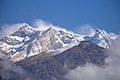 Fang to the right with Annapurna I to left
 -
 Southwest face
 -
 Southeast aspect
 -
 Sun setting over Fang and Annapurna
 -
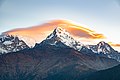 Annapurna Fang to left, Annapurna South centered
 -
 Varaha Shikhar is the peak furthest to left
 -
 Annapurna I to left with Fang to the right
 -
 Southeast aspect
 -
 Scott Fischer on the Fang in 1984

.JPG)


.jpg)

_1984_Cropped.jpg)
References
[edit]- ^ a b c d e "Varaha Shikhar (Fang)". Nepal Himal Peak Profile. Government of Nepal. Retrieved 8 June 2025.
- ^ Frederic V. Hartemann, The Mountain Encyclopedia: An A-Z Compendium of More Than 2,300 Terms, Concepts, Ideas, and People, Bloomsbury Academic, 2005, ISBN 9780810850569
- ^ a b c "Annapurna Fang". peakvisor.com. Retrieved 8 June 2025.
- ^ "Annapurna Fang, Nepal". Peakbagger.com. Retrieved 8 June 2025.
- ^ Hendrik Erasmus, Drifting into a Side-Stream, Trafford Publishing, 2009, ISBN 9781425177539, p. 166.
- ^ Nepal - FinnMaps, Retrieved June 8, 2025.
- ^ "Fang (Varaha Shikhar) Attempt". American Alpine Journal. 25 (57). American Alpine Club: 242. 1983. Retrieved 8 June 2025.
- ^ Peel, M. C.; Finlayson, B. L.; McMahon, T. A. (2007). "Updated world map of the Köppen−Geiger climate classification". Hydrol. Earth Syst. Sci. 11 (5): 1633. Bibcode:2007HESS...11.1633P. doi:10.5194/hess-11-1633-2007. ISSN 1027-5606.
- ^ Best time to go to Annapurna, whereandwhen.net, Retrieved June 8, 2025.
- ^ a b c Annapurna, Kris (17 December 2022). "The Annapurna Massif: More Than Annapurna I". Explorersweb.com. Retrieved 8 June 2025.
- ^ Birkby, Robert (1 February 2008). Mountain Madness: Scott Fischer, Mount Everest & a Life Lived on High. Citadel Press / Kensington Publishing. ISBN 9780806528755.
- ^ Seok, Park Soo (2009). "Annapurna Fang". Himalayan Journal. 65. Himalayan Club. Retrieved 8 June 2025.
- ^ Young-Jun, Lee (2008). "Varaha Shikhar (The Fang), Second Ascent, East Face to South Ridge". American Alpine Journal. 50 (82). Translated by Peter Jensen-Choi. American Alpine Club: 375. Retrieved 20 June 2025.
External links
[edit]Places adjacent to Varaha Shikhar | ||||||||||||||||
|---|---|---|---|---|---|---|---|---|---|---|---|---|---|---|---|---|
| ||||||||||||||||


