Talk:Resonant inductive coupling
| This is the talk page for discussing improvements to the Resonant inductive coupling article. This is not a forum for general discussion of the subject of the article. |
Article policies
|
| Find sources: Google (books · news · scholar · free images · WP refs) · FENS · JSTOR · TWL |
| Archives: 1 |
 | This article is rated C-class on Wikipedia's content assessment scale. It is of interest to the following WikiProjects: | |||||||||||||||||||||||||||
| ||||||||||||||||||||||||||||


Resonance mechanism poorly described and invasive dogmatic content
[edit]In this page the resonance mechanism is suggested to improve the coupling factor whereas it is only a way to reduce losses on both the generator side and the load side for the same field level as it is also explained somewhere in the page. Resonance is a first consequence of the impedance matching process, it is similar for all types of couplings ( mechanical, acoustic, magnetic, electric) and consists in compensating a reactive link impedance by a conjugate reactance, see for instance: https://en.wikipedia.org/wiki/Impedance_matching and in particular the 'Maximum power transfer matching' subsection. All this is well known for centuries and well described in many old books, see for instance VACUUM TUBE AMPLIFIERS Copyright, 1948, by the McGraw-Hill Book Company, Inc, chapter5 pp201 to 226, for a direct reading see https://www.jlab.org/ir/MITSeries/V18.PDF. This book summarized works done well before (before 1937 at least). The link is not affected by the resonance effect that is an internal process in the devices, the coupling factor 'k' is a constant that doesn't depend on frequency but only on distribution of charge and currents (then electrodes and coils geometry). The appropriate quantity to take into account the "resonance" effect is the coupling index 'kQ' introduced in the bottom of page 202 in the book. It is also introduced in this page under a new name "factor of merit" that if not inappropriate but somehow hides the historical succession of events. Chapter 5, also address the asymmetry between coils Q-factors 'Q1, Q2' (the second resonance awkward idea). The two introduction figures are then dogmatic according to me as they indicate a sort of focalization of field lines whereas, as explained, resonance does not affect coupling 'k' and field line distribution or it should be proved with actual data. The chapter "Witricity resonant...." where the coupling index is introduced is totally commercial. The commercial name "Witricity" should not figure here as the information introduced apply for all resonant systems. By the way, according to me the only specific aspect of the Witricity patent is the use of two core-less transformers on both side to provide resistance tuning. The whole tuning process is two fold reactance and resistance tuning as explained in the following didactic videos I made a few years ago when teaching the field in University: https://www.youtube.com/watch?v=yKmseA3Fd-g for inductive coupling and https://www.youtube.com/watch?v=YegIW-1hbvQ for capacitive coupling. Finally the dipole field admittedly decreases as 1/r3, evanescent waves and field (exponential decrease) are only obtained at the interfaces between two mediums. Considering that a magnetic transformer is based on evanescent wave whereas it can be described accurately by non propagating field (quasi-static approximation) is totally inappropriate, dogmatic and doesn't fit with the Okkam razor principle. According to me, this page was well written up to January 2017, then it was turned into some form of advertising for a given company and became more and more dogmatic with time (the awkward figures introduction used to defend a dogmatic content), the use of evanescent field suggesting that the idea is new. Besides the duality theorem that states that a dual capacitive coupling implementation exist (at least theoretically) is totally avoided in the page and I think creating a specific resonant capacitive page would not be an example of good practice. I am afraid that a personal direct contribution on the page will be perceived as non neutral, I am involved in many articles, patents concerning non-radiating near-fields and longitudinal capacitive coupling (resonant of course).Henri BONDAR (talk) 06:39, 10 January 2019 (UTC)
I suggest tagging this article for non neutral point of view (WP:NPOV policy). As said I don't think adding a Resonant capacitive coupling page is a good idea. As an expert in non-radiating near-field applications, I suggest to separate clearly the coupling aspects as well described in the https://en.wikipedia.org/wiki/Coupling_coefficient_of_resonators page, from resonance considerations that are specific implementations in the loads and generators devices and not specific to Witricity patent as falsely suggested here. They can be introduced straightforwardly using impedance matching considerations (see: https://en.wikipedia.org/wiki/Impedance_matching#Maximum_power_transfer_matching) and the coupling index kQ as introduced at least since 1937 in MacGraw-Hill book reference.Henri BONDAR (talk) 13:33, 12 January 2019 (UTC)
- Still no one to remove these hawful pictures and this dogmatic content from Wikipedia ? There is no place for such dogmatic and NPOV content here ! As already explained; coupling between coils or dipoles in vacuum or air is not affected by resonance (the link itself is not frequency dependent) coupling between distant coils is well described in the specific page (see my comment above). Resonances only reduce the losses in the generator (or load or both) for the same amount of transferred energy or said otherwise allows increasing the amount of power transfer (by either a voltage or current increase) for the same amount of losses. Said otherwise it is a pure matter of quality inside the devices themselves. The pictures showing that field lines distribution are somehow altered by resonances belong to pure phantasm and have nothing to do with actual field lines that again (louder this time) ARE NOT AFFECTED BY RESONANCES !!!!.Henri BONDAR (talk) 12:18, 26 December 2019 (UTC)
- Agree with the above critique as far as I can understand it. More generally, the article focuses with WP:undue weight on one specialized application of resonant transformers, power supplies and single resonant transformers. A WP:NOTHERE WP:SPA editor who manufactured resonant CCFL power supplies turned this page into his private playground. Most of it should be deleted and rewritten. I would like to do it but I have a big backlog of articles I am already working on. --ChetvornoTALK 06:50, 19 February 2022 (UTC)
- Maybe you don't know the effect of resonating only the secondary side. The description about CCFL has been corrected in the wrong direction. The description of the TDK patent I presented should also be very helpful.--Neotesla (talk) 01:44, 20 February 2022 (UTC)
- Agree with the above critique as far as I can understand it. More generally, the article focuses with WP:undue weight on one specialized application of resonant transformers, power supplies and single resonant transformers. A WP:NOTHERE WP:SPA editor who manufactured resonant CCFL power supplies turned this page into his private playground. Most of it should be deleted and rewritten. I would like to do it but I have a big backlog of articles I am already working on. --ChetvornoTALK 06:50, 19 February 2022 (UTC)
- Wow, the History section is also totally inadequate, it leaves out Karl Ferdinand Braun and almost all of the history of double tuned transformers in radio. This guy really had tunnel vision. --ChetvornoTALK 07:00, 19 February 2022 (UTC)
- I'm not the one who leaves out the history of double tuned transformers in radio. That field you say is the field of telecommunications or high frequency amplifier circuits. Now this discussion is a mix of those fields and power electronics field writers. This is an interesting situation, and it will be a very constructive discussion if each person shares their knowledge. I suggest that this discussion be divided into four cases: analog drive cases with a large drive side impedance, power switching cases with a drive side impedance of zero, and large or small coupling coefficient cases. Then, I think that neither discussion will conflict with each other.--Neotesla (talk) 00:17, 26 February 2022 (UTC)
- Wow, the History section is also totally inadequate, it leaves out Karl Ferdinand Braun and almost all of the history of double tuned transformers in radio. This guy really had tunnel vision. --ChetvornoTALK 07:00, 19 February 2022 (UTC)
- Before the discussion gets confused, I just put on the conclusion first. There is a boundar that at the coupling coefficient is low, the double tuning circuit is practical, and at it is high, resonance only on the secondary side is more practical. Moreover, the double tuning circuit in the high freaquency amplifier circuit is no needed to consider the efficiency. On the other hand, in power electronics, efficiency is considered. It depends on the impedance of the load, I think that k = 0.1 or k = 0.2 is the border. In power electronics, the area of close coupling of a double-tuned circuit is extremely bad efficiency and the FET may be damaged. In such a case, it is better to remove the resonance circuit on the primary side. Is this likely to give sepalate direction to discussions and criticism?--Neotesla (talk) 02:51, 20 February 2022 (UTC)
I agree with a number of points made here. Note that I have recently entered the wireless power transfer space, which is what brought this article to my attention, and Witricity is a competitor with the company I work for. Even still, repeated references to Witricity (or any particular wireless power transfer company which is not historically significant in general consensus) seems commercial and very out of place. Use of the terminology "evanescent" has commercial benefit for Witricity, and in the past they have used that terminology (which is non-standard) to add credibility to e.g. their patents. Impartial background investigation is warranted, though I don't have any references on hand. This isn't to accuse Witricity of editing the page themselves, but it's obvious that their work was a major influence on the article, and unnecessarily so. It is not an impartial article, and the content does not belong in an encyclopedic reference. There was also a noted shift in content quality and impartiality in the closely related article on evanescent waves, where the definition of evanescent has become increasingly ambiguous since about 2015.
The discussion by Henri above certainly is sound, but if I had to disagree with any point, it would be the quibble with the field lines. Resonance does change the field intensity near a receive coil, but only in the same way that input impedance matching increases the field intensity at the transmitter - the power transfer from generator to transmit coil is necessarily larger so of course the field is stronger. But observe that when a receive coil in a resonant circuit is placed into the field, the only way for the received signal strength to increase, is for the magnetic field intensity to increase inside the loop. Put another way, reactive energy stored in the resonant circuit has a significant impact on the local H field around the receive coil, via increased loop current. The power transfer to the receive circuit from the receiving coil is also dependent on impedance matching, but this is a distinct effect.
It's hard to separate the receive circuit from the transmit coil circuit. Above, I mean that the magnetic field at some position in space is hardly changed when a receive coil is introduced, whether the loop is shorted or open, but if you put a resonant capacitor in series with the receive coil (with a closed loop), the magnetic field strength inside the loop is dramatically increased relative to the transmit coils field contribution. The contribution to the field from the transmit coil is not changed, but the reactive energy stored in the resonant network contributes significantly as well.
Comments from others are encouraged. Sjgallagher2 (talk) 19:23, 22 October 2021 (UTC)
- I have just participated in the wireless power transfer field. This is a coincidence. After all, I also have a competitive relationship with WiTricity. I agree with your view of the Evanescent Field. This has a lot to do with their patents.
- By the way, the fact that sufficient power can be supplied by resonating only the secondary side is the fact that TDK in Japan has applied their patent and is shown in patent specification (JPA_2012182980). Please refer to this as a physical fact. Of course I did the same experiment and understand that their mention is correct.
- By the way, WiTricity has filed a patent infringement lawsuit toward Momentum Dynamics regarding wireless power transfer.[1] As a result, this description and facts of TDK have become very delicate. Do I need to mention the reason?
- The following is a literal translation.
- [0084]
- [Third Embodiment]
- FIG. 19 is a principle diagram of the wireless power transmission system 100 according to the third embodiment. The wireless power transfer system 100 in the third embodiment also includes a wireless power feeding device 116 and a wireless power receiving device 118. However, the wireless power receiving device 118 includes the power receiving LC resonance circuit 302, but the wireless power feeding device 116 does not include the power feeding LC resonance circuit 300. That is, the feeding coil L2 is not a part of the LC resonance circuit. More specifically, the feeding coil L2 does not form a resonant circuit with other circuit elements included in the wireless feeding device 116. No capacitor is inserted in series or in parallel with the feeding coil L2. Therefore, the feeding coil L2 is non-resonant at the frequency at which electric power is transmitted.
- [0085]
- The power supply VG supplies an alternating current having a resonance frequency fr1 to the feeding coil L2. The feeding coil L2 does not resonate, but generates an AC magnetic field having a resonance frequency fr1. The power receiving LC resonance circuit 302 resonates due to this AC magnetic field. As a result, a large alternating current flows through the power receiving LC resonance circuit 302. Through the study, it was found that it is not always necessary to form an LC resonant circuit in the wireless power feeding device 116. Since the feeding coil L2 is not a part of the feeding LC resonance circuit, the wireless feeding device 116 does not move to the resonance state at the resonance frequency fr1. Generally, in magnetic field resonance type wireless power transfer, a resonance circuit is formed on both the power supply side and the power reception side, and each resonance circuit is resonated at the same resonance frequency fr1 (= fr0) to transmit a large amount of power. Is interpreted as possible. However, it was found that even if the wireless power feeding device 116 does not include the power feeding LC resonance circuit 300, the magnetic field resonance type wireless power feeding can be realized as long as the wireless power receiving device 118 includes the power receiving LC resonance circuit 302.--Neotesla (talk) 01:31, 20 February 2022 (UTC)
How does the generation of amplitude modulation gets avoided?
[edit]Normally coupled oscillators create amplitude modulation if they are in in resonance. Should that be explained to? Quaderratistteuer (talk) 19:40, 30 September 2020 (UTC)
- One solution is to remove the primary resonator.
- The causing of the amplitude modulation is that
- the difference between the resonance frequency of the primary side and the secondary side , and the non-linear characteristics of the rectifier circuit. Modulation occurs when these two factors interact.
-
- Here, if the resonant circuit is only on the secondary side, no modulation will occur. If the coupling coefficient is over than 0.1, the resonant circuit can be enough only on the secondary side. Nevertheless high efficiency power transfer is possible. Neotesla (talk) 16:12, 16 November 2022 (UTC)




The First Discoverer of the Highly Resonant Phenomenon Was Stark
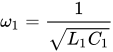
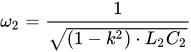
[edit]In the world of energy transfer innovation, a name often celebrated is Marin Soljačić, known for his pioneering experiments in highly resonant phenomena. However, recent insights have uncovered an earlier contributor whose work laid the theoretical groundwork for this breakthrough—Stark. Referenced in the U.S. Court of Appeals for the Federal Circuit (CAFC) ruling as prior art, Stark stands as the first individual to identify or predict the highly resonant phenomenon. Using simulations, Stark foresaw the potential of this phenomenon for achieving high efficiency power transfer—a visionary leap ahead of its time. Meanwhile, Marin Soljačić, the MIT researcher whose contributions have become synonymous with this field, took Stark's theoretical findings a step further. Soljačić demonstrated the feasibility of highly resonant energy transfer through experimental validation, cementing the concept's practicality. The relationship between Stark's predictive insights and Soljačić's experimental achievements illustrates the complementary roles theory and experimentation play in scientific discovery. While Stark’s contributions highlight the power of foresight and theoretical modeling, Soljačić's work showcases the impact of translating those ideas into tangible results. Together, their efforts have propelled advancements in wireless power transmission technologies. This revelation of Stark’s foundational work does not diminish Soljačić’s achievements but instead enriches the narrative of progress in this exciting scientific domain.
I tried to make it look like a newspaper article.Neotesla (talk) 07:58, 23 April 2025 (UTC)