Portal:American Civil War

 |
|
 |
 The American Civil War Portal


The American Civil War (1861–1865) was a sectional rebellion against the United States of America by the Confederate States, formed of eleven southern states' governments which moved to secede from the Union after the 1860 election of Abraham Lincoln as President of the United States. The Union's victory was eventually achieved by leveraging advantages in population, manufacturing and logistics and through a strategic naval blockade denying the Confederacy access to the world's markets.
In many ways, the conflict's central issues – the enslavement of African Americans, the role of constitutional federal government, and the rights of states – are still not completely resolved. Not surprisingly, the Confederate army's surrender at Appomattox on April 9,1865 did little to change many Americans' attitudes toward the potential powers of central government. The passage of the Thirteenth, Fourteenth and Fifteenth amendments to the Constitution in the years immediately following the war did not change the racial prejudice prevalent among Americans of the day; and the process of Reconstruction did not heal the deeply personal wounds inflicted by four brutal years of war and more than 970,000 casualties – 3 percent of the population, including approximately 560,000 deaths. As a result, controversies affected by the war's unresolved social, political, economic and racial tensions continue to shape contemporary American thought. The causes of the war, the reasons for the outcome, and even the name of the war itself are subjects of much discussion even today. (Full article)
Featured article

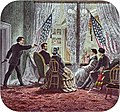
On April 14, 1865, Abraham Lincoln, the 16th president of the United States, was shot at Ford's Theatre in Washington, D.C., one month into his second term and towards the conclusion of the American Civil War. Lincoln was watching the play Our American Cousin with his wife Mary Todd, Major Henry Rathbone, and Rathbone's fiancé Clara Harris when John Wilkes Booth, an actor and Confederate sympathizer, shot him in the head. Lincoln was taken to the Petersen House across the street, where he died the following morning.
With Union victory imminent, Booth and his conspirators, including Lewis Powell, David Herold, and George Atzerodt, originally plotted to kidnap Lincoln to aid the Confederacy. After that plan failed to materialize, they decided to assassinate him, Secretary of State William H. Seward, and Vice President Andrew Johnson. Booth hoped that eliminating the three most important officials of the federal government would revive the Confederate cause. Powell and Herold were assigned to kill Seward, while Atzerodt was assigned to kill Johnson. Booth succeeded in killing Lincoln, but Powell only managed to wound Seward, while Atzerodt became drunk and never targeted Johnson. (Full article...)
Grand Parade of the States
.svg)
The state of New York during the American Civil War was a major influence in national politics, the Union war effort, and the media coverage of the war. New York was the most populous state in the Union during the Civil War, and provided more troops to the U.S. army than any other state,[1] as well as several significant military commanders and leaders. New York sent 400,000 men to the armed forces during the war. 22,000 soldiers died from combat wounds; 30,000 died from disease or accidents; 36 were executed. The state government spent $38 million on the war effort; counties, cities and towns spent another $111 million, especially for recruiting bonuses.
The voters were sharply divided politically. A significant anti-war movement emerged, particularly in the mid- to late-war years. The Democrats were divided between War Democrats who supported the war and Copperheads who wanted an early peace. Republicans divided between moderates who supported Lincoln, and Radical Republicans who demanded harsh treatment of the rebel states. New York provided William H. Seward as Lincoln's Secretary of State, as well as several important voices in Congress. (Full article...)
Featured biography

James Bennett McCreary (July 8, 1838 – October 8, 1918) was an American lawyer and politician from Kentucky. He represented the state in both houses of the U.S. Congress and served as its 27th and 37th governor of Kentucky. Shortly after graduating from law school, he was commissioned as the only major in the 11th Kentucky Cavalry, serving under Confederate Brigadier General John Hunt Morgan during the American Civil War. He returned to his legal practice after the war. In 1869, he was elected to the Kentucky House of Representatives where he served until 1875; he was twice chosen Speaker of the House. At their 1875 nominating convention, state Democrats chose McCreary as their nominee for governor, and he won an easy victory over Republican John Marshall Harlan. With the state still feeling the effects of the Panic of 1873, most of McCreary's actions as governor were aimed at easing the plight of the state's poor farmers.
In 1884, McCreary was elected to the first of six consecutive terms in the U.S. House of Representatives. As a legislator, he was an advocate of free silver and a champion of the state's agricultural interests. After two failed bids for election to the Senate, McCreary secured the support of Governor J. C. W. Beckham, and in 1902, the General Assembly elected him to the Senate. He served one largely undistinguished term, and Beckham then successfully challenged him for his Senate seat in 1908. The divide between McCreary and Beckham was short-lived, however, and Beckham supported McCreary's election to a second term as governor in 1911. (Full article...)
WikiProjects
Featured picture
-
-
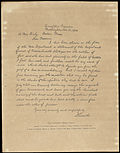 Lithographic facsimile of the Bixby letter, by Huber's Museum
 -
-
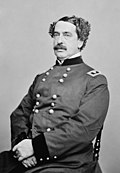
 Daniel McCallum, by the Brady National Photographic Art Gallery
 -

-
 The Chickahominy – Sumner's Upper Bridge at Peninsula campaign, by William McIlvaine
 -

-

-

-
 The original sketch of Sherman in South Carolina: The burning of McPhersonville, at and by William Waud
 -

-
 The print version of Sherman in South Carolina: The burning of McPhersonville at McPhersonville, South Carolina, by William Waud
 -
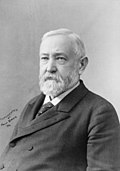 United States President (and former Brigadier-General) Benjamin Harrison
 -
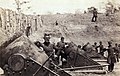 Siege of Yorktown, by James F. Gibson
 -
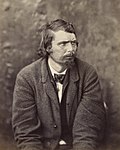
-
 The burning of Columbia at Columbia, South Carolina in the American Civil War, by William Waud
 -

-
 President Rutherford B. Hayes was the 19th President of the USA
 -

-

-
 Confederate casualties at Chancellorsville during the American Civil War, by the National Archives and Records Administration
 -

-

-
 Allan Pinkerton, President Lincoln, and John A. McClernand in 1862 by Alexander Gardner
 -

-

-
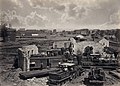 Atlanta roundhouse ruin at History of Atlanta, by George Barnard
 -

-
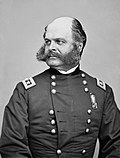
-
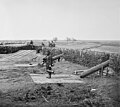 Quaker guns, by George Barnard and James F. Gibson
 -
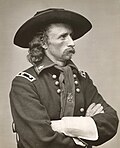 George Armstrong Custer, by George L. Andrews
 -
-

-

-

-

-
 Francis B. Spinola, Brigadier General for the Union in the American Civil War, and Congressman from New York
 -

-
 Andersonville survivor
 -

-
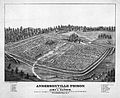 Andersonville Prison at Andersonville National Historic Site, by John L. Ransom
 -
 Abraham Lincoln's private secretary and biographer John Hay
 -

-
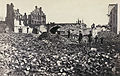 Richmond, Virginia after the American Civil War
 -

-
 Military execution of the conspirators in the Abraham Lincoln assassination


.jpg)


Did you know...
- ... that Colonel Bradley Winslow was brevetted by US president Abraham Lincoln for "brave and gallant conduct" during the siege of Petersburg in the American Civil War?
- ... that singer Frank Croxton performed a duet with his father for the unveiling of a monument to a Confederate States Army general?
- ... that CSS Beaufort fought USS Albatross in the first ship-versus-ship action of the American Civil War?
- ... that Nereus Mendenhall led a delegation to the Confederate States Congress in April 1862 to allow military exemption in the Confederate Army for Quakers?
- ... that Edward W. Gantt was a Confederate soldier who defected to the Union during the American Civil War?
- ... that Dethloff Willrodt fought for the Union army on the first day of the Battle of Gettysburg on July 1, 1863, having previously been a soldier in the Confederate army?
Subcategories
American Civil War topics

Related portals


Things you can do
- Attention needed
- ...to referencing and citation • ...to coverage and accuracy • ...to structure • ...to grammar • ...to supporting materials
- Popular pages
- Full list
- Cleanup needed
- The West Tennessee Raids
- Requested articles
- Benjamin D. Fearing • James B. Speers • Charles S. Steedman • Battle of Barton's Station • Lawrence P. Graham • Frederick S. Sturmbaugh • Mexico and the American Civil War • Savannah Campaign Confederate order of battle • Battle of Lafayette • Battle of Sunshine Church • Tangier Difficulty • Requested American Civil War Medal of Honor recipients • Battle of Tazewell
- Expansion needed
- Battle of Boonsborough • Battle of Guard Hill • Battle of Rice's Station • Battle of Simmon's Bluff • Battle of Summit Point • Charleston Arsenal • Edenton Bell Battery • First Battle of Dalton • Blackshear Prison • Edwin Forbes • Hiram B. Granbury • Henry Thomas Harrison • Louis Hébert (colonel) • Benjamin G. Humphreys • Maynard Carbine • Hezekiah G. Spruill • Smith carbine • Edward C. Walthall • Confederate States Secretary of the Navy • Confederate States Secretary of the Treasury • David Henry Williams • Battle of Rome Cross Roads • Delaware in the American Civil War • Ironclad Board • United States Military Railroad • Kansas in the American Civil War • Rufus Daggett • Ebenezer Magoffin • Confederate Quartermaster-General's Department • First Corps, Army of Northern Virginia • Francis Laurens Vinton • Henry Maury • Smith's Expedition to Tupelo • Ambrose Dudley Mann • Patrick Neeson Lynch • Stone Fleet (add international reactions and diplomacy) • Other American Civil War battle stubs • Other American Civil War stubs
- Images needed
- Preston Pond, Jr. • Melancthon Smith
- Merging needed
- 1st Regiment New York Mounted Rifles and 7th Regiment New York Volunteer Cavalry
- Citations needed
- 1st Alabama Cavalry Regiment (Union) • 4th Maine Battery • 33rd Ohio Infantry • 110th New York Volunteer Infantry • Battle of Hatcher's Run • Camp Dennison • Confederate colonies • CSS Resolute • Dakota War of 1862 • Florida in the American Civil War • Ethan A. Hitchcock (general) • Fort Harker (Alabama) • Gettysburg (1993 film) • Iowa in the American Civil War • Second Battle of Fort Sumter • Samuel Benton
- Translation needed
- Add an article here!
Associated Wikimedia
The following Wikimedia Foundation sister projects provide more on this subject:
-
 Commons
Free media repository -
 Wikibooks
Free textbooks and manuals -
 Wikidata
Free knowledge base -
 Wikinews
Free-content news -
 Wikiquote
Collection of quotations -
 Wikisource
Free-content library -
 Wikiversity
Free learning tools -
 Wikivoyage
Free travel guide -
 Wiktionary
Dictionary and thesaurus


- Shortcuts to this page: Portal:ACW • P:ACW
- ^ Dyer (1908), pp. 11–12, 1367–1471; Federal Publishing Company (1908), p. 18.