Alcestis

In Greek mythology, Alcestis (/ælˈsɛstɪs/; Ancient Greek: Ἄλκηστις, Álkēstis) or Alceste, was a princess of Iolcus known for her love of her husband. Her life story was described by Pseudo-Apollodorus in his Bibliotheca,[1] and a version of her death and return from the dead was also popularized by Euripides' tragedy Alcestis.
Family
[edit]Alcestis was the fairest among the daughters of Pelias, king of Iolcus, and either Anaxibia or Phylomache. She was sister to Acastus, Pisidice, Pelopia and Hippothoe.[2] Alcestis was the wife of Admetus by whom she bore a son, Eumelus, a participant in the siege of Troy, and a daughter, Perimele.[3]
Mythology
[edit]
When Alcestis came of age to marry, many suitors presented themselves before King Pelias to compete for her hand. Pelias proposed an impossible task, and declared that she would marry the first man to yoke a lion and a boar (or a bear in some cases) to a chariot. King Admetus of Pherae, was able to complete the task with the help of Apollo, who had been banished from Olympus for one year to serve as Admetus' shepherd. Alcestis and Admetus were married, but when making sacrifices after the wedding, Admetus forgot to make the required offering to Artemis; when he opened the marriage chamber, he found his bed full of coiled snakes.[4] Admetus interpreted the scene as a sign of his early death.[5]
Apollo again helped the newlywed king, this time by making the Fates drunk and tricking them into promising that if anyone was willing to die in Admetus' place, they would allow it. When the day of his death came near, no one volunteered, not even his elderly parents. Alcestis alone came forward to die in place of her husband.[6] As a token of his appreciation for Admetus' hospitality,[7] Heracles rescued Alcestis from the underworld shortly after fighting Thanatos.
After Heracles brings Alcestis back to the mortal realm and unites her with her husband, she is unable to speak. When Admetus questions this, Heracles informs him that she will be silent for three days until she is purified of her debt to the chthonic gods.[8]
Cultural Reference
[edit]Being an early Greek myth, the story of Alcestis can represent the cultural values in Greece at the time. It is known that myths hold cultural values as ways to teach lessons and highlight morals.[9] In the myth of Alcestis, somebody can interpret that she symbolizes women’s roles and expectations in Greece. Alcestis’ character also shows an integral trait cherished by the Greek and desired upon any gender.[10]
Such study can also be extended to other myth characters, including Alcestis’ husband, Admetus. An analysis of Admetus can come to criticize his acceptance of Alcestis’s sacrifice. However, he is shown to realize his mistake—a development in the character to represent growth.[11]
Gallery
[edit]-
 Scenes from the myth of Admetus and Alcestis. Marble, sarcophagus of C. Junius Euhodus and Metilia Acte, 161–170 CE.
 -
 The Farewell of Admetus and Alcestis by George Dennis (1848)
 -
 Hercules Wrestling with Death for the Body of Alcestis by Frederic Lord Leighton, England (c. 1869–1871)
 -
 The Death of Alcestis by Angelica Kauffmann.
 -
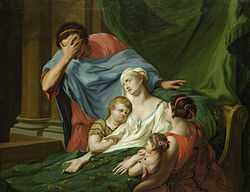 Admetus beweint Alkeste by Johann Heinrich Tischbein (circa 1780)
 -
 Herkules entreißt Alkestis dem Totengott Thanatos und führt sie dem Admetus zu by Johann Heinrich Tischbein (circa 1780)
 -
 Alceste mourante by Jean-François Pierre Peyron (1785)
 -
 Alcestis and Admetus, ancient Roman fresco (45–79 CE.) from the House of the Tragic Poet, Pompeii, Italy


Notes
[edit]
- ^ Apollodorus, 1.9.15
- ^ Apollodorus, 1.9.10
- ^ Antoninus Liberalis, 23
- ^ Apollodorus, 1.9.15
- ^ Roman, L., & Roman, M. (2010). Encyclopedia of Greek and Roman mythology., p. 54, at Google Books
- ^ Hyginus, Fabulae 243
- ^ Apollodorus, 2.6.2
- ^ Euripides, Alcestis, 1118
- ^ "Culture, Religion, & Myth: Interdisciplinary Approaches". web.cocc.edu. Retrieved 2025-05-02.
- ^ Goldfarb, Barry E. (1992). "The Conflict of Obligations in Euripides' Alcestis". Greek, Roman, and Byzantine Studies. 33 (2): 109–126. ISSN 2159-3159.
- ^ Lloyd, Michael (1985). "Euripides' 'Alcestis'". Greece & Rome. 32 (2): 119–131. ISSN 0017-3835.
References
[edit]
- Antoninus Liberalis, The Metamorphoses of Antoninus Liberalis translated by Francis Celoria (Routledge 1992). Online version at the Topos Text Project.
- Cotterell, Arthur, and Rachel Storm. The Ultimate Encyclopedia of Mythology. Hermes House. ISBN 978-0-681-03218-7.
- Pseudo-Apollodorus, The Library with an English Translation by Sir James George Frazer, F.B.A., F.R.S. in 2 Volumes, Cambridge, MA, Harvard University Press; London, William Heinemann Ltd. 1921. Online version at the Perseus Digital Library. Greek text available from the same website.
External links
[edit]

- "Alcestis"—a poem by Rainer Maria Rilke
