Tryphoninae
| Tryphoninae | |
|---|---|

| |
| Tryphon rutilator | |
Scientific classification 
| |
| Kingdom: | Animalia |
| Phylum: | Arthropoda |
| Class: | Insecta |
| Order: | Hymenoptera |
| Family: | Ichneumonidae |
| Subfamily: | Tryphoninae Shuckard, 1840 |
The Tryphoninae comprise a worldwide subfamily of the parasitic wasp family Ichneumonidae.
Behavior
[edit] |
Most species of the Tryphoninae are koinobiont ectoparasitoids of Symphyta larvae, but members of some genera (e.g. Netelia) are ectoparasitoids of Lepidoptera larvae. Tryphonines have a hair-margined clypeus and two longitudinal parallel ridges occur on the first tergite. The female sometimes has stalked eggs projecting from her ovipositor.
Distribution
[edit]The family Tryphoninae is cosmopolitan with the greatest biodiversity in the Holarctic.[1]
Tribes and genera
[edit]As of 2024[update], the following eight tribes are recognized.[2][3] Fifty-five extant genera are described[1][3] as well as at least 3 extinct genera.
Tribe Ankylophonini Gauld, 1984
[edit]- Ankylophon Gauld, 1984
- Eclytus Holmgren, 1857
Tribe Exenterini Förster, 1869
[edit]- Acrotomus Holmgren, 1857
- Cteniscus Haliday, 1832
- Cycasis Townes, 1965
- Eremodolius Kasparyan, 1985
- Eridolius Förster, 1869
- Excavarus Davis, 1897
- Exenterus Hartig, 1837
- Exyston Schiødte, 1839
- Kerrichia Mason, 1962
- Kristotomus Mason, 1962
- Orthodolius Kasparyan, 2024
- Orthomiscus Mason, 1955
- Scapnetes Townes, 1969
- Schelocentrus Kasparyan, 1976
- Smicroplectrus Thomson, 1883
Tribe Idiogrammatini Cushman, 1942
[edit]- Idiogramma Förster, 1869
- †Urotryphon Townes 1973
Tribe Oedemopsini Woldstedt, 1877
[edit]- Acaenitellus Morley
- Atopotrophos Cushman
- Cladeutes Townes, 1969
- Debophanes Gauld
- Hercus Townes, 1969
- Leptixys Townes, 1969
- Neliopisthus Thomson, 1883
- Oedemopsis Tschek, 1869
- Scudderopsis Bennett
- †Thymariodes Kasparyan, 1988
- Thymaris Forster, 1869
- Zagryphus Cushman
Tribe Phytodietini Hellén, 1915
[edit]- †Biamosa Khalaim
- Brevitubulus Wang, 1987
- Netelia Gray, 1860
- Phytodietus Gravenhorst, 1829
Tribe Sphinctini Förster, 1869
[edit]- Sphinctus Gravenhorst, 1829
Tribe Tryphonini Shuckard, 1840
[edit]- Aridella Kasparyan, 1970
- Boethella Bennett, 2003
- Boethus Forster, 1869
- Chiloplatys Townes & Townes, 1945
- Cosmoconus Forster, 1869
- Ctenochira Forster, 1855
- Dyspetes Forster, 1869
- Erromenus Holmgren, 1857
- Grypocentrus Ruthe, 1855
- Ibornia Seyrig, 1936
- Lagoleptus Townes, 1969
- Ledora Kasparya, 1983
- Leviculus Townes, 1969
- Megatryphon Cockerell, 1924
- Monoblastus Hartig, 1837
- Neleges Forster, 1869
- Otoblastus Förster, 1869
- Parablastus Constantineanu, 1973
- Polyblastus Hartig, 1837
- Thibetoides Davis, 1879
- Tryphon Fallén, 1813
- Zambion Kasparyan, 1993
Gallery
[edit]-
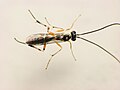 Phytodietus sp. male (Tribe Phytodietini)
 -
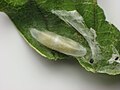 Phytodietus sp. pupa
 -
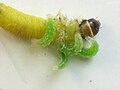 Hercus fontinalis late instar larvae (tribe Oedemopsini)


References
[edit]- ^ a b Watanabe, Kyohei (2020). "New distribution records of the subfamily Tryphoninae (Hymenoptera, Ichneumonidae) in Japan". Japanese Journal of Systematic Entomology. 26 (2): 208–215. Retrieved 2025-08-27.
- ^ "Tryphoninae". Hymenoptera Online (HOL). 2017. Retrieved 30 November 2017.
- ^ a b Kasparyan, Dmitriy R. (2024). "New Palaearctic Taxa of Ichneumonids (Hymenoptera, Ichneumonidae: Tryphoninae): Orthodolius gen. n., Praectenochira subgen. n., and Aderaeon Townes, 1949, stat. resurr". Entomological Review. 104: 63–71. doi:10.1134/S001387382401007X.
Further reading
[edit]- Townes, H.K. (1969) Genera of Ichneumonidae, Part 1 (Ephialtinae, Tryphoninae, Labiinae, Adelognathinae, Xoridinae, Agriotypinae). Memoirs of the American Entomological Institute 11: 1–300.
External links
[edit]
 | This Ichneumonidae-related article is a stub. You can help Wikipedia by expanding it. |