Tourism in Uttar Pradesh


Situated in the northern part of India, bordering with the capital of India New Delhi, Uttar Pradesh is one of the most popular and an established tourist destination for both Indians and non-Indians alike in India. The most populous state of India, Uttar Pradesh contains many historical monuments and places of religious significance. Geographically, Uttar Pradesh is very diverse, with Himalayan foothills in the extreme north and the Gangetic Plain in the centre. It is also home of India's most visited sites, Hinduism's holiest city, Varanasi. Kumbh city, Prayagraj. Kathak, one of the eight forms of Indian classical dances, originated from Uttar Pradesh.[citation needed] Uttar Pradesh is at the heart of India, hence it is also known as The Heartland of India. Cuisine of Uttar Pradesh like Awadhi cuisine, Mughlai cuisine and Bhojpuri cuisine are very famous not only in India but also many places abroad.[1]
Uttar Pradesh is known for its rich culture and tradition.[citation needed] It is home to Ayodhya and Mathura birthplace of Lord Rama, Lord Krishna and Bhagwan Parshuram respectively. Uttar Pradesh attracts many national and international tourists. The Taj Mahal, one of the New Seven Wonders of the World in Agra is also located in Uttar Pradesh.[citation needed]
There are different places one can visit in Uttar Pradesh. Agra, Ayodhya, Jhansi, Kanpur and Lucknow are historical cities famous for their monuments. Mathura, Vrindavan, Gokul, Varanasi, Vindhyachal, Ayodhya, Gorakhpur and Prayagraj are holy cities for Hindus and Kushinagar and Sarnath are important Buddhist places among the main four pilgrimage sites related to the life of Gautama Buddha. Noida is the most developed urban city of Uttar Pradesh.
To boost the tourism in the state from within the country and other parts of the world, the Government of Uttar Pradesh established an Uttar Pradesh Heritage Arc covering the cities of Agra, Kanpur, Lucknow and Varanasi.
Agra
[edit]The 17th-century Taj Mahal in Agra is the most popular monument in India, attracting over 7 million visitors per year.[2] Agra is home to four World Heritage Sites in Taj Mahal, Agra Fort, Sikandra & the Fatehpur Sikri. Agra is also home to many other Mughal buildings like Akbar's Tomb, Itmad-Ud-Daulah etc. Dayal Bagh is an under-construction temple that many visit. The lifelike carving in marble is not seen anywhere else in India.

Hindu religious sites
[edit]Millions of tourists and pilgrims visit the cities like Prayagraj, Varanasi, Vindhyachal, Mathura, Gorakhpur, and Ayodhya, as those are considered to be the holiest cities in India.
Kanpur
[edit]Bithoor or Bithur is a town in Kanpur district, 23.4 kilometres (14.5 mi) by road north of the centre of Kanpur city, in Uttar Pradesh, India. Bithoor is situated on the right bank of the River Ganges, and is a centre of Hindu pilgrimage. Bithoor is also the centre for War of Independence of 1857 as Nana Sahib, a popular freedom fighter who was based there. The city is enlisted as a municipality of Kanpur metropolitan area.
Varanasi
[edit]
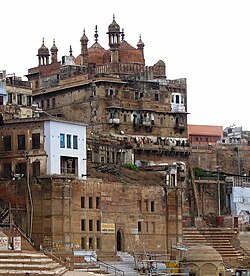
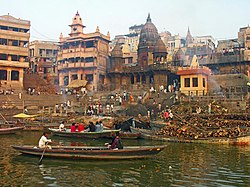
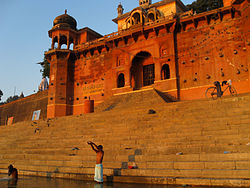
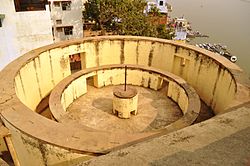
Varanasi (also called Kashi and Benares) is widely considered to be the oldest city in the world, before Jerusalem. This spiritual place is famous for its ghats (steps along the river) which are populated year round with people who want to take a dip in the holy Ganges River.
Kashi Vishwanath Temple in Varanasi is home to the Vishwanath Jyotirling temple, which is one of the most sacred of Hindu Temples dedicated to lord Shiva.
Varanasi is famous for its banarasi sarees, cuisines, it includes food like diversity of sweets and all kinds of spicy food .
Mathura-Vrindavan
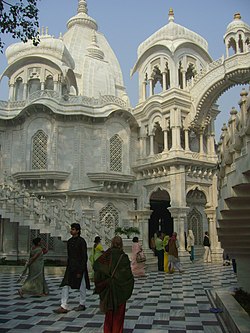
[edit]Birthplace of Lord Krishana. Both Mathura & Vrindavan have temples devoted to Krishna. During Holi, a special form of Holi called the Lath mar Holi is played here.
Janmaashtami, the birth of Lord Krishna, is celebrated in the region.
Mathura is one of the seven most important pilgrimage sites in Hindu religion. Vrindavan, another place related to Lord Shri Krishna, is said to be twin city of Mathura. There are about more than 25 ghats out of which Vishram Ghat is most sacred where Shri Krishna rested after killing Kansa.
Ayodhya
[edit]Hindus believe the birthplace of Lord Rama to be in Ayodhya at the place called Ram Janmabhoomi.[citation needed]
Ayodhya is also the birthplace of five Tirthankars, including the first Tirthankar of Jainism, Shri Rishabh Dev. He is known as the father of Jain religion. The city is also important in the history and heritage of Buddhism in India, with several Buddhist temples, monuments and centers of learning having been established here during the age of the Mauryan Empire and the Gupta Dynasty. Ayodhya reached its glorious peak as known to history during the reign of the Guptas over India.[citation needed]
Swaminarayan led the Swaminarayan Sampraday sect of Hinduism and lived here during his childhood years. It was from Ayodhya that Swaminarayan started his seven-year journey across India as Neelkanth.[citation needed]
Tulsidas is said to have begun the writing of his famous Ramayana poem Shri Ramacharitamanas in Ayodhya in 1574 CE. Several Tamil Alwar mention the city of Ayodhya. Ayodhya is also said to be the birthplace of Bahubali, Brahmi, Sundari, King Dasaratha, Acharya Padaliptasurisvarji, King Harishchandra, Shri Rama, Achalbhrata, and the ninth Gandhara of Mahavir Swami.[citation needed]
The Atharva Veda called Ayodhya "a city built by gods and being as prosperous as paradise itself".[citation needed]
Soron Shukar Kshetra is salvation land of Lord Varah and birthland of Sant Tulsidas.[citation needed]
Ayodhya is likely to get 5-6 crore people annually after the Ram Mandir construction is completed in 2023.[citation needed]
Naimisaranya
[edit]Naimisaranya also known as Neemsar, Nimsar or Nimkhar is a Hindu temple dedicated to Vishnu located in Sitapur district in the north Indian state of Uttar Pradesh.[3] It is one of the Divya Desams, the 108 temples of Vishnu revered in Nalayira Divya Prabandham by the 12 poet saints, or Alwars. The temple is believed to be of significant antiquity with contributions at different times from the ruling kings. The temple is counted as one of the eight temples of Vishnu that self-manifested and is classified as Swayamvyaktha Kshetra. The holy tank Chankra Kunda is associated with the temple and it is a pilgrimage centre where people take a holy dip during festive occasions.[4]
Prayagraj
[edit]
Every year thousands gather at Prayagraj to take part in the festival on the banks of the Ganges, the Magh Mela. The same festival is organised in a larger scale every 12th year and attracts millions of people and is called the Kumbha Mela. Kumbh Mela (especially the Maha Kumbh Mela) is the most sacred of all the pilgrimages. Thousands of holy men and women (monks, saints and sadhus) attend, and the auspiciousness of the festival is in part attributable to this. The sadhus are seen clad in saffron sheets with plenty of ashes and powder dabbed on their skin per the requirements of ancient traditions. Some called Nanga sanyasis or Dhigambers may often be seen without any clothes even in severe winter, generally considered to live an extreme lifestyle. This tends to attract a lot of western attention as it is seemingly in contrast to a generally conservative social modesty practised in the country.[citation needed]
Buddhist religious sites
[edit]Uttar Pradesh has many sites which are connected to Lord Buddha and hence, are sacred to Buddhist.
- Sarnath: a place where he held his first public discourse. Also at Sarnath is the Ashoka Pillar with the Lion Capital, is important archaeological artifact with national significance.[citation needed]
- Kushinagar: Where he attained Mahaparinirvana (Demise).[citation needed]
- Kaushambi: Where Buddha delivered many sermons.[citation needed]
- Sankassa: Where he descended after addressing his mother in Heaven.[citation needed]
- Sravasti: His favorite monsoon resort.[citation needed]
Jain religious sites
[edit]


Parshvanatha, the twenty-third Tirthankara, was born in Benaras (now Varanasi)[5] in 872 BCE.[6] According to Jain tradition, Kashi (now Varanasi) is the birthplace of three more Tirthankaras, namely Suparshvanatha, Chandraprabha and Shreyansanatha.[7]
According to Jain tradition, five tirthankaras were born at Ayodhya, including Rishabhanatha,[8] Ajitanatha,[9] Abhinandananatha,[10] Sumatinatha[11] and Anantanatha.[12]
Uttar Pradesh has many sites which are connected to Jainism and hence, are sacred to Jains.[citation needed]
- Jain temple, Deogarh is a complex of 31 Jain temples built inside fort belonging to 8th-9th century.
- Hastinapur is believed to be birthplace of Shantinatha, Kunthunatha and Aranatha.
- Ahichchhatra is place where Parshvanatha attained Kevala Jnana.[13]
- Sarnath Jain Tirth is believed to be birthplace of Shreyansnath.
- Varansi is believed to be birthplace of Suparshvanatha and Parshvanatha.
- Shobhnath temple, Shravasti is believed to be birthplace of Sambhavanatha.
- Shouripur is believed to be birthplace of Neminatha.
- Bada Gaon
- Navagarh Tirth
- Bundelkhand, in the heart of India, has been an ancient centre of Jainism. It is mostly in modern Madhya Pradesh, but part of it is in Uttar Pradesh.
Places of interest
[edit]Places of interest in Uttar Pradesh include[citation needed]:
- Varanasi – The origin of Hinduism and the oldest city of the world, also known as City of temples, holy place for devotees of Lord Shiva, one of the finest Textiles Industry in the world.

- Agra – Taj Mahal and several others historical monuments and gardens.
- Ambedkar Nagar - Historical places from ancient India to modern India and India's fastest growing Industrial city .
- Prayagraj – Well known for its Kumbh Mela. The place where Indian national river Ganges and Yamuna and Saraswati rivers meet. A mass Hindu pilgrimage in which Hindus gather at the Ganges river. Akbar forts, one of the most popular religious center of ancient and modern India for Hinduism. Uttar Pradesh's administrative and education capital.

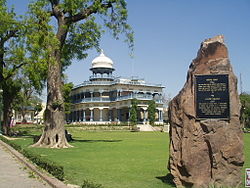
- Allahabad museum - is a National-level museum in Prayagraj Uttar Pradesh
- Kanpur – Uttar Pradesh's commercial and Industrial hub, several historical places from British era like Kanpur Memorial Church and an ancient brick temple at Bhitargaon.

- Lucknow – The capital of Uttar Pradesh, Several historical places Nawab, British and ancient India.
- Mathura-Vrindavan-The birthplace of Lord Krishna of Hinduism and Neminath of Jainism.
- Ayodhya – The birthplace of Lord Vishnu's incarnation prabhu Shri Rama.
- Jhansi – Historical place, Rani Lakshmibai's battlefield against British, Jhansi Fort.
- Pilibhit Tiger Reserve - 45th tiger reserve of India, won international award for doubling tiger count before target.
- Bareilly—A large city of Uttar Pradesh with many attractions such as Banke Bihari Temple, Hari Temple, Ala Hazrat, and Gandhi Udhayan. The jhumka style of music is associated with Bareilly.
- Sarnath-Gautama Buddha first taught the Dharma, the Buddha as one of the four places of pilgrimage which his devout followers should visit. The birthplace of Shreyansanath, the eleventh Jain Tirthankar of the Jainism.
- Kushinagar – It is an important Buddhist pilgrimage site, where Gautama Buddha is believed to have attained Parinirvana after his death.
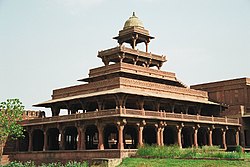
- Fatehpur Sikri-Historical place for Mughal Empire's palaces and forts.

- Meerut – The historical place of the Sepoy Mutiny of 1857 or the First War of Indian Independence. Indian Historical place from Mahabharata period of ancient India to Modern Uttar Pradesh, India.
- Mirzapur – Mirzapur is famous for its carpet and brassware industries, its rich spiritual and historical sites like the Vindhyavasini Temple and Chunar Fort, and its folk traditions such as the Kajari festival. The city is also known for its natural beauty, including waterfalls and the Vindhya Hills.[14] Moreover Mirzapur also tells time to whole India as Indian Standard Time (IST) is calculated on the basis of 82.5 degrees east longitude from the clock tower which is in Mirzapur.[15]
- Ghaziabad – Historical places from ancient India to modern India and India's fastest growing Industrial city .
- Noida and Greater Noida – IT, Electronics and education hub of Northern India.India's biggest city with planned and iconic skyscrapers.
- Gorakhpur – The city was home to Buddhist, Hindu, Muslim, Jain and Sikh saints. The birthplace of Paramhansa Yogananda, great Hindu emperor Chandragupta Maurya. Gorakhpur is famous for Gorakhnath Temple (Gorakshnath Math), Chauri Chaura, Geeta press, Gita Vatika, Ramgarh Tal Lake, and is one of the fastest-growing cities in Uttar Pradesh.
- Jaunpur – Historical city founded by the Sultan of Delhi, Feroz Shah Tughlaq and named in memory of his father, Muhammad bin Tughluq as Jaunpur Sultanate. Mughals, Lodis and Islamic forts.
- Dudhwa National Park – Dudhwa Tiger Reserve, Birds Sanctuary, the unique Frog Temple at Oyal, Surat Bhawan Palace, Elephant Rides.
- Rehar – Several major tourist attractions can be mentioned in the town's surroundings, like Jim Corbett National Park (India) about 24 km, Nainital (India) about 69 km
- Gonda - Mulagandhakuti. The remains of Buddha's hut in Jetavana Monastery, Sravasti in Gonda Division and Swaminarayan Chhapaiyā: The village of Chhapaiya is situated at a distance of 50 km from the district headquarters. The chief interest of the place is Swaminarayan temple which marks the birthplace of Swaminarayan, or Sahajanand Swami, who was born here on 2 April 1781 as Ghanshyam Pande. Ghanshyam left Chhapaiya at the age of 11 to travel to the pilgrimage sites around India. He completed his pilgrimage in Western Gujarat, where he assumed the leadership of Swaminarayan Sampradaya. The Akshardham temples in New Delhi and in Gandhinagar, Gujarat built by his spiritual successor, Pramukh Swami Maharaj, are both dedicated to him. His followers consider him to be a manifestation of the Supreme Godhead.[10] There have been many movies about the Swaminarayan filmed in this temple in Chhapaiya and in nearby places in the district.
Wildlife
[edit]Dudhwa National Park
[edit]Dudhwa Tiger Reserve
[edit]Pilibhit Tiger Reserve
[edit]Pilibhit Tiger Reserve (pronounced [piːliːbʱiːt̪ ˈtaɪɡə rɪˈzɜːvː]), is among the narrowest yet most canopy-rich tiger reserves, spread across a horseshoe-shaped landscape.[18] It covers a total area of 730.24 km2, of which 97.6% (712.88 km2) lies in Pilibhit district and 2.4% (17.36 km2) in Shahjahanpur district, both located in the Rohilkhand region of Uttar Pradesh.[19][20] Approximately 21% of Pilibhit district's total geographical area comes under reserve's limits, thereby positioning it in the category of Uttar Pradesh's most forest-rich districts. It consists of the Himalayan lowlands terrain along the Indo–Nepal border in the upper northern plains. The habitat is distinguished by tall grasslands, sal forests, and the swamp ecosystem, which is maintained through regular flooding events originating from nearby rivers, riverlets and lakes during the rainy seasons. The Sharda sagar dam elongating up to a length of 22 km (14 mi) is on the edge of the reserve.[21]
The core area of the reserve contains 35 species of mammals,[22] 556 avians species,[23][24] 79 species of piscines,[25] as well as several species of reptiles and amphibians,[26] including herbivorous, carnivorous, and omnivorous fauna. In 2020, the tiger reserve was awarded the inaugural TX2 global award in recognition of its achievement in multiplying the number of tiger within the stipulated time frame.[27] As per an internal survey conducted by the authorities in 2022, the reserve has more than 99,882 animals of 22 species of different class.[28] In August 2025, the reserve's officials confirmed that the core area hosts more than 79 adult tigers.[a][29][30] The reserve is known to have an estimated tiger density of 10.8 per 100 km2 area.[b]Galleries
[edit]Agra
[edit]-

-

-

-

-

-
 Soami Bagh Samadh, in Dayalbagh.


.jpg)

Prayagraj
[edit]-

-

-

-
 Victoria Memorial at Alfred Park
 -

-
-
 Sangam, the site of Kumbh Mela
 -

-


Ayodhya
[edit]-

-
 Sri Sri Vijayaraghavaji Temple
 -

-

-

-

-

.jpg)


Fatehpur Sikri
[edit]-
-
 Buland Darwaza, the 54 mt. high entrance to Fatehpur Sikri complex
 -


Kanpur
[edit]-

-
 Brahmavart Ghat
 -

-

_is_a_temple_in_the_Indian_city_of_Kanpur.It_is_considered_to_be_a_unique_blend_of_ancient_and_modern_architecture.jpg)

Kushinagar
[edit]-
 Ramabhar Stupa
 -

-
 Mahasukhamdada Chin Thargyi Pagoda
.jpg)
.jpg)

Lucknow
[edit]-
 Gateway to Bara Imambara
 -
 The Chhota Imambara
 -

-

-
 Park of Begum Hazrat Mahal
 -


Mathura and Vrindavan
[edit]-

-
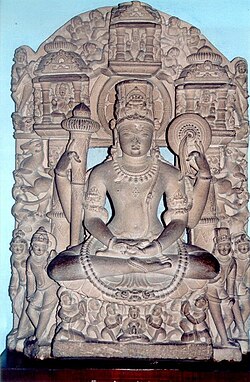 Statue of Lord Vishnu in Mathura
 -
-

-
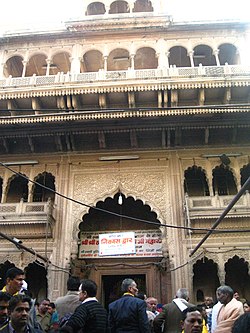 Main gate of Banke Bihari Temple, Vrindavan
 -
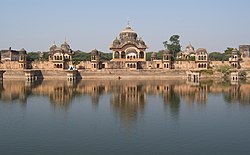 Kusuma Sarovar bathing ghat, in the Govardhan area, Vrindavan.


Varanasi and Sarnath
[edit]-

-

-

-
-
-
 Tomb of Lal Khan
 -

-
-
-

-

-
 Dhamek Stupa, Sarnath
 -
 Archaeological Buddhist Remains, Sarnath
 -
 Golden Temple, Sarnath
.jpg)


.jpg)


Etawah and Saifai
[edit]-
 Etawah Safari Park's entrance
 -
 Saifai Clock Tower


See also
[edit]Notes
[edit]- ^ including 14 males, 53 females, and 12 tigers of undetermined gender. This figure excludes an additional 18 tigers, comprising cubs less than one year of age and individual tigers that have dispersed beyond the designated core zone into adjacent agricultural areas, commonly referred to as sugarcane tigers.
- ^ (total recorded tigers in the core area / area in square kilometers)*100
References
[edit]- ^ "Bhojpuri Cuisine: Food From Uttar Pradesh & Bihar in India". Sanskruti Manchester. 17 May 2022. Retrieved 27 November 2023.
- ^ "Archaeological Survey of India Agra working on compiling visual archives on Taj Mahal". The Economic Times. 29 November 2015. Archived from the original on 23 April 2016. Retrieved 16 January 2016.
- ^ M. S., Ramesh (2000). 108 Vaishnavite Divya Desams: Divya desams in Malai Nadu and Vada Nadu. Tirumalai-Tirupati Devasthanam. p. 188.
- ^ "Naimisharanya-Must Visited Place in Sitapur near Lucknow". chaloghumane.com.
- ^ Zimmer, Heinrich (1953) [April 1952]. Campbell, Joseph (ed.). Philosophies Of India. London: Routledge & Kegan Paul Ltd. p. 195. ISBN 978-81-208-0739-6.
{{cite book}}: ISBN / Date incompatibility (help) - ^ Zimmer 1953, p. 183.
- ^ "4 Jain Tirthankaras born in Varanasi", The Times of India, 25 August 2015
- ^ Birth of Adinath in Ayodhya, archived from the original on 27 June 2012, retrieved 2 June 2018
- ^ Birth of Ajitnath in Ayodhya, archived from the original on 14 April 2012, retrieved 2 June 2018
- ^ Birth of Abhinandanath in Ayodhya, archived from the original on 10 April 2012, retrieved 2 June 2018
- ^ Birth of Sumatinath in Ayodhya, archived from the original on 10 March 2012, retrieved 2 June 2018
- ^ Birth of Anantnath in Ayodhya, archived from the original on 14 April 2012, retrieved 2 June 2018
- ^ Law, Bimala Churn (1942). Panchalas and their capital Ahichchhatra (PDF). Memories of the Archaeological Survey of India. Vol. 67. Archaeological Survey of India. p. 15. Retrieved 27 April 2022.
- ^ "Culture & Heritage | Mirzapur | India". Retrieved 2 December 2021.
- ^ "https://byjus.com/ias-questions/the-standard-meridian-of-india-passes-through-which-city/". BYJUS. Retrieved 19 October 2025.
{{cite web}}: External link in|title= - ^ Mathur, P. K. & Midha, N. (2008). Mapping of National Parks and Wildlife Sanctuaries, Dudhwa Tiger Reserve. NNRMS - MoEF Project, Final Technical Report (PDF) (Report). Dehradun: Wildlife Institute of India. Archived from the original (PDF) on 12 April 2015. Retrieved 4 March 2013.
- ^ Mathur, P. K. and N. Midha (2008). Mapping of National Parks and Wildlife Sanctuaries, Dudhwa Tiger Reserve Archived 12 April 2015 at the Wayback Machine. WII – NNRMS - MoEF Project, Final Technical Report. Wildlife Institute of India, Dehradun.
- ^ "field experience of Pilibhit tiger reserve" (PDF).
- ^ "district wise area percentage of Pilibhit tiger reserve" (PDF). Central Academy for state forest service.
- ^ Chanchani, P. (2015). "Pilibhit tiger reserve: conservation opportunities and challenges". Economic and Political Weekly. 50 (20): 19. Archived from the original on 18 August 2023. Retrieved 18 August 2023.
- ^ "Pilibhit tiger reserve". Reserve Guide – Project Tiger Reserves In India. National Tiger Conservation Authority. Retrieved 29 February 2012.
- ^ "Pilibhit tiger reserve - mammals".
- ^ "556 birds species". Govt. of Uttar Pradesh. Archived from the original on 24 January 2020. Retrieved 8 October 2025.
- ^ "Biodiversity". pilibhittigerreserve.in/.
- ^ "Pilibhit tiger reserve- Fishes' species" (PDF). National Tiger Conservation Authority.
- ^ "Pilibhit tiger reserve – Reptiles and Amphibians" (PDF). National Tiger Conservation Authority.
- ^ "Pilibhit tiger reserve Gets Global Award For Doubling Tiger Population". NDTV.com. Archived from the original on 26 November 2020. Retrieved 29 November 2020.
- ^ "UP: 160% surge in wildlife population in Pilibhit Tiger Reserve in 3 years". The Times of India. 25 July 2022.
- ^ "Pilibhit tiger reserve introduces new method to count tigers by gender". The Times of India. 15 August 2025.
- ^ "Three tigresses with nine cubs spotted at Pilibhit tiger reserve; sign of rise in big cat count". The Times of India. 15 April 2025.
External links
[edit]- Official Website of Agra maintained by NIC
- 27°11′24″N 78°00′36″E / 27.190000°N 78.010000°E
 Uttar Pradesh travel guide from Wikivoyage


