Tornesch
 | You can help expand this article with text translated from the corresponding article in German. (March 2011) Click [show] for important translation instructions.
|
Tornesch | |
|---|---|
 Flag  Coat of arms | |
Location of Tornesch
within Pinneberg district 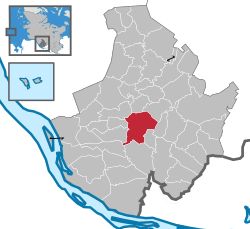 | |
 Location of Tornesch | |
  Tornesch  Tornesch | |
| Coordinates: 53°42′N 9°43′E / 53.700°N 9.717°E | |
| Country | Germany |
| State | Schleswig-Holstein |
| District | Pinneberg |
| Subdivisions | 3 Stadtteile |
| Government | |
| • Mayor | Christopher Radon |
| Area | |
• Total | 20.61 km2 (7.96 sq mi) |
| Elevation | 12 m (39 ft) |
| Population (2023-12-31)[1] | |
• Total | 14,606 |
| • Density | 708.7/km2 (1,835/sq mi) |
| Time zone | UTC+01:00 (CET) |
| • Summer (DST) | UTC+02:00 (CEST) |
| Postal codes | 25436 |
| Dialling codes | 04122, 04120 |
| Vehicle registration | PI |
| Website | www.tornesch.de |
Tornesch (German pronunciation: [ˈtɔʁnɛʃ]; Low German: Torneesch) is a town in the district of Pinneberg, in Schleswig-Holstein, Germany. It is situated approximately 7 km (4 mi) southeast of Elmshorn, and 25 km (16 mi) northwest of Hamburg. Tornesch is also the home of the Klaus-Groth-Schule, named after the German poet Klaus Groth. It is also home to the Fritz-Reuter-Schule, named after German writer Fritz Reuter.
History
[edit]Tornesch has a place in biochemical history from the wood saccharification[2] process developed by Scholler,[3] also known at the Scholler-Tornesch process. The first factory to use the process was built in Tornesch. This early work was part of the development of biofuel such as cellulosic ethanol.
References
[edit]- ^ "Alle politisch selbständigen Gemeinden mit ausgewählten Merkmalen am 31.12.2023" (in German). Federal Statistical Office of Germany. 28 October 2024. Retrieved 16 November 2024.
- ^ Wood Saccharification
- ^ Decomposition of wood by acids
External links
[edit]| International | |
|---|---|
| National | |
| Other | |

 | This Pinneberg district location article is a stub. You can help Wikipedia by expanding it. |