Talk:Hartogs number
 | This article is rated Start-class on Wikipedia's content assessment scale. It is of interest to the following WikiProjects: | ||||||||||
| |||||||||||


Invalid (or at least unclear) "Proof"
[edit]The proof given appears to be invalid or at least so unclear as to be unconvincing. JRSpriggs 06:14, 26 June 2007 (UTC)
- I'm working on it. You could have tagged it with {{expert}}.... — Arthur Rubin | (talk) 18:53, 1 December 2007 (UTC)
- Can we assume that, in ZF, if X is a set, then X × X is a set. The proof I'm familiar with in is NBG, where that's one of the finite set of axioms encompassing comprehension. — Arthur Rubin | (talk) 19:03, 1 December 2007 (UTC)
- See Kripke–Platek set theory#Proof that Cartesian products exist for a proof that Cartesian products exist. Or use the axiom of powerset#Consequences and the axiom schema of specification. JRSpriggs 22:11, 1 December 2007 (UTC)
- And thanks for reworking the proof, it is much clearer now. JRSpriggs 22:27, 1 December 2007 (UTC)
Greater than vs. not less than or equal
[edit]Forgive my ignorance, but this sentence confuses me:
- If X cannot be wellordered, then we can no longer say that this α is the least wellordered cardinal greater than the cardinality of X, but it remains the least wellordered cardinal not less than or equal to the cardinality of X.
What is the difference between "greater than" and "not less than or equal to"? Solemnavalanche (talk) 19:52, 23 November 2008 (UTC)
- See the article on cardinality. If A is a set of cardinality κ and B is a set of cardinality μ, then means that there is no injection from A to B while means that there is an injection from B to A in addition to the absence of an injection from A to B. Does that clarify it? JRSpriggs (talk) 21:29, 23 November 2008 (UTC)


- Thanks for the prompt response. It does clarify it somewhat, but it raises a further question. Does this mean that, absent the axiom of choice, there could exist pairs of sets for which no injection exists in either direction? That is, we could have ? That clashes with my intuition, so I want to be sure I'm understanding you (and these articles) correctly. I see that the Law of Trichotomy article appears to say the same thing; but I'm having a difficult time imagining what such sets A and B would look like. Is there an article that addresses that question? Solemnavalanche (talk) 04:04, 24 November 2008 (UTC)
- Well, it's good that it conflicts with your intuition, because the axiom of choice is intuitively correct.
- But anyway, a good example is this: Let one of your sets be R, the set of all real numbers, and the other one be the Hartogs number of R. Then by definition there's no injection from the second to the first, and if there were an injection from the first to the second, that would imply that the reals could be wellordered.
- Actually this generalizes, and shows that trichotomy implies the axiom of choice. --Trovatore (talk) 04:41, 24 November 2008 (UTC)
- I think I'm starting to understand a bit more. So there exists an injection from R to its Hartogs number iff there exists a choice function on R. And so this must be related to the fact that ZF + GCH -> AC, is that right? Solemnavalanche (talk) 06:04, 24 November 2008 (UTC)
- GCH only constrains |ℝ|, not H(ℝ) as the Hartogs number for ℝ. Regardless of GCH, |ℝ| = ₁ = ωr for some ordinal r > 0; with Choice, H(ℝ) = ωr+1. With GCH (and hence Choice), r = 1 so H(ℝ) = ω₂, still in the same position relative to ℝ. Without either Choice or GCH, ω₁ ≤ H(ℝ) ≤ ωr+1, with the lower bound on H(ℝ) resulting from all countable ordinals being embeddable in ℝ since ℚ is embedded in ℝ. If X is infinite but Dedekind-finite (only finite ordinals embeddable in X) then H(X) = ω (= ω₀), no matter what the cardinality of X is. If X is finite, so is H(X), namely |X| + 1. Vaughan Pratt (talk) 23:44, 28 November 2025 (UTC)
- I think I'm starting to understand a bit more. So there exists an injection from R to its Hartogs number iff there exists a choice function on R. And so this must be related to the fact that ZF + GCH -> AC, is that right? Solemnavalanche (talk) 06:04, 24 November 2008 (UTC)
- Thanks for the prompt response. It does clarify it somewhat, but it raises a further question. Does this mean that, absent the axiom of choice, there could exist pairs of sets for which no injection exists in either direction? That is, we could have ? That clashes with my intuition, so I want to be sure I'm understanding you (and these articles) correctly. I see that the Law of Trichotomy article appears to say the same thing; but I'm having a difficult time imagining what such sets A and B would look like. Is there an article that addresses that question? Solemnavalanche (talk) 04:04, 24 November 2008 (UTC)
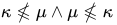

- Please see my comments at Talk:Tarski's theorem about choice for why the axiom of choice is equivalent to the trichotomy of cardinality. JRSpriggs (talk) 01:12, 29 November 2025 (UTC)
Clarity issues
[edit]The definition "" introduces several pieces of unexplained and unlinked notation.

- Is Ord the category of preordered sets or the ordinal numbers? The latter makes little sense because the lead is talking exclusively about cardinal numbers.
- Is the hooked arrow an embedding or an inclusion map?
- And what's with this variable i? i is usually an index, right? It's never referred to anywhere else, so why can't it just be deleted? "". Oh, right, there's a colon. It's not a variable, it's a function named . Why not call it ?
- Not to mention set-builder notation in the first place, although that's hopefully well-known enough.



It's not stated anywhere that , so I'm assuming that's false. That implies that is not the natural injection , which opens the question of decidability: can it be determined if such a function exists? 71.41.210.146 (talk) 05:41, 21 January 2017 (UTC)


- "Ord" refers to the class of ordinal numbers. If the axiom of choice holds, then the cardinal numbers can be regarded as a subclass of the ordinal numbers, namely the initial ordinals.
- The hooked arrow means that "i" refers to an injective function.
- Yes, "X" refers to an arbitrary set. Indeed, there would be little point in defining this (Hartog's number), if X were a set of ordinals. JRSpriggs (talk) 18:22, 21 January 2017 (UTC)
- @JRSpriggs: Thanks! Article clarified, I hope. Now to just untangle the fact that the lead talks about cardinals while the proof is about ordinals. Perhaps I should just import (paraphrase) the explanation at http://planetmath.org/HartogsNumber, which is nicely clear. 71.41.210.146 (talk) 20:26, 21 January 2017 (UTC)
- Thank you for clarifying the article. I am glad that I could help you. JRSpriggs (talk) 18:52, 22 January 2017 (UTC)
Hartogs['][s] function
[edit]Re the late exchange between User:JRSpriggs and User:Cherkash: I decided to go looking on Google Scholar to see how the terminology is actually used. I agree with Cherkash that the general style on WP is to keep the final s. On the other hand, if the term Hartogs' function without the s is the common usage, then we should use it. Or, if attested, we might be able to cut the Gordian knot by writing Hartogs function, using Hartogs as a noun adjunct rather than a possessive.
As it turns out, though, I was not able to verify (with any of the search terms) that this terminology is used for this at all. It seems to be used instead for some quite different notion. To quote this paper, "[a]n upper semi-continuous function h in a Stein space X is called a Hartogs function in X if the Hartogs domain is Runge–Stein in C×X." I don't know what all of that means, exactly, but it does not appear to be about ordinal numbers.

So maybe we should just remove the contested text altogether? --Trovatore (talk) 06:27, 21 December 2017 (UTC)
- Going by the grammar argument alone, I agree with the dichotomy presented: we are effectively left to decide whether to use the noun adjunct form (aka noun's attributive form), or a possessive (with " 's " added). Either one is a grammatically acceptable way to use here, with the choice towards one or the other usually guided by tradition and commonality of use. In the first case, the spelling is "Hartogs function", in the second it's "Hartogs's function". As for the actual subject, if there's any doubt about the statement presented, then please by all means go ahead and either tag it with the "citation needed" tag (pending reliable sources) – or just go ahead and remove it altogether. cherkash (talk) 06:50, 21 December 2017 (UTC)
- Well, if it appears standardly in the literature as Hartogs' function, then that's what we should say; I don't care what the general WP standard is in that case. However I don't see any evidence so far that that's actually the case. --Trovatore (talk) 06:54, 21 December 2017 (UTC)
Absolute nonsense "Proof"
[edit]Please erase it completely and precis either the original paper or my translation, a link to which has recently been added to this page.
Paul Taylor, 25 November 2025. — Preceding unsigned comment added by ~2025-36371-09 (talk) 20:54, 25 November 2025 (UTC)
- What do you see as wrong in Derek Goldrei's proof?
- The article claims that the proof is constructive, but Replacement as used in step 4 isn't usually considered constructive. For a constructive version of Goldrei's proof one would use John Myhill's Axiom schema of collection (1965) as weakened by Peter Aczel in 1968. Vaughan Pratt (talk) 02:42, 26 November 2025 (UTC)
- Incidentally there's a subtlety in the case when X is Dedekind-finite defined as infinite with no injection ω ↪ X, which can happen in ZF without Choice. In that case α = ω because Dedekind-finite sets (in the above sense) only admit injections from finite ordinals (and, with the above definition, do so for all finite ordinals). This is true even when X is uncountable; counterintuitively the Hartogs number of any Dedekind-finite set is ω.
- But it's also worth mentioning that the continuum ℝ is not Dedekind-finite because the rationals ℚ can be given the order type of any countable ordinal, whence α ≥ ℵ₁, with equality if and only if no uncountable subset of ℝ can be well-ordered. Vaughan Pratt (talk) 18:07, 26 November 2025 (UTC)
- A subtlety in Hartogs' Choice-free construction is his Lemma 4 (Satz 4 in his paper). He states and proves that in any totally ordered set L, if every element is strictly preceded by a well-ordered set, then L itself is well-ordered. (How would you prove that without Choice and without looking at Hartogs proof?)
- One might wonder why modern constructions of the Hartogs number of any set X manage to sidestep this subtlety. The reason is that Hartogs starts by considering all possible total orderings. (In those days, "ordered set" defaulted to totally ordered set, different from today's default of partially ordered set or sometimes even preordered set.) If instead you consider only ordinals that inject into X, you get Lemma 4 for free and arrive at the same H(X) as Hartogs does by bypassing the whole notion of total orderings that might not be well-orderable for whatever reason.
- With Choice, H(X) is just the next cardinal after |X|, e.g. 8 if |X| = 7, ℵ₈ if |X| = ℵ₇, usw.
- Without Choice, size comparisons must now be made in terms of ordinals rather than cardinals. The cardinality of X might be huge, e.g. X = P(P(P(P(N)))), but if the only ordinals you can inject into X are the members of ω₁, namely the countable ordinals, then H(X) will just be ω₁ itself. This is the "size" of all uncountable X that could be called "Dedekind-countable" by virtue of only embedding countable ordinals, namely their sup as an ordinal. Vaughan Pratt (talk) 18:50, 28 November 2025 (UTC)
- You asked "How would you prove that [in any totally ordered set L, if every element is strictly preceded by a well-ordered set, then L itself is well-ordered] without Choice and without looking at Hartogs proof?". Suppose S is a non-empty subset of L. Let x be an element of S. Either x is already the minimal element of S or there are elements below it by the totality of L. If there are elements below x, then the set of such elements is a non-empty subset of a well-ordered set so it contains an element y which is minimal in that subset. If so, then y < x and thus is less than the other elements of S by the transitivity of the total ordering. JRSpriggs (talk) 01:31, 29 November 2025 (UTC)
- Well done. (I didn't mean it to be a hard challenge for those familiar with reasoning about infinite ordinals.) Vaughan Pratt (talk) 05:07, 29 November 2025 (UTC)
- I do not understand your sentence "With Choice, H(X) is just the next cardinal after |X|, e.g. 8 if |X| = 7, ℵ₈ if |X| = ℵ₇, usw.". Please explain what you mean. JRSpriggs (talk) 01:34, 29 November 2025 (UTC)
- Wait, I thought you'd already understood how Hartogs' construction works with sets when Choice holds. Are you questioning one or both of H(X) = 8 and H(X) = ℵ₈ in the respective cases for X, or something else? Vaughan Pratt (talk) 05:15, 29 November 2025 (UTC)
- OK. I see it now. I think I was thrown off by the reverse order of your if-then constructions and by the "usw" which I still do not understand. JRSpriggs (talk) 14:31, 29 November 2025 (UTC)
- Sorry, und so weiter. (Reading Hartogs auf deutsch for too long.) Vaughan Pratt (talk) 17:47, 29 November 2025 (UTC)
- OK. I see it now. I think I was thrown off by the reverse order of your if-then constructions and by the "usw" which I still do not understand. JRSpriggs (talk) 14:31, 29 November 2025 (UTC)
- Wait, I thought you'd already understood how Hartogs' construction works with sets when Choice holds. Are you questioning one or both of H(X) = 8 and H(X) = ℵ₈ in the respective cases for X, or something else? Vaughan Pratt (talk) 05:15, 29 November 2025 (UTC)
- You asked "How would you prove that [in any totally ordered set L, if every element is strictly preceded by a well-ordered set, then L itself is well-ordered] without Choice and without looking at Hartogs proof?". Suppose S is a non-empty subset of L. Let x be an element of S. Either x is already the minimal element of S or there are elements below it by the totality of L. If there are elements below x, then the set of such elements is a non-empty subset of a well-ordered set so it contains an element y which is minimal in that subset. If so, then y < x and thus is less than the other elements of S by the transitivity of the total ordering. JRSpriggs (talk) 01:31, 29 November 2025 (UTC)