Straight stitch
.JPG)


The straight or running stitch is the basic stitch in hand-sewing and embroidery, on which all other forms of sewing are based. The stitch is worked by passing the needle in and out of the fabric at a regular distance.[2] All other stitches are created by varying the straight stitch in length, spacing, and direction.


Running stitches are most often not visible as they are used to close seams.[3]
Running stitch, Holbein or double-running stitch, satin stitch and darning stitch are all classed as straight or flat stitches. Backstitch is also sometimes included in this category.[4]
Terminology
[edit]Some sources only use the term straight stitch to refer to a single stitch and use running stitch for a line of single stitches,[5] while others use it interchangeably with or in place of running stitch.[6]
Uses
[edit]Embroidery
[edit]Seams, hems, and tailoring
[edit]Running stitches are used in hand-sewing and tailoring to sew basic seams, hems and gathers; in hand patchwork to assemble pieces of light fabrics; and in quilting to hold the fabric layers and batting or wadding in place.[7] Loosely spaced rows of short running stitches are used to support padded satin stitch.
Darning
[edit]Darning has two purposes, decorative and functional, though it is often both.[8] Darning for decorative purposes, often referred to as Pattern darning, is an ancient technique in which parallel rows of straight stitches in varying lengths are arranged to form geometric patterns.[9] Japanese Kogin embroidery is a pattern darning style from the island of Honshū, often worked in white cotton thread on rough, dark blue indigo-dyed linen.[4]

Running stitches are a component of many traditional embroidery styles, including kantha of India and Bangladesh, and Japanese sashiko quilting and other embroidery styles such as pattern darning and redwork.[10] Running stitches are the primary stitch used in Colonial American bed rugs.[11]: 25
Related stitches
[edit]- The running stitch family includes looped running stitches, laced running stitches, whipped running stitches, and others like the Holbein stitch, seed stitch and more.[12]
- Basting stitches, also called "tailor's tack", are long-running stitches used to keep two pieces of fabric or trim aligned during final sewing, or to otherwise temporarily sew two pieces together.
- Darning stitches are closely spaced parallel rows of running stitches used to fill or reinforce worn areas of a textile, or as decoration.
- Holbein or double-running stitches have a second row of running stitches worked in a reverse direction in between the stitches of the first pass, to make a solid line of stitching.
- Double darning stitches are closely spaced (but not overlapping) rows of Holbein stitches.[13]
- The saddle stitch, commonly used in leathercrafting and shoemaking, consists of two running stitches done at the same time using a single thread with a needle at either end.
Stitch gallery
[edit]-
 Arrowhead stitch
 -
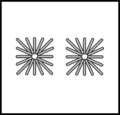 Eye stitch
 -
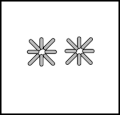 Algerian eye stitch
 -
 Fishbone stitch
 -
 Open fishbone stitch
 -
 Raised fishbone stitch
 -
 Flat stitch


See also
[edit]References
[edit]- ^ Christie, Grace (September 1906). "Chapter 9: Methods of Work (continued)". Embroidery and Tapestry Weaving. The Artistic Crafts Series of Technical Handbooks. New York: Macmillan. p. 198 – via Internet Archive.
- ^ "Running Stitch". Sarah's Hand Embroidery Tutorials. Retrieved 2020-05-11.
- ^ Reader's Digest Complete Guide to Needlework. The Reader's Digest Association, Inc. (July 25th 2008). ISBN 0-89577-059-8, p. 46
- ^ a b Enthoven, Jacqueline: The Creative Stitches of Embroidery, Van Norstrand Rheinhold, 1964, ISBN 0-442-22318-8, p. 29-46
- ^ "Straight Stitch Family". Sarah's Hand Embroidery Tutorials. Retrieved 27 January 2021.
- ^ "CyberSeams". Retrieved 2021-01-27.
- ^ Complete Guide to Needlework, p. 200, 220
- ^ "Pattern Darning". Sew Guide. Retrieved 27 January 2021.
- ^ Christie, Grace: Embroidery and Tapestry Weaving, London, John Hogg, 1912
- ^ Gillow, John, and Bryan Sentance: World Textiles, Bulfinch Press/Little, Brown, 1999, ISBN 0-8212-2621-5, p. 172-173
- ^ Weissman, Judith R.; Lavitt, Wendy (1994). Labors of love: America's textiles and needlework, 1650 - 1930. New York: Wings Books. ISBN 978-0-517-10136-0.
- ^ "Running Stitch Family". Sarah's Hand Embroidery Tutorials. Retrieved 2020-07-14.
- ^ Complete Guide to Needlework, p. 46-47
Further reading
[edit]- Caulfield, S.F.A., and B.C. Saward, The Dictionary of Needlework, 1885.
- Christie, Grace (Mrs. Archibald Christie: Embroidery and Tapestry Weaving, London, John Hogg, 1912
- Eaton, Jan. Mary Thomas's Dictionary of Embroidery Stitches, Revised by Jan Eaton. London: Hodder&Stoughton, 1989. ISBN 0-340-51075-7
- Enthoven, Jacqueline: The Creative Stitches of Embroidery, Van Norstrand Rheinhold, 1964, ISBN 0-442-22318-8
- Reader's Digest, Complete Guide to Needlework. The Reader's Digest Association, Inc. (March 1992). ISBN 0-89577-059-8
- Levey, S. M. and D. King, The Victoria and Albert Museum's Textile Collection Vol. 3: Embroidery in Britain from 1200 to 1750, Victoria and Albert Museum, 1993, ISBN 1-85177-126-3
- Sarah's Hand Embroidery Tutorials.
External links
[edit]
- The Crimson Thread of Kinship is a 12-metre-long embroidery predominantly using a straight stitch at the National Museum of Australia


