Sixteen Kingdoms
| Sixteen Kingdoms | |||||||||||||||||||||||||||||||||||||||||||||||||
|---|---|---|---|---|---|---|---|---|---|---|---|---|---|---|---|---|---|---|---|---|---|---|---|---|---|---|---|---|---|---|---|---|---|---|---|---|---|---|---|---|---|---|---|---|---|---|---|---|---|
| Traditional Chinese | 十六國 | ||||||||||||||||||||||||||||||||||||||||||||||||
| Simplified Chinese | 十六国 | ||||||||||||||||||||||||||||||||||||||||||||||||
| |||||||||||||||||||||||||||||||||||||||||||||||||
| Part of a series on the |
| History of China |
|---|
 |
The Sixteen Kingdoms (simplified Chinese: 十六国; traditional Chinese: 十六國; pinyin: Shíliù Guó), less commonly the Sixteen States, was a chaotic period in Chinese history from AD 304 to 439 when northern China fragmented into a series of short-lived dynastic states. Most of these regimes were created by groups such as the Xiongnu, Xianbei, Di, Jie, and Qiang, who had moved into northern and western China over earlier centuries and rose in rebellion against the Western Jin dynasty in the early fourth century. Some states were founded by the Han as well. Regardless of their rulers' background, every state adopted dynastic institutions in the Han tradition and styled itself as a legitimate monarchy. These states often fought one another and also contended with the Eastern Jin dynasty, which governed the south after the collapse of Western Jin in 317. The era ended in 439, when Northern Wei, founded by the Tuoba clan of the Xianbei, reunified the north. The Eastern Jin dynasty had already collapsed in 420 and been replaced by the Liu Song dynasty, the first of the Southern Dynasties. After the consolidation of the north, Chinese history entered the period known as the Northern and Southern Dynasties.
The term "Sixteen Kingdoms" was first used by the 6th-century historian Cui Hong in the Spring and Autumn Annals of the Sixteen Kingdoms and refers to the five Liangs (Former, Later, Northern, Southern and Western), four Yans (Former, Later, Northern, and Southern), three Qins (Former, Later and Western), two Zhaos (Han/Former and Later), Cheng-Han and Xia. Cui Hong did not count several other kingdoms that appeared at the time including the Ran Wei, Zhai Wei, Chouchi, Duan Qi, Qiao Shu, Huan Chu, Tuyuhun and Western Yan. Nor did he include the Northern Wei and its predecessor Dai, because the Northern Wei is considered to be the first of the Northern Dynasties in the period that followed the Sixteen Kingdoms.
Classical Chinese historians called the period the "Sixteen Kingdoms of the Five Barbarians" (simplified Chinese: 五胡十六国; traditional Chinese: 五胡十六國; pinyin: Wǔhú Shíliù Guó) because of the active roles played by non-Han ethnicities during this period. Even among the states founded by ethnic Han (Former Liang, Western Liang, Ran Wei and Northern Yan), several founders had close relations with ethnic minorities. For example, the father of Ran Min, who founded Ran Wei, was adopted by the ethnically Jie Later Zhao ruling family, though Ran Min ordered a genocidal massacre of Jie people after he seized power. Feng Ba, who is considered by some historians to be the founder of the Northern Yan, was an ethnic Han who had prominent Xianbei friends, as well as a Xianbei nickname. Gao Yun, considered by other historians to be the Northern Yan founder, was a member of the Goguryeo royal family who had been adopted by Xianbei nobility.
Due to fierce competition among the states and internal political instability, the kingdoms of this era were mostly short-lived. For seven years from 376 to 383, the Former Qin briefly unified northern China, but this ended when the Eastern Jin inflicted a crippling defeat on it at the Battle of Fei River, after which the Former Qin splintered and northern China experienced even greater political fragmentation. The fall of the Western Jin dynasty amidst the rise of non-Han regimes in northern China during the Sixteen Kingdoms period resembles the fall of the Western Roman Empire amidst invasions by the Huns and Germanic tribes in Europe, which also occurred in the 4th to 5th centuries.
History
[edit]Background
[edit]

Since the Western Han dynasty (202 BC–9 AD), the non-Han peoples of the northern steppe and western highlands had been resettling into northern China. Along the frontiers in the north, the Chinese court employed a policy of recruiting surrendered tribes to serve as auxiliaries to defend against attacks from nomadic enemies. In the northeast, the Wuhuan tribes submitted as Chinese tributaries, and in 50 AD, the Eastern Han dynasty (25–220) established the Southern Xiongnu vassal state in the northern Bing province. In the Guanzhong region in the northwest, western herders known as the Qiang and Di were brought in, predominantly to work as farmers and slaves. As migrants, these people lived among the ethnic Han and were sinified to varying degrees while retaining their tribal affiliations. However, they also faced discrimination and oppression, leading to racial tension and frequent rebellions.[3]
The fall of Eastern Han (189–220) and the Three Kingdoms period (220–280) brought the non-Han people closer to the Chinese heartlands. After revolting and murdering their own chanyu, the Southern Xiongnu tribes dissolved their government and dispersed throughout the north. Several frontier commanderies had to be abandoned. The Han Chancellor, Cao Cao reorganized the remaining Southern Xiongnu forces into the Five Divisions and resettled them away from the frontier near Taiyuan in modern Shanxi, where they would be less likely to rebel. The Wuhuan also rebelled but were defeated, with many forcibly relocated and scattered throughout the Central Plains. The Xianbei tribes of the steppe such as the Murong and Tuoba were drawn to the power vacuum left behind in the northeast, and they too became Chinese vassals. In the Guanzhong, the population of the Qiang, Di and other tribes continued to grow. By the late 3rd-century, an edict to the court claimed that half of the Guanzhong population were "Rong and Di (non-Han)".[4]
Despite efforts to appease and punish, disparity between the ethnic Han and tribes persisted into the Western Jin period (266–316). The War of the Eight Princes (291–306) during the reign of the Emperor Hui of Jin severely weakened and divided imperial authority. Corruption was rampant among the Chinese elites and administrators, and popular rebellions against heavy taxation and repression eruptred throughout the country. As the Jin princes exhausted the imperial army with their civil wars, they turned to the frontier auxiliaries as their source of military power, placing the tribes in prime position to exploit the chaos.[5]
The beginning of the Sixteen Kingdoms period is often considered to be 304 AD. That year, as part of a rebellion that began back in 301, Li Xiong, a Ba-Di chieftain and refugee from the Guanzhong, formally claimed the imperial title of King and established his state of Cheng-Han (304–347) in the Sichuan region. Most of the Sixteen Kingdoms were founded by non-Han leaders whose family had lived in China for generations, collectively known in more recent historiography as the "Five Barbarians". They heavily adopted the Chinese framework of imperial governance, including their titles and customs, and employed ethnic Han officials in their administrations.
Fall of the Western Jin to the Han-Zhao (304–318)
[edit]
During the Jin civil wars, Liu Yuan, a noble from the Five Divisions and a descendant of the Southern Xiongnu chanyu, had been serving as a general for one of the princes. The Five Divisions plotted to take advantage of the disorder to stage a revolt, and Liu Yuan, after convincing his prince that he would rally his people to fight for his side, was allowed to return home to Shanxi. Upon his arrival, Liu Yuan rebelled and declared his intent to restore the fallen Han dynasty. His regime, later renamed Zhao, is designated by historians as the Han-Zhao (304–329).[6]
By the end of the War of the Eight Princes in 306, the Jin military in northern China had been weakened and was ineffective in dealing with the various uprisings led by both the Han Chinese and the tribes. Many of these rebel groups, aggrieved by the civil wars and ongoing famines, flocked to join the Han-Zhao and soon encroached on the Chinese capital of Luoyang. In 311, less than a year after the ascension of Liu Cong to the Han throne, his forces annihilated the Jin imperial army and captured Luoyang along with Emperor Huai in the Disaster of Yongjia. In 316, the Western Jin came to an end after Liu Cong's cousin Liu Yao seized Chang'an and Emperor Min, though pockets of Jin resistance continued to resist in the north. In the south, where the regions were mostly unaffected by the chaos in the north, the prince, Sima Rui claimed the imperial title at Jiankang, preserving the dynasty as the Eastern Jin (318–420).
Shi Le and the Later Zhao (318–351)
[edit]
After Liu Cong's death and a failed coup that wiped out most of the imperial family in 318, the Han empire was split between Liu Yao in the west and the powerful general, Shi Le in the east. Shi Le was an ethnic Jie of Southern Xiongnu descent who worked as an indentured farm laborer before joining Liu Yuan's rebellion and gaining considerable power over the Hebei region. In 319, he founded the Later Zhao (319–351), and in 329, he conquered Liu Yao's Han-Zhao, placing most of northern China under his control.
Carrying on from the Han-Zhao, Shi Le reinforced the dual-system of government that imposed separate rules for Chinese and non-Chinese. After his death, his adoptive brother, Shi Hu seized the throne from his son in 334 and ruled the empire for the next 15 years. Shi Hu was described by records as a cruel and tyrannical ruler, especially towards the Han Chinese. On the other hand, he also allowed Buddhism to spread in the north by employing the monk, Fotu Cheng and promoting religious freedom. Shi Hu maintained a stalemate with the Eastern Jin and other neighbouring states, unable to make significant gains in his military campaigns. After he died in 349, his family members engaged in a fratricidal succession for the throne, culminating in his adopted Han Chinese grandson, Ran Min, seizing the government and carrying out a large-scale ethnic cleansing of the Jie people. The Later Zhao was soon destroyed by Ran Min in 351.
During this period, several parts of northern China were largely free from Later Zhao control. In Gansu, the Zhang clan of Han ethnicity had been governing the region since 301 and survived the fall of Western Jin. Though they outwardly remained loyal to the Eastern Jin and never claimed the imperial title (with the exception of Zhang Zuo), their remoteness from the southern court allowed them to self-govern without much intervention, so historiography often refer to them as an independent regime known as the Former Liang (301–376).
In the Liaodong region, the Murong clan of Xianbei ethnicity also professed their allegiance to the Eastern Jin, but internally vied for independence. In 337, while still claiming to be a vassal of Jin, their chieftain, Murong Huang took the title of Prince and founded the Former Yan (337–370). He led his state to conquer the rival Duan and Yuwen tribes as well as forced the Goguryeo and Buyeo into submission, thus allowing them to compete with the Later Zhao. Other states that existed in northern China around this time but are not listed among the Sixteen Kingdoms are the Tuoba-Xianbei of Dai and the Di-led Chouchi.
Former Qin and the brief unification of northern China (351–383)
[edit]

In the course of the Later Zhao collapse, Ran Min proclaimed his new state of Ran Wei (350–352). However, many of his generals refused to accept his proclamation, and northern China fragmented into numerous regions controlled by warlords. The Former Yan, under the rule of Murong Jun, capitalized on the situation to expand into the Central Plains. In 352, Murong Jun's brother, Murong Ke defeated and captured Ran Min at the Battle of Liantai. After the battle, Murong Jun formally broke away from the Eastern Jin and proclaimed himself as emperor. The Former Yan continued their southward expansion, reaching all the way to the Huai river and establishing dominance over the northeast.
Among the states that emerged from the chaos was the Former Qin (351–394), established in 351 by the Later Zhao general, Fu Jiàn of Di ethnicity, who conquered and secured control over the Guanzhong region. In 357, his nephew Fu Jiān seized the throne from his son in a coup. The younger Fu Jiān was a staunch Confucianist and entrusted most of state affairs to his ethnic Chinese advisor, Wang Meng. Through their policies, the Former Qin rapidly developed into a regional power in the northwest, forming a tripartite confrontation with the Former Yan and Eastern Jin. Despite their military superiority and the competent regency of Murong Ke, the Former Yan suffered from corruption within its administration, which worsened after Murong Ke died in 367.
In 370, Wang Meng led the Former Qin to invade the Former Yan, and though outnumbered, he was able to vanquish them in one fell swoop. Riding on his momentum, Fu Jiān unified northern China by subjugating the Chouchi, Former Liang and Dai while also capturing Sichuan from the Eastern Jin by 376. Fu Jiān had a tendency to spare and recruit his enemies, employing many of them in his government and military. With most of China under his rule, he wanted to end the Eastern Jin to complete the unification. Wang Meng opposed his move, and before his death in 375, he warned Fu Jiān that the Former Qin first needed to consolidate control over the various ethnicities in northern China, but Fu Jiān did not heed his advice. In 383, he launched a massive invasion of southern China, and he was routed in a devastating defeat at the Battle of Feishui, in which Eastern Jin troops vanquished a much larger Former Qin force.

Fragmentation after the Battle of Feishui (383–394)
[edit]After the Battle of Feishui, the power of the Former Qin quickly unraveled as various regimes in the north broke loose. In 384, the Xianbei general, Murong Chui rebelled in the Hebei and founded the Later Yan (384–409), intending to restore his family's empire. His relatives responded by forming the Western Yan (384–394; not listed among the Sixteen Kingdom) and laid siege on Fu Jiān at his capital in Chang'an. During the war, Fu Jiān's general of Qiang ethnicity, Yao Chang also rebelled and established the Later Qin (384–417). In 385, the Western Yan ousted Fu Jiān from Chang'an, and he was soon captured and executed by Yao Chang.
After Fu Jiān's death, more states began to spring up. That same year, the Xianbei former vassal, Qifu Guoren founded the Western Qin (385–431) in eastern Gansu. In 386, the Di general, Lü Guang established the Later Liang (386–403) in western Gansu while another Xianbei leader, Tuoba Gui revived the Dai as the Northern Wei (386–535; not listed among the Sixteen Kingdoms). During the Later Yan's conquest of the northeast, the Dingling troops under Murong Chui mutinied, and in 388, they formed their state of Zhai Wei (388–392; not listed among the Sixteen Kingdoms).
Later Qin and the propagation of Buddhism (394–417)
[edit]For the next decade, Yao Chang fought against remnants of the Former Qin for supremacy over the Guanzhong. In 394, he was succeeded by his son, Yao Xing, who shortly after crushed the last remaining power of the Former Qin military. He then ushered the Later Qin into a period of relative peace and prosperity. During his reign, the Later Qin received the nominal submissions of several neighbouring states such as the Later Liang and Western Qin and conquered the Luoyang region from the Eastern Jin.
Much like Fu Jiān, Yao Xing strongly adhered to Confucian principles and turned Chang'an into an education hub by establishing schools and attracting many prospective scholars. He was also a candid believer in Buddhism and actively spread the religion through widespread state support. In 401, after defeating the Later Liang into submission, he welcomed into his court the Kuchean monk, Kumārajīva and sponsored him in translating Buddhist texts from Sanskrit to Chinese. Buddhism flourished under his reign, with most of the Later Qin population following the teachings of the Buddha.
Despite their early success, the Later Qin's momentum came to a halt in 402 after they were routed by the Northern Wei at the Battle of Chaibi. The empire stagnanted, and in 407, Helian Bobo, chieftain of the Tiefu tribe rebelled against Yao Xing in the Hetao region and founded the Helian Xia (407–431), beginning a protracted war that greatly drained the Later Qin's resources. Yao Xing soon lost control over his other vassals, and when he died in 416, he left his successor contending with his relatives over the throne. In 417, the Eastern Jin commander, Liu Yu took advantage of the tumultuous situation to conquer the Later Qin.

Gansu: The Four Liangs and Western Qin
[edit]In the Gansu, the Later Liang and Western Qin fought each other for supremacy over the region. The Later Liang had the upper hand early on, but when they invaded in Western Qin in 397, they were badly routed and suffered heavy losses. The defeat sparked upheaval in Later Liang, as soon after, the Xianbei chieftain, Tufa Wugu broke away and founded the Southern Liang (397–414), followed by the Chinese governor, Duan Ye, who established the Northern Liang (397–439) with the support of the Lushuihu chieftain, Juqu Mengxun. In 400, the Chinese general, Li Gao rebelled against the Northern Liang and formed the Western Liang (400–421). The next year, Juqu Mengxun deposed Duan Ye and took over the Northern Liang.
Between 400 and 401, the Later Qin carried out two western expeditions to Gansu, annexing the Western Qin and forcing the four Liangs into nominal submission. Unable to withstand anymore attacks, the Later Liang gave up their remaining territory to the Later Qin in 403. As the Later Qin went into decline, the Southern Liang broke off relations in 407 while the Western Qin reestablished themselves in 409. The Southern Liang suffered heavy losses on the battlefield and eventually fell to the Western Qin in 414. In 421, Juqu Mengxun pacified the Western Liang, leaving Northern Liang and Western Qin to compete for Gansu. In the end, the Western Qin declined from internal and external pressure, and in 431, they were subjugated by the Helian Xia. The Northern Liang hence gained sole control over Gansu for a brief period of time.
Northern Wei and the reunification of northern China (394–439)
[edit]


Division of the Later Yan
[edit]In the northeast, Murong Chui spent the majority of his reign waging war and quelling rebellions to recover his family's holdings in the northeast. He extinguished the Zhai Wei in 392 and conquered the Western Yan in 394. Yet, his former ally, the Northern Wei under Tuoba Gui remained a nuisance to his empire. In 395, he sent his sons to lead a punitive expedition against the Northern Wei, but Tuoba Gui dealt them a grave defeat at the Battle of Canhe Slope. In 396, Murong Chui personally led another campaign to Northern Wei in retribution, but died of illness along the way.
Not long after Murong Chui's heir took the throne, Tuoba Gui launched his own invasion of Later Yan. The Murong clan decided to concentrate their forces to their major cities, which allowed the Northern Wei to overrun the Central Plains. Though Tuoba Gui initially struggled to take their cities, he eventually won a decisive victory over the main Later Yan forces at the Battle of Baisi. The Murong family fell into infighting; the emperor decided to evacuate the Central Plains for his ancestral home in Liaodong, while an offshoot led by his uncle, Murong De founded the Southern Yan (398–410) and occupied the Shandong region. Following a coup, the Later Yan branch was later replaced by the Northern Yan (407–436), whose founder, Gao Yun was of Goguryeo descent, but his successor, Feng Ba, was a Han Chinese.
Conquest of Emperor Taiwu
[edit].jpg)
With the Later Yan divided and a foothold on the Central Plains, the Northern Wei became the new hegemonic power in the northeast. After Tuoba Gui's assassination in 409, his son, Tuoba Si, posthumously known as Emperor Mingyuan, succeeded him and prioritized in stabilizing the state over expanding. In the northwest, shortly after the Eastern Jin destroyed Later Qin, Helian Bobo took the opportunity to seize the Guanzhong region as Liu Yu returned to the south in 418.
In 423, Emperor Taiwu of Northern Wei ascended the throne with ambitions to unify northern China. He intensified his assault on the Helian Xia in 425 following the death of Helian Bobo. By 428, he had captured both the Xia capital, Tongwancheng and their second emperor. The emperor's brother, Helian Ding succeeded him and continued to resist. He made a last-ditch effort to save the empire by expanding westward, even conquering the weakened Western Qin in 431. However, as he attempted to invade the Northern Liang later that year, he was captured in a raid by the Tuyuhun nomads of modern Qinghai and sent to the Northern Wei as a prisoner.
With the defeat of their last major rival in northern China, reunification under the Northern Wei was inevitable. Emperor Taiwu turned his focus to the Northern Yan in 432, launching incessant attacks on their border. Eventually, in 436, the Northern Yan ruler was unable to resist a large-scale invasion by the Northern Wei and was forced to flee his territory for Goguryeo. Thus, the Northern Liang became the last of the Sixteen Kingdoms. Despite a marriage alliance between the two sides, Emperor Taiwu accused the Northern Liang of plotting rebellion and sent an expeditionary force into Gansu in 439. Placed under siege, the last ruler of Northern Liang soon surrendered. The Sixteen Kingdoms era came to an end, as the Northern Wei unification would last for nearly a century.
Relations with the Eastern Jin
[edit]Diplomatic status
[edit]
For the majority of the period, the Sixteen Kingdoms coincided with the Eastern Jin dynasty in southern China. Most people at the time viewed the Eastern Jin as a direct continuation of the Western Jin, since they were ruled by the same imperial Sima clan albeit distant members, and therefore had more right to rule than the other coinciding states. The Eastern Jin insisted on their status as supreme overlord and refused to treat any of their adversaries as equals. For instance, when the Later Zhao sent a diplomatic mission to the south to establish equal relations, they burnt the embassy's gifts and expelled the envoy. Some of the Sixteen Kingdoms such as Former Liang and Former Yan also agreed to nominally recognize the Eastern Jin as their suzerain for their source of legitimacy.[9]
Eastern Jin efforts to retake the north
[edit]
Despite the hostility, the Eastern Jin court was often divided on the subject of reclaiming lost territory. Many among the Jin elites, both the southern natives and northern migrants, enjoyed their new influence in the south and were content with just maintaining a border along or above the Huai river in the north. On the other hand, reunification was still recognized as an inherent responsibility, and military generals who bring success from their campaigns were rewarded with titles and prestige. There were real concerns that powerful commanders would use the influence they gained from their campaigns as leverage against the court and the emperor. Hence, the court was often reluctant and passive in supporting expeditions against the Sixteen Kingdoms.[10]
The first significant attempt to retake the north was carried out by Zu Ti, who led a voluntary expedition force in response to Emperor Min's call to arms in 313. Sima Rui, then still a prince, showed little interest in the expedition, claiming that his forces were still putting down rebellions in the south, and only gave Zu Ti very meager resources. Despite his limitations, Zu Ti managed to recapture a large swath of the Henan south of the Yellow River and repeatedly defeated the Later Zhao. However, with civil war looming back home, Sima Rui abruptly ended the expedition by stripping Zu Ti off his commanding role in 321, and his gains were swiftly reversed the following year.
The aftermath of Wang Dun and Su Jun's rebellions further discouraged the Jin court from launching expeditions as they required time to recuperate. Nonetheless, in 346–347, without prior authorization of the court, the general, Huan Wen invaded and ended the Cheng-Han state, bringing Sichuan back under Jin rule. Interest in recovering lost territory grew during the collapse of the Later Zhao, and Huan Wen was able to pressure the court into giving him command over the expeditionary forces. His first expedition against the Former Qin in 354 was unsuccessful, but his second expedition in 356 saw him recover the old capital of Luoyang. In 369, in his bid to claim the Jin throne, Huan Wen launched his third and final northern expedition against the Former Yan, but campaign ended in failure as he suffered defeat at the Battle of Fangtou.
Not long after, Huan Wen died of illness and the Eastern Jin had to deal with the meteoric rise of the Former Qin. Early on, the Jin lost Sichuan in 373 and then the major city of Xiangyang in 379. However, after their victory at the Battle of Feishui in 383, Jin forces led by Xie Xuan, Liu Laozhi others were able to recover them and push the Former Qin back all the way to the Yellow River. From there, the Eastern Jin reached a deadlock, and as internal strife and civil war plagued the Jin once more, the Later Qin seized the chance to annex the Henan region while the Southern Yan occupied Shandong in 399.
In 404, the Jin general, Liu Yu defeated the usurper, Huan Xuan and restored Emperor An to the throne. Liu Yu had ambitions to claim the throne for himself and built his legitimacy by launching northern expeditions. In 409–410, he led Jin forces to defeat and destroy the Southern Yan, thus recapturing the Shandong. In 416, taking advantage of the death of Yao Xing, he invaded Henan and captured Luoyang before turning towards the Guanzhong and seizing Chang'an. The last Later Qin ruler surrendered and was sent to Jiankang for execution. With the Later Qin destroyed, the Western Qin, Northern Liang and Western Liang nominally submitted to Eastern Jin authority. However, due to pressing matters back in the south, Liu Yu was forced to return, and in his absence, the Helian Xia invaded and conquered the Guanzhong. Despite the loss of the region, Liu Yu's expeditions were enough for him to usurp the throne and establish the Liu Song dynasty (420–479). The Liu Song and the rest of the Southern dynasties continued to wage war against their northern counterparts before the Sui dynasty (581–618) eventually unified China in 589.
Maps
[edit]-
 304
304 -
 317
317 -
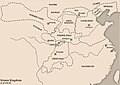 326
326 -
 338
338 -
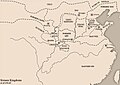 350
350 -
 369
369 -
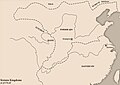 376
376 -
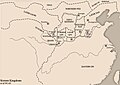 391
391 -
 400
400 -
 404
404 -
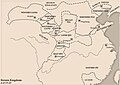 410
410 -
 423
423 -
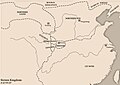 436
436

.jpg)
.jpg)
.jpg)
.jpg)

.jpg)
.jpg)
.jpg)
.jpg)

.jpg)
.jpg)
Chronology
[edit]| Chronology of the Sixteen Kingdoms with Ethnicity of Founders | ||||||||||||
| Xianbei Xiongnu Jie Di Qiang Dingling Han Chinese | ||||||||||||
| 303 | Jin Dynasty's rule over northern China and Sichuan begins to break down in 304 | WESTERN JIN DYNASTY* 266-317 | ||||||||||
| 304 | Cheng-Han 304-47 |
Han-Zhao 304-29 |
||||||||||
| 314 | ||||||||||||
| 315 | Dai* 315-76 |
|||||||||||
| 317 | ||||||||||||
| 318 | Former Liang 318-76 |
EASTERN JIN DYNASTY* 318-420 | ||||||||||
| 319 | Later Zhao 319-51 |
|||||||||||
| 329 | ||||||||||||
| 330 | ||||||||||||
| 337 | Former Yan 337-70 | |||||||||||
| 347 | ||||||||||||
| 350 | Ran Wei* 350-52 | |||||||||||
| 351 | Former Qin 351-94 | |||||||||||
| 352 | ||||||||||||
| 353 | ||||||||||||
| 370 | ||||||||||||
| 376 | ||||||||||||
| 377 | From 376 to 383, Former Qin briefly unites northern China | |||||||||||
| 384 | NORTHERN WEI DYNASTY* 386-534 |
Later Qin 384-417 |
Western Yan* 384-94 |
Later Yan 384-409 | ||||||||
| 385 | Western Qin 385-400 |
|||||||||||
| 386 | Later Liang 386-403 |
|||||||||||
| 388 | Zhai Wei* 388-92 | |||||||||||
| 392 | ||||||||||||
| 394 | ||||||||||||
| 397 | Southern Liang 397-414 |
Northern Liang 397-439 |
||||||||||
| 398 | Southern Yan 398-410 |
|||||||||||
| 400 | Western Liang 400-21 |
|||||||||||
| 403 | ||||||||||||
| 404 | ||||||||||||
| 407 | Xia 407-31 |
|||||||||||
| 409 | Western Qin resurrected 409-31 |
Northern Yan 409-36 | ||||||||||
| 410 | ||||||||||||
| 414 | ||||||||||||
| 417 | ||||||||||||
| 420 | LIU SONG DYNASTY* 420-79 | |||||||||||
| 421 | ||||||||||||
| 431 | ||||||||||||
| 436 | ||||||||||||
| 439 | ||||||||||||
| 440 | In 439, the Northern Wei reunites northern China | |||||||||||
| asterisk (*) denotes kingdoms not counted among the sixteen in the Spring and Autumn Annals of the Sixteen Kingdoms bold denotes major kingdoms among the sixteen with large jurisdiction and their rulers elevated themselves as emperors | ||||||||||||
Involvement of other ethnicities
[edit]
The Goguryeo kingdom was a powerful and influential state in northern Korea and parts of northeastern China at the beginning of the Sixteen Kingdoms period. Goguryeo was attacked by the Murong Xianbei numerous times, and in 342 Prince Murong Huang of Former Yan captured the Goguryeo capital Hwando (Wandu in Chinese). Under the powerful and dynamic leadership of feudal kings, Goguryeo during the reign of Gwanggaeto the Great successfully invaded the kingdoms of Baekje, Silla, and Dongbuyeo. Riding its success, Goguryeo campaigned against the Later Yan, obtaining the Liao River region. King Murong Xi of Later Yan twice launched retaliatory attacks to reclaim the Liao River watershed territory, but was only partially successful. At Northern Yan's destruction by the Northern Wei, Yan king Feng Hong fled to Goguryeo to seek asylum. Although granted asylum, Hong was said to have acted as if he was still king, issuing orders and demanding respect, and was executed by King Jangsu of Goguryeo.
After the Yuwen Xianbei tribe was defeated by the Former Yan in 344, the Kumo Xi and Khitan branches of the tribe survived and began increasing in strength north of You province. In 414, the Kumo Xi tribes sent a trade caravan to Northern Yan, then joined with the Khitan in declaring allegiance to Northern Yan, and then to Northern Wei after its destruction of Northern Yan. Thus, the Northern Wei held de facto rule over the entire Mongolian Plateau and the Liao River region.
In the Western Regions (modern Xinjiang) of the former Han Empire lay the kingdoms of Shanshan, Qiuzi, Yutian, Dongshi, and Shule. These kingdoms were often controlled or influenced by the various Liang kingdoms that existed during the Sixteen Kingdoms period. The Former Liang organized Gaochang Commandery (Chinese: 高昌郡) and Tiandi County (Chinese: 闐地縣) in the west, both under the administration of the Gaochang Governor. Day-to-day administration was run out of several forts: Western Regions Chief Clerk, Wu and Ji Colonel, and Jade Gate Commissioner of the Army. Other Liangzhou states generally followed this administrative system. In 382, the Former Qin ruler Fu Jiān sent General Lü Guang on a military expedition to the Dayuan kingdom and promoted him to Protector General of the western border regions. After Qin collapsed and Lü Guang founded the Later Liang, the western border forts and the Shanshan kingdom all became parts of or vassals to the Later Liang.
Religion
[edit]
Several rulers of the northern kingdoms patronized Buddhism which spread across northern China during the Sixteen Kingdoms and flourished during the subsequent Northern Dynasties. The Later Zhao was one of the earliest to provide Buddhism with state recognition, with the Kuchean monk, Fotu Cheng occupying a high and privileged position within the imperial court.
During the Former Qin, Fu Jiān was a strong patron of Buddhist scholarship. After capturing Xiangyang in 379, he invited the monk Dao An to Chang'an to catalogue Buddhist scriptures. When the teachings of the famed Kuchean monk, Kumārajīva, reached Chang'an, Dao An advised Fu Jiān to invite the Kumārajīva. In 382, Fu Jiān sent general Lü Guang to conquer the Western Regions (Tarim Basin) and bring Kumārajīva to Chang'an. Lü Guang captured Kucha and seized Kumārajīva, but the Former Qin collapsed after the Battle of Feishui in 383. Lü Guang founded the Later Liang and held Kumārajīva captive in western Gansu for 18 years. In 401, the Later Qin under Yao Xing conquered the Former Liang and Kumārajīva was able to settle in Chang'an and become one of the most influential translators of Buddhist sutras into Chinese. Another monk, Faxian began his journey from Later Qin territory in 399 to acquire Buddhist texts in India.
The earliest grottoes in the Mogao Caves of Dunhuang were carved in the Former Liang. Work on the Maijishan Grottoes began during the Later Qin. The Bingling Grottoes were started during the Western Qin. Numerous other grottoes were built in the Hexi Corridor under the Northern Liang.
See also
[edit]

- Battle of Fei River
- Ethnic groups in Chinese history
- Family trees of the rulers of the Sixteen Kingdoms
- Five Barbarians
- Upheaval of the Five Barbarians
- Sinicization
References
[edit]Citations
[edit]- ^ (Chinese) 许红梅, "'汉匈奴归义亲汉张' 印考释" 行知部落 xzbu.com Accessed 2020-06-02
- ^ (Chinese) 环首铁刀, CCTV.com Accessed 2020-06-02]
- ^ Cosmo, Nicola di (2009), Military Culture in Imperial China, Harvard University Press, p. 104
- ^ David Graff (2003). Medieval Chinese Warfare 300–900. Routledge. p. 48. ISBN 1134553536.
- ^ Jacques Gernet (1996). A History of Chinese Civilization (illustrated, reprint, revised ed.). Cambridge University Press. p. 180. ISBN 0521497817.
- ^ Grousset, Rene (1970). The Empire of the Steppes. Rutgers University Press. pp. 56. ISBN 0-8135-1304-9.
- ^ "Buddha dated 338". searchcollection.asianart.org. Retrieved 8 December 2025.
- ^ Dien, Albert E. (1986). "The Stirrup and Its Effect on Chinese Military History". Ars Orientalis. 16: 33–56. ISSN 0571-1371.
- ^ Puning Liu (2020). China's Northern Wei Dynasty, 386–535: The Struggle for Legitimacy. Routledge. pp. 86–87. ISBN 9781000283143.
- ^ Li and Zheng, p. 391
Sources
[edit]- Spring and Autumn Annals of the Sixteen Kingdoms
- Li Bo; Zheng Yin (2001). "5000 years of Chinese history", Inner Mongolian People's Publishing Corp., ISBN 7-204-04420-7.
| National | |
|---|---|
| Other | |
