Regulus (geometry)

In three-dimensional space, a regulus R is a set of skew lines, every point of which is on a transversal which intersects an element of R only once, and such that every point on a transversal lies on a line of R.
The set of transversals of R forms an opposite regulus S. In the union R ∪ S is the ruled surface of a hyperboloid of one sheet.

Any 3 skew lines generates a pair of reguli:[1]
- The set of lines that intersect all 3 of them sweeps out a quadratic surface. This ruling of this quadratic surface is the regulus.
- The set of lines that intersect all lines in the regulus is the complementary regulus or associated regulus, by Gallucci's theorem.
Any 3 lines in a regulus generates the complementary regulus, and vice versa. The regulus surface is the unique quadratic surface that contains these 3 lines. The pair of regulus sweep out the same surface, showing that it is a doubly ruled surface.
According to Charlotte Scott, "The regulus supplies extremely simple proofs of the properties of a conic...the theorems of Chasles, Brianchon, and Pascal ..."[2]
In a finite geometry PG(3, q), a regulus has q + 1 lines.[3] For example, in 1954 William Edge described a pair of reguli of four lines each in PG(3,3).[4]
Robert J. T. Bell described how the regulus is generated by a moving straight line. First, the hyperboloid is factored as
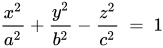

Then two systems of lines, parametrized by λ and μ satisfy this equation:
- and


No member of the first set of lines is a member of the second. As λ or μ varies, the hyperboloid is generated. The two sets represent a regulus and its opposite. Using analytic geometry, Bell proves that no two generators in a set intersect, and that any two generators in opposite reguli do intersect and form the plane tangent to the hyperboloid at that point. (page 155).[5]
See also
[edit]References
[edit]- ^ H. S. M. Coxeter (1969) Introduction to Geometry, page 259, John Wiley & Sons
- ^ Charlotte Angas Scott (1905) The elementary treatment of the conics by means of the regulus, Bulletin of the American Mathematical Society 12(1): 1–7
- ^ Albrecht Beutelspacher & Ute Rosenbaum (1998) Projective Geometry, page 72, Cambridge University Press ISBN 0-521-48277-1
- ^ W. L. Edge (1954) "Geometry of three dimensions over GF(3)", Proceedings of the Royal Society A 222: 262–86 doi:10.1098/rspa.1954.0068
- ^ Robert J. T. Bell (1910) An Elementary Treatise on Co-ordinate Geometry of Three Dimensions, page 148, via Internet Archive
- H. G. Forder (1950) Geometry, page 118, Hutchinson's University Library.