Orhei
Orhei | |
|---|---|
 Flag  Coat of arms | |
  Orhei Location within Moldova | |
| Coordinates: 47°23′N 28°49′E / 47.383°N 28.817°E | |
| Country | Moldova |
| County | Orhei District |
| Government | |
| • Mayor | Tatiana Cociu (FASM) |
| Area | |
• Total | 8.5 km2 (3.3 sq mi) |
| Population | |
• Total | 22,183 |
| • Density | 2,600/km2 (6,800/sq mi) |
| Time zone | UTC+2 (EET) |
| • Summer (DST) | UTC+3 (EEST) |
| Postal code | 3505 |
| Website | Official website |
.jpg)
.jpg)

.jpg)

Orhei (Romanian pronunciation: [orˈhej]) is a city, municipality[2] and the administrative centre[3] of Orhei District in the Republic of Moldova, with a population of 22,183. It lies roughly 40 kilometres (25 miles) north of the capital, Chișinău.
History
[edit]
Orhei is believed to derive its name from the Hungarian word Őrhely, meaning “guard post” or “lookout post,” and could be linked to a Hungarian army outpost guarding the gyepű.[4][5] Locally, orhei was understood to mean “strengthened hill,” “fortress,” or “deserted courtyard.”[6] The town historically served as an important defensive outpost on Moldavia’s eastern border.
In the 14th century, the Crimean Tatars established a settlement at Orheiul Vechi (Old Orhei), constructing baths, mosques, and other buildings, leaving a lasting cultural influence. By the early 15th century, the area was incorporated into the Moldavian principality, and Orhei gradually shifted to its present location, with the first documented mention in 1554 during the reign of Alexandru Lăpușneanu.[7]
After centuries under Moldavian rule, Orhei was ceded to the Russian Empire in 1812 following the Russo-Turkish wars. Like the rest of Bessarabia, it became part of the Kingdom of Romania after World War I, was annexed by the Soviet Union in 1940, briefly recaptured by Romania in 1941, and re-occupied by the USSR in 1944 during the Uman–Botoșani offensive. After World War II, the town was rebuilt, and in 1991 it became part of the Republic of Moldova.
Before 2003, Orhei served as the capital of Orhei County, a large administrative region, until the country was reorganized into smaller raions (districts).
The St. Dumitru Church, constructed by Vasile Lupu, is located in the town. Lupu, who ruled from 1634 to 1653, is credited with ushering in the town's so-called golden age, and a statue in the central square honors his legacy.
Orhei has gained national and international attention as a political stronghold of fugitive Moldovan oligarch Ilan Shor. Since his election as mayor in 2015, Shor built a network of local support that has enabled his influence to endure even after he fled the country amid criminal investigations. His preferred candidates, such as Pavel Verejanu in the 2019 mayoral election,[8] have continued to secure dominant victories in the city, often with overwhelming majorities.
Demographics
[edit]According to the 2024 census, 22,183 inhabitants lived in Orhei (making it the ninth largest city in Moldova), an increase compared to the previous census in 2014, when 21,065 inhabitants were registered.[9][10]
- Moldovans[a] (86.0%)
- Romanians (9.20%)
- Ukrainians (1.90%)
- Russians (1.70%)
- Others (1.00%)
| Year | Pop. | ±% |
|---|---|---|
| 1897 | 12,336 | — |
| 1930 | 15,279 | +23.9% |
| 1959 | 14,131 | −7.5% |
| 1970 | 25,707 | +81.9% |
| 1979 | 30,260 | +17.7% |
| 1989 | 38,038 | +25.7% |
| 2004 | 25,641 | −32.6% |
| 2014 | 21,065 | −17.8% |
| 2024 | 22,183 | +5.3% |
- ^ There is an ongoing controversy regarding the ethnic identification of Moldovans and Romanians.
- ^ In March 2023, the Parliament of Moldova passed a law updating all legislative texts and the constitution to refer to the national language as Romanian, effectively rendering the term "Moldovan" obsolete.[11][12]
At the onset of the Great War, Orhei's population was estimated at 25,000. About two-thirds of the inhabitants were Jewish, while the remainder consisted primarily of Romanians, with smaller groups of Ruthenians, Russians, and others.[13]
Religion
[edit].jpg)
.jpg)
Orhei was home to many Jews prior to World War II, and has a large Jewish cemetery. Currently, only one synagogue remains active in the community. The primary churches are the Romanian Orthodox Church and the Russian Orthodox Church. The area is also home to congregations of Baptists, Roman Catholics, Seventh-day Adventist Church, the Church of Jesus Christ of Latter-day Saints, the Salvation Army, and Jehovah's Witnesses.
Economy
[edit]Orhei was the first place in what was then known as Bessarabia, to have a successful tobacco industry. The area is also known for wine production.[13]
Sport
[edit]FC Milsami Orhei is based in the city. The team won the Moldovan National Division in 2015 and 2025.
Media
[edit]Orhei has two local radio stations: Radio Orhei (101.6 FM) founded in 2005, contains news from region and republic.[14] In 2018, its name was cloned by a broadcaster affiliated to the Șor Party – Radio Orhei FM (97.5 FM).[15][16] Radio Orhei FM broadcasts news from the Orhei region, Moldova national news, international news, and Russian, Moldovan, and Romanian music.[17] There is also an Orhei City Hall site.[18]
Natives
[edit]- Jacobo Fijman
- Dovid Knut
- Mihail Maculețchi
- Alex Magala
- Rodica Mahu
- Pasha Parfeny
International relations
[edit]Twin towns – Sister cities
[edit]Orhei is twinned with:

Gallery
[edit]-
-

-
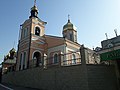 Saint Nicholas church
 -
 Armenian church


References
[edit]- ^ Results of Population and Housing Census in the Republic of Moldova in 2014: "Characteristics – Population (population by communes, religion, citizenship)" (XLS). National Bureau of Statistics of the Republic of Moldova. 2017. Retrieved 1 May 2017.
- ^ LEGE Nr. 248 din 03.11.2016 pentru modificarea și completarea Legii nr. 764-XV din 27 decembrie 2001 privind organizarea administrativ-teritorială a Republicii Moldova Archived 19 February 2019 at the Wayback Machine (in Romanian)
- ^ "Moldova Pitorescá" (PDF). Archived from the original (PDF) on 18 May 2019.
- ^ Faragó, Imre (2014). Márton, Mátyás (ed.). Domborzat- és tájábrázolás (PDF). Vol. Sokrétű térképészet II. Eötvös Loránd Tudományegyetem Informatikai Kar. p. 985. ISBN 978-963-284-468-8.
- ^ Nándor Bárdi, László Diószegi, András Gyertyánfy, "Hungarians in Moldavia" Archived 5 March 2010 at the Wayback Machine, Magyar Kisebbség 1–2 (7–8), 1997 (III), pp. 370–390.
- ^ Teodor PORUCIC – Lexiconul termenilor entropici din limba română în Basarabia, extras din Arhivele Basarabiei, 1931, nr. 1–4, Chişinău
- ^ "History of Orhei". The official website of the City Hall of Orhei. (in Romanian)
- ^ "Pavel Verejanu becomes mayor of Orhei with over 80% of the votes cast and with differences of millions between the income declared at CECE and ANI". 21 October 2019. (in Romanian)
- ^ "Rezultatele finale ale Recensământului Populației și Locuințelor 2024: Caracteristici etnoculturale ale populației". National Bureau of Statistics of the Republic of Moldova. (in Romanian)
- ^ "2014 Moldova Census of Population and Housing". National Bureau of Statistics of the Republic of Moldova. (in Romanian, Russian, and English)
- ^ "Chisinau Recognizes Romanian As Official Language". Radio Free Europe/Radio Liberty. 5 December 2013. Archived from the original on 23 September 2016. Retrieved 11 March 2014.
- ^ "Moldovan parliament approves law on Romanian language". Reuters. 16 March 2023. Retrieved 11 July 2024.
- ^ a b Kaba, John (1919). Politico-economic Review of Basarabia. United States: American Relief Administration. p. 14.
- ^ "RO-MD.INFO | cu subiect si predicat, și nu doar". radioorhei.info. Retrieved 1 May 2025.
- ^ "Orhei Radio Station 'Cloned' – How and in Whose Benefit | Media Azi". Archived from the original on 8 July 2018. Retrieved 1 May 2025.
- ^ "Radio Orhei in Litigation with the BCC after Their Name was 'Cloned' | Media Azi". Archived from the original on 10 August 2018. Retrieved 1 May 2025.
- ^ "Radio Orhei Fm 97,5". Archived from the original on 16 June 2021. Retrieved 15 July 2022.
- ^ "Primaria orașului Orhei – Republica Moldova". www.orhei.md. Retrieved 1 May 2025.
- ^ "Piatra Neamț – Twin Towns". 2007–2008 piatra-neamt.net. Archived from the original on 16 November 2009. Retrieved 27 September 2009.
Further reading
[edit]- Orgeyev/Orhei (pp. 372–375) at Miriam Weiner's Routes to Roots Foundation
External links
[edit]
| Municipalities |  | |
|---|---|---|
| Capitals of autonomous units | ||
| District seats4 | ||
| Other towns | ||
1 In Transnistria. 2 Controlled by the Transnistrian authorities. 3 Also a municipality. 4 The seat of Dubăsari District is the commune of Cocieri (not a city). | ||
| Districts | |
|---|---|
| Autonomous territorial units | |
| Municipalities | |
| |

| International | |
|---|---|
| National | |
| Other | |
