In optics, optical path length (OPL, denoted Λ in equations), also known as optical length or optical distance, is the vacuum length that light travels over the same time taken to travel through a given medium length. For a homogeneous medium through which the light ray propagates, it is calculated as taking the product of the geometric length of the optical path followed by light and the refractive index of the medium. For inhomogeneous optical media, the product above is generalized as a path integral as part of the ray tracing procedure. A difference in OPL between two paths is often called the optical path difference (OPD). OPL and OPD are important because they determine the phase of the light and govern interference and diffraction of light as it propagates.
In a medium of constant refractive index, n, the OPL for a path of geometrical length s is just

If the refractive index varies along the path, the OPL is given by a line integral
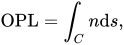
where n is the local refractive index as a function of distance along the path C.
An electromagnetic wave propagating along a path C has the phase shift over C as if it was propagating a path in a vacuum, length of which, is equal to the optical path length of C.[note 1] Thus, if a wave is traveling through several different media, then the optical path length of each medium can be added to find the total optical path length. The optical path difference between paths taken by two identical waves can then be used to find the difference between phase shifts over the paths. Finally, using this phase difference, the interference between the two waves at the end of the paths can be calculated.
Fermat's principle states that the path light takes between two points is the path that has the minimum optical path length.
Optical path difference
[edit]The optical path difference (OPD) corresponds to the phase shift undergone by the light emitted from two previously coherent sources when passed through mediums of different refractive indices. For example, a wave passing through air appears to travel a shorter optical distance (the refractive index n2 ~ 1) than an identical wave traveling the same geometric distance in glass (n1 > 1). This is because a larger number of wavelengths fit in the same geometric distance due to the higher refractive index of the glass.
The OPD can be calculated from the following equation:

where d1 and d2 are the geometric distances of the ray passing through medium 1 or 2, n1 is the greater refractive index (e.g., glass) and n2 is the smaller refractive index (e.g., air).
Note
[edit]- ^ For example, a single wavelength light traveling in a medium with the refractive index n is often expressed in a simplified formula , where and are the angular frequency and the wavenumber of the light respectively ( is the vacuum wavenumber), and indicates that the light travels towards + in the x-axis. The phase shift over the path C starting at x0, that is the phase difference between x0 and x0 + C at the same time t, is where is the OPL (Optical Path Length) of C, indicating that the same phase shift is obtained by treating the light traveling a vacuum over the distance of OPL.


![{\textstyle kC=\left[k_{0}n\right]C=k_{0}\left[nC\right]}](https://wikimedia.org/api/rest_v1/media/math/render/svg/57eca51b027235193ef42b097daa1acca929250c)

See also
[edit]References
[edit] This article incorporates public domain material from Federal Standard 1037C. General Services Administration. Archived from the original on 2022-01-22. (in support of MIL-STD-188).
- Jenkins, F.; White, H. (1976). Fundamentals of Optics (4th ed.). McGraw-Hill. ISBN 0-07-032330-5.
