Microactuator
 | This article needs additional citations for verification. (November 2025) |
A microactuator is a microscopic servomechanism that supplies and transmits a measured amount of energy for the operation of another mechanism or system. As a general actuator, following standards have to be met:
- Large travel
- High precision
- Fast switching
- Low power consumption
- Power free force sustainability
For microactuator, there are two in addition
- Microstructurability
- Integrability
Principle of microactuators
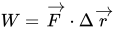
[edit]The basic principle can be described as the expression for mechanical work
since an actuator is to manipulate positions and therefore force is needed. For different kind of microactuators, different physical principles are applied.
Classes of microactuators
[edit]See also
[edit]- Newton's laws
- Euler–Bernoulli beam equation
- Electrostatics
- Electromagnetism
- Piezoelectricity
- Microfluidics
- Sensors
- Nanotube nanomotor
References
[edit]- ^ Fujita, Hiroyuki; Toshiyoshi, Hiroshi (1998). "Micro actuators and their applications". Microelectronics Journal. 29 (9): 637–640. doi:10.1016/S0026-2692(98)00027-5.
- ^ Wood, D.; Burdess, J. S.; Harris, A. J. (1996). "Actuators and their mechanisms in microengineering". IEE Colloquium on Actuator Technology: Current Practice and New Developments (Digest No: 1996/110): 7/1–7/3. doi:10.1049/ic:19960698.
- ^ Ma, Z. C.; Fan, J.; Wang, H.; Chen, W.; Yang, G. Z.; Han, B. (2023). "Microfluidic Approaches for Microactuators: From Fabrication, Actuation, to Functionalization". Small. 19 (22). doi:10.1002/smll.202300469. PMID 36855777.
- ^ Yoshida, K.; Park, J. H.; Yano, H.; Yokota, S.; Yun, S. (2005). "Study of Valve-Integrated Microactuator Using Homogeneous Electro-Rheological Fluid" (PDF). Sensors and Materials. 17 (3): 97–112.
| National | |
|---|---|
| Other | |
