Kluang | |
|---|---|
Town and district capital | |
| Kluang Town Bandar Kluang | |
Clock tower Jalan Batu Pahat Sunway Kluang Mall Street Art Alley Mengkibol River Jalan Mersing | |
 Seal | |
| Motto(s): Maju Sejahtera "Progress, Prosper" (motto of Kluang Municipal Council) | |
 Location of Kluang in Johor | |
| Coordinates: 2°2′1″N 103°19′10″E / 2.03361°N 103.31944°E | |
| Country |  Malaysia Malaysia |
| State |  Johor Johor |
| District |  Kluang Kluang |
| Establishment | 1915 |
| Granted municipal status | 8 May 2001 |
| Government | |
| • Type | Municipal council |
| • Body | Kluang Municipal Council |
| • President | Mohd Fahmy Yahya |
| Area | |
• District | 2,852 km2 (1,101 sq mi) |
| • Urban | 126.57 km2 (48.87 sq mi) |
| Population (2022) | |
• District | 323,762 |
| • Density | 113.5/km2 (294/sq mi) |
| • Urban | 204,964 |
| • Rural | 19,340 |
| Time zone | UTC+8 (MST) |
| • Summer (DST) | UTC+8 (Not observed) |
| Postcode | 86000 |
| Calling code | +6-07 |
| Vehicle registration | J |
| Website | www |


Kluang, formerly Keluang, is a town in Kluang District, Johor, Malaysia. Kluang was founded in 1915 as the administrative capital of central Johor by the British. It is located in the centre of the state and is within 90 minutes of all major urban areas of Johor. Kluang, combined with Batu Pahat, encompasses central Johor with a market catchment of over 700,000. Over the 20th century, Kluang's economy transitioned from rubber to palm oil and now has some of Malaysia's largest organic farms. The industrial sector has also grown significantly with multinational investment and a critical mass of tile manufacturers enabling the district to be called the 'tile capital of Malaysia'. The organic farming sector has also boosted Kluang as an ecotourism destination with key farms such as Zenxin, UK Agro and Kahang Organic Rice Farm.
History
[edit]The name Kluang derives from the Malay word 'keluang' which means a type of flying fox or rather a type of fruit bat, which used to be plentiful in the district decades ago. They have almost completely disappeared due to the combination of hunting and destruction of their natural habitat (deforestation).

Kluang was founded in 1915 as the administrative capital for central Johor by the British.[1] The main railway line linking north to south Malaya was built passing through Kluang and this helped in its growth. Roads were built to link Kluang to Johor Bahru towards the south-east, to Batu Pahat towards the south-west and to Mersing towards the north-east.
During World War II, the town of Kluang was occupied by Japanese forces on 25 January 1942 as they advanced southwards as it was abandoned by Allied forces withdrawing towards Singapore. General Yamashita moved his headquarters forward from Kuala Lumpur to Kluang on 27 January 1942 as he advanced southwards. The Japanese later used the airfield in Kluang to launch air attacks on targets ranging from Singapore to Sumatra.
In the mid-1950s the airfield was used for spotter planes and helicopters searching for communists who were encamped in the Bukit Lambak area and as an artillery base. It served as a base for the Kluang Flying Club which used old Tiger Moth biplanes. Communists were largely driven out of the area in the six months leading up to Merdeka in 1957. The area around the airfield was a substantial army garrison with many different units and a large hospital. The 75 Workshop was an aviation united based in Kluang from 1946 to 1970.[2] The veteran's group continues to hold reunions throughout the world.[3]
There was a very big flood in Kluang in 1969. The river overflowed by 7 to 10 feet and much damage was caused to property.[4]
Today, the Malaysian Army maintains military camps in Kluang at Kem Batu Tiga and Kem Mahkota, which hosts the Malaysian Army Aviation Unit, 881 Squadron.
Geography
[edit]Kluang is located in the centre of Johor, a 90-minute drive from most urban areas in the country.
Kluang town lies in an area of undulating hills. The highest point is Gunung Lambak, a landmark 510 m (1,673 ft) mountain and which lies at the eastern oustkirts of the town. In the eastern part of the district lies the Gunung Belumut Recreational Forest.
The Kluang Municipal Council's administrative area, where the town is located is approximately 126.57 square kilometers (327.8/sq mi).[5]
Kluang is landlocked and has no seafront. The Mengkibol River runs through the centre of the town while the Melantai River runs through the eastern part and the Sembrong River runs through the western part.
Urban sprawl in Kluang from the 1970s to 2000 has seen Kluang expand in a horizontal fashion, roughly along the major roads leading west to east. The town centre itself has more than tripled in size in terms of the number and land area occupied by commercial and retail buildings in that time. Many acres of rubber and oil palm plantations have been re-developed into housing estates.
Demographics
[edit]As of 2010, total population of Kluang District was 319,629 people. In 2000, the population growth was 1.48%.[6]
As of 2022, the population of Kluang District was 323,762 residents out of four million statewide, with 55.4% of them being male.[7]
Government and politics
[edit]Kluang Municipal Council Majlis Perbandaran Kluang | |
|---|---|
Emblem | |
| Type | |
| Type | |
| History | |
| Founded | 8 May 2001 |
| Preceded by | Kluang North District Council |
| Leadership | |
President | Mohd Fahmy Yahya (Since 20 October 2024) |
Secretary | Azmi Ahmad (Since 1 January 2024) |
| Structure | |
| Seats | 24 |
Political groups | Councillors: |
Length of term | 1 April 2024–31 December 2025 |
| Motto | |
| Maju Sejahtera (Progress, Prosper) | |
| Meeting place | |
| Wisma Baharu Majlis Perbandaran Kluang, Persiaran Utama Bandar Primer, 86000 Kluang, Johor | |
| Website | |
| www | |
Kluang Municipal Council (Malay: Majlis Perbandaran Kluang, MPKluang), previously known as the Kluang North District Council (Malay: Majlis Daerah Kluang Utara) is the local authority which administrates the town of Kluang in Kluang District, Johor, Malaysia since 8 May 2001. The latter was formed on 1 January 1977 by merging the Kluang Town Council (previously known as the Kluang Town Board from 1920 until 1957) and the local councils of Kampong Paya, Kampong Gajah, Sri Lalang, Chamek and Paloh.[8] Its current headquarters is located at Persiaran Utama Bandar Primer, replacing its previous location at Jalan Kota Tinggi since 1 July 2025.[9]
Presidents of Kluang
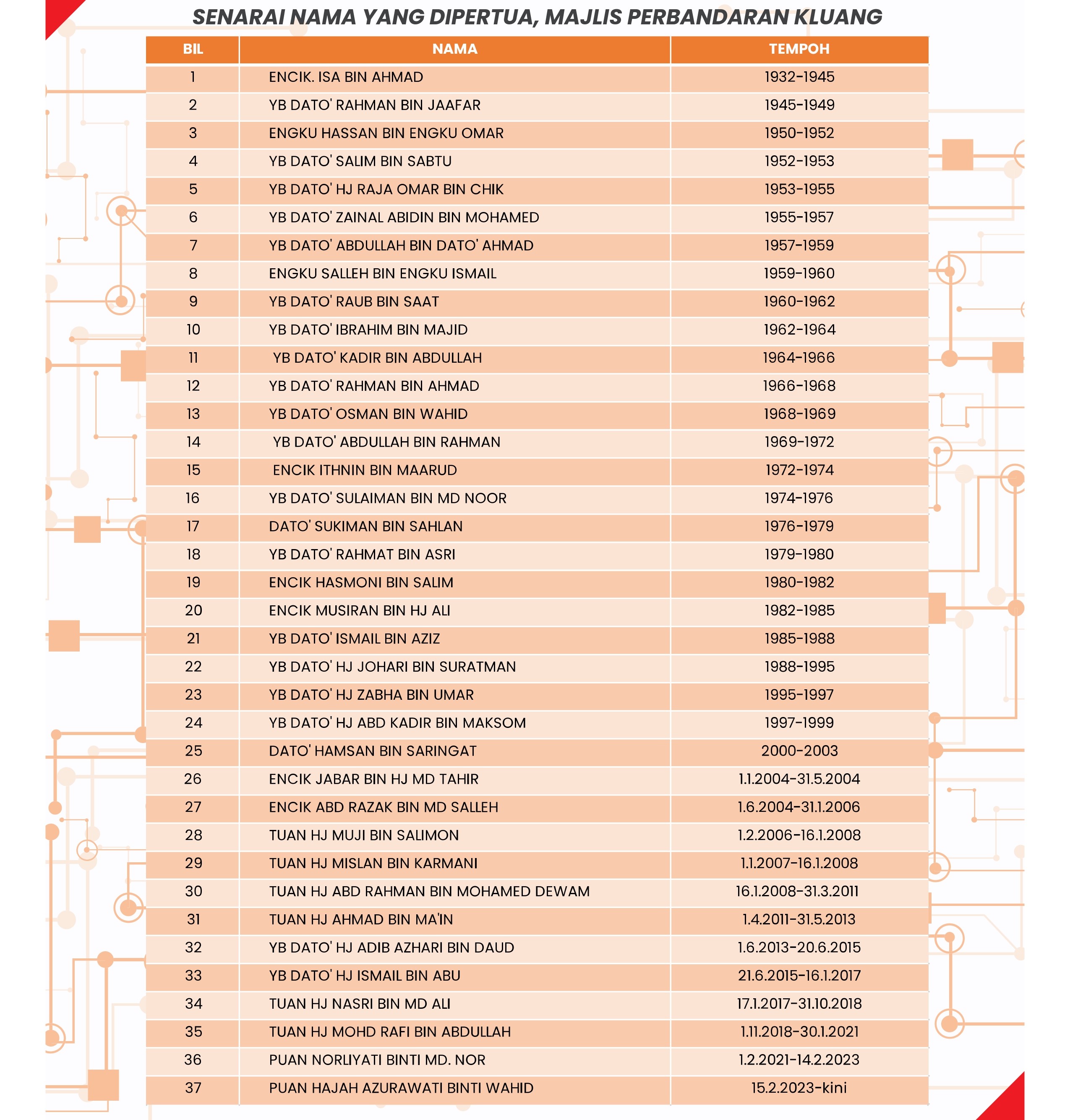
[edit]To date, 38 people have been appointed as presidents of Kluang Town Board and Town, District and Municipal Councils, two of which are women.[10]
| # | Name | Term start | Term end |
|---|---|---|---|
| 1 | Isa Ahmad | 1932 | 1945 |
| 2 | Rahman Jaafar | 1945 | 1949 |
| 3 | Hassan Omar | 1950 | 1952 |
| 4 | Salim Sabtu | 1952 | 1953 |
| 5 | Raja Omar Chik | 1953 | 1955 |
| 6 | Zainal Abidin Mohamed | 1955 | 1957 |
| 7 | Abdullah Ahmad | 1957 | 1959 |
| 8 | Salleh Ismail | 1959 | 1960 |
| 9 | Raub Saat | 1960 | 1962 |
| 10 | Ibrahim Majid | 1962 | 1964 |
| 11 | Kadir Abdullah | 1964 | 1966 |
| 12 | Rahman Ahmad | 1966 | 1968 |
| 13 | Osman Wahid | 1968 | 1969 |
| 14 | Abdullah Rahman | 1969 | 1972 |
| 15 | Ithnin Maarud | 1972 | 1974 |
| 16 | Sulaiman Md Noor | 1974 | 1976 |
| 17 | Sukiman Sahlan | 1976 | 1979 |
| 18 | Rahmat Asri | 1979 | 1980 |
| 19 | Hasmoni Salim | 1980 | 1982 |
| 20 | Musiran Ali | 1982 | 1985 |
| 21 | Ismail Aziz | 1985 | 1988 |
| 22 | Johari Suratman | 1988 | 1995 |
| 23 | Zabha Umar | 1995 | 1997 |
| 24 | Abd Kadir Maksom | 1997 | 1999 |
| 25 | Hamsan Saringat | 2000 | 2003 |
| 26 | Jabar Md Tahir | 1 January 2004 | 31 May 2004 |
| 27 | Abd Razak Md Salleh | 1 June 2004 | 31 January 2006 |
| 28 | Muji Salimon | 1 February 2006 | 31 December 2006 |
| 29 | Mislan Karmani | 1 January 2007 | 16 January 2008 |
| 30 | Abd Rahman Mohamed Dewam | 16 January 2008 | 31 March 2011 |
| 31 | Ahmad Ma'in | 1 April 2011 | 31 May 2013 |
| 32 | Adib Azhari Daud | 1 June 2013 | 20 June 2015 |
| 33 | Ismail Abu | 21 June 2015 | 16 January 2017 |
| 34 | Nasri Md Ali | 17 January 2017 | 31 October 2018 |
| 35 | Mohd Rafi Abdullah | 1 November 2018 | 30 January 2021 |
| 36 | Norliyati Md Nor | 1 February 2021 | 14 February 2023 |
| 37 | Azurawati Wahid | 15 February 2023 | 19 October 2024 |
| 38 | Mohd Fahmi Yahya | 20 October 2024 | Present |
Secretaries of Kluang
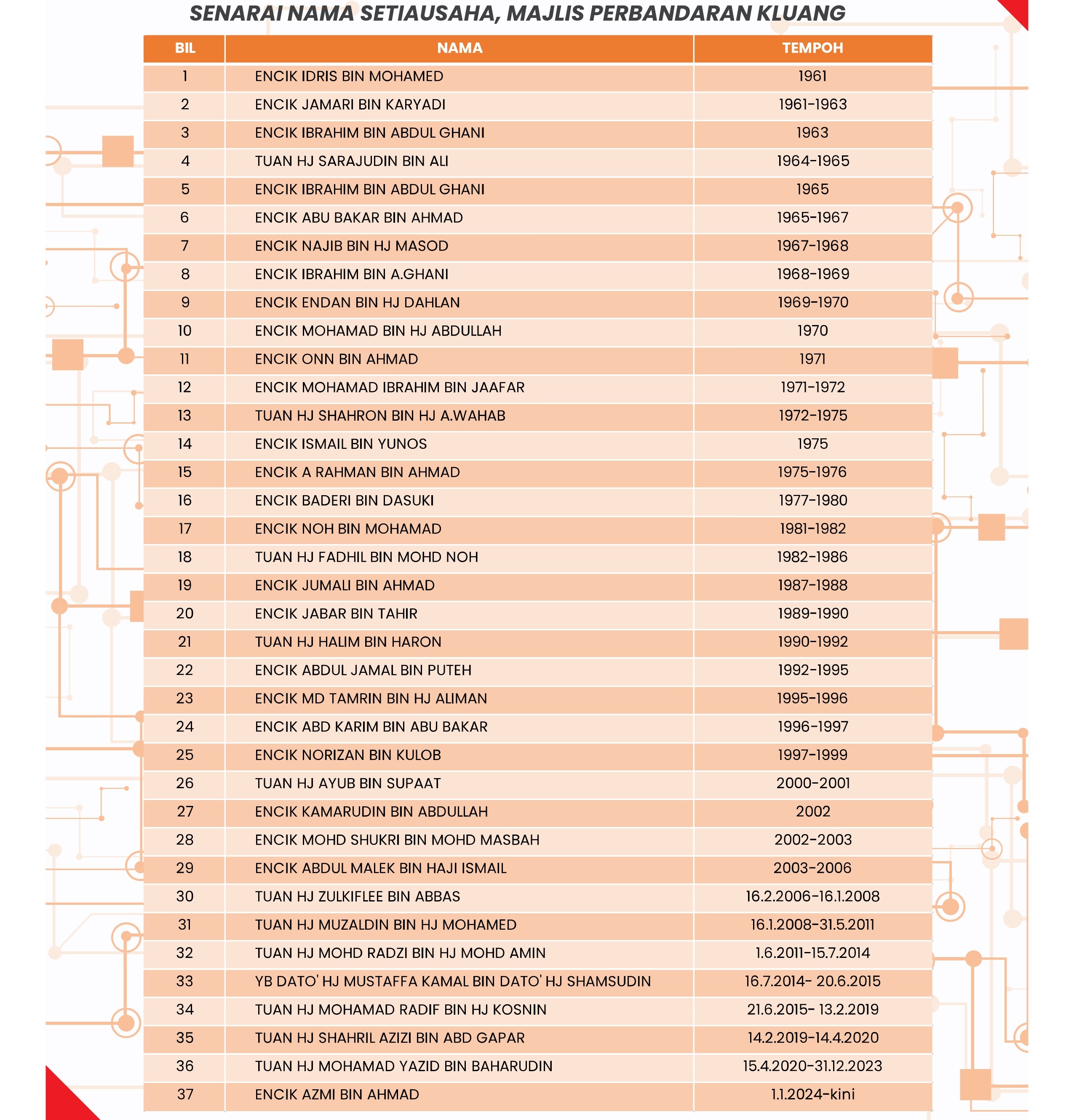
[edit]To date, 37 people have been appointed as secretaries of Kluang Town, District and Municipal Councils.[11]
| # | Name | Term start | Term end |
|---|---|---|---|
| 1 | Idris Mohamed | 1961 | 1961 |
| 2 | Jamari Karyadi | 1961 | 1963 |
| 3 | Ibrahim Abdul Ghani | 1963 | 1963 |
| 4 | Sarajudin Ali | 1964 | 1965 |
| 5 | Ibrahim Abdul Ghani | 1965 | 1965 |
| 6 | Abu Bakar Ahmad | 1965 | 1967 |
| 7 | Najib Masod | 1967 | 1968 |
| 8 | Ibrahim Abdul Ghani | 1968 | 1969 |
| 9 | Endan Dahlan | 1969 | 1970 |
| 10 | Mohamad Abdullah | 1970 | 1970 |
| 11 | Onn Ahmad | 1971 | 1971 |
| 12 | Mohamad Ibrahim Jaafar | 1971 | 1972 |
| 13 | Shahron Abdul Wahab | 1972 | 1975 |
| 14 | Ismail Yunos | 1975 | 1975 |
| 15 | Abdul Rahman Ahmad | 1975 | 1976 |
| 16 | Baderi Dasuki | 1977 | 1980 |
| 17 | Noh Mohamad | 1981 | 1982 |
| 18 | Fadhil Mohd Noh | 1982 | 1986 |
| 19 | Jumali Ahmad | 1987 | 1988 |
| 20 | Jabar Tahir | 1989 | 1990 |
| 21 | Halim Haron | 1990 | 1992 |
| 22 | Abdul Jamal Puteh | 1992 | 1995 |
| 23 | Md Tamrin Aliman | 1995 | 1996 |
| 24 | Abd Karim Abu Bakar | 1996 | 1997 |
| 25 | Norizan Kulob | 1997 | 1999 |
| 26 | Ayub Supaat | 2000 | 2001 |
| 27 | Kamarudin Abdullah | 2002 | 2002 |
| 28 | Mohd Shukri Mohd Masbah | 2002 | 2003 |
| 29 | Abdul Malek Ismail | 2003 | 2006 |
| 30 | Zulkiflee Abbas | 16 February 2006 | 16 January 2008 |
| 31 | Mulzaldin Mohamed | 16 January 2008 | 31 May 2011 |
| 32 | Mohd Radzi Mohd Amin | 1 June 2011 | 15 July 2014 |
| 33 | Mustaffa Kamal Shamsudin | 16 July 2014 | 20 June 2015 |
| 34 | Mohamad Radif Kosnin | 21 June 2015 | 13 February 2019 |
| 35 | Shahril Azizi Abd Gapar | 14 February 2019 | 14 April 2020 |
| 36 | Mohamad Yazid Baharudin | 15 April 2020 | 31 December 2023 |
| 37 | Azmi Ahmad | 1 January 2024 | Present |
Departments
[edit]- Management Services (Khidmat Pengurusan)
- Finance (Kewangan)
- Valuation and Property Management (Penilaian dan Pengurusan Harta)
- Engineering (Kejuruteraan)
- Environmental Health and Licensing (Kesihatan Persekitaran dan Pelesenan)
- Urban Planning and Landscape (Perancang Bandar dan Landskap)
- Building Control (Kawalan Bangunan)
- Enforcement (Penguatkuasaan)
Units
[edit]- Internal Audit (Audit Dalam)
- Law (Undang-undang)
- One Stop Centre (Pusat Sehenti)
- Corporate Communications and Community (Komunikasi Korporat dan Kemasyarakatan)
Branch
[edit]- Commissioner of Building (Pesuruhjaya Bangunan)
Administration areas (zones)
[edit]As of 2025, Kluang town is divided into 24 zones represented by 24 councillors to act as mediators between residents and the city council.[12][13] The councillors for the 1 April 2024 to 31 December 2025 session are as below:
| Zone | Councillor | Political affiliation |
|---|---|---|
| Kahang A | Abdul Ghani Abdul Rashid | UMNO |
| Paloh A | Atan Ibrahim | UMNO |
| Paloh B | Au Xian Jie | MCA |
| Sri Lalang | Gan Lee Chiu | MCA |
| Kampong Melayu | Haslina Mohammad Dom | UMNO |
| Kampong Paya | Kelly Chye Pei Yee | MCA |
| Taman Intan | Izaluddin Akmat | UMNO |
| Town Centre (Bandar) | Law Mona | MCA |
| Taman Puteri | Mohd Saim Paiman | UMNO |
| Taman Suria | Law Yew Shen | MCA |
| Taman Megah | Raman M Govindan Nair | MIC |
| Sri Kluang | Mohd Khairul Ishak | UMNO |
| Kahang B | Siti Norreha Hussin | UMNO |
| Taman Delima | S Sarasvathi K.Sinatambi | MIC |
| Taman Kasih | Zainal Mohamed | UMNO |
| Taman Sri Tengah | Zakiah Pardi | UMNO |
| Taman Pelangi | Zaimani Jamaluddin | UMNO |
| Yap Tau Sah | Yap Zhi Peng | MCA |
| Taman Kluang Barat | Azizul Ali | UMNO |
| Taman Ilham | Abd Hamid Dahlan | UMNO |
| Chamek | Go Yen Hong | MCA |
| Gunung Lambak | Shey Risha Abdul Karim | UMNO |
| Kampung Gajah | Lim Yew Chin | MCA |
| Taman Seri Impian | Syed Hussin Syed Abdullah | UMNO |
Agriculture
[edit]Since its founding in 1915, the area initially grew as a rubber planting place. There are vast areas planted with rubber in the early days under the Guthrie Ropel Group, Asiatic Plantations, Harrisons & Crossfield and various other rubber companies. An innovation was the process of vacuum evaporation of rubber latex by the Revertex company. Planters established the Kluang Club which is still thriving as the Kluang Country Club. Notable rubber plantations, surrounding Kluang town were Lambak Estate, Mengkibol Estate, Kluang Estate, Coronation Estate, Wessington Estate (now renamed as Simpang Renggam Estate), Benut Estate, Paloh Estate, Sepuloh Estate, Chamek Estate, Niyor Estate, Kahang Estate, Pamol Estate and Kekayaan Estate.
Among the rubber plantations, Lambak Estate is elaborately described in the book Malabar to Malaya written by Ravindran Raghavan[14] who was born in this estate in 1965. The book gives a first-hand account of life in the estate and also provides statistics about wages earned by a rubber tapper family residing in the estate between 1977 and 1986.
Among the early Indian settlers who "migrated" here during the British era (they were considered as non-legitimate property owners at that time) were those who built some temples (although contrary against the British binding precedent) and the notable toddy shops in the surrounding areas of Kluang.[15] Today you can find the remaining commercial elements in the "Little India" section of Kluang town. You can find "ONE" from a million interesting stories on the website containing the biography of Ravindran Raghavan ([1]), a native Kluang boy who grew in a rubber estate.
Rubber planting has over time transitioned to other types of crops. In the 1970s, rubber plantations were gradually replanted and replaced by oil palms. Kluang now boasts large tracts of oil palm plantations as well as cocoa and tea plantations. The former rubber plantation, Pamol Estate is now a high-performing palm oil plantation owned by IOI Corporation,[16] considered one of the most efficient palm oil producers in the world. Pamol Estate has a total certified sustainable palm oil area of 12,044 hectares and a production of 56,528 tonnes.[17]
Kluang has developed a diversified agricultural and organic farm sector. New kinds of plantation such as dragon fruit and organic vegetables have emerged.[18] One of Malaysia's largest vegetable organic farms at over 100 acres, Zenxin Agri-Organic Food, is also located in Kluang.[19] The Kluang Modern Agriculture Project (Projek Pertanian Moden Kluang) was officially launched in 2004 and covers over 9,000 acres.[20] Within this project, there are herbal and grazing farms, including the largest goat and sheep farm, UK Agro Farm with over 4,000 heads of sheep and goat grazing over 100 acres.[21] Further out in Kahang, within Kluang district, is the Kahang Organic Eco Rice Farm, the first certified organic rice farm in Malaysia.[22]
Industry and commerce
[edit]Kluang possesses a diverse industrial economy with sector-leading companies. From its early days as an entirely agricultural & horticulture economy, Kluang has developed various industries including polymer, paper, textiles, ceramics, industrial paints and electrical products.
Kluang is considered a "tile capital" of Malaysia. Leading companies such as MML (Malaysian Mosaics), French-based Terreal, Venus Ceramic and Guocera (subsidiary of Bursa Malaysia-listed Hong Leong Industries) house major factories in Kluang, contributing to Malaysia's position as a top 20 ceramic tile producer in the world.[23]
There are a few multinational corporations operating in Kluang. Malaysia's largest tissue paper factory is owned and operated by Kimberly-Clark[24] and is situated on the eastern industrial sector of the town. The Swiss-based conglomerate, Liebherr Group owns and operates a subsidiary, Liebherr Appliances which manufactures freezers and refrigerators for domestic consumption and export.
One of the world's largest nitrile production facilities is owned by Synthomer plc (listed in London FTSE). Synthomer is the new name of Yule Catto & Co Ltd. which traces its existence from pre-independence Malaya. Yule Catto merged with Malaya General Company Limited in 1971 and acquired Revertex Chemicals Ltd in 1980, inheriting the Revertex Estate and industrial complex in Kluang.[25] The sprawling Kluang facility produced over 120,000 tons of nitrile latex out of an estimated worldwide production of 550,000 tons in 2010.[26]
The commercial heart of Kluang lies downtown within the Kluang Inner Ring Road. The downtown district contains the shopping centres, restaurants and entertainment areas. All the major banks, brokerages and other financial institutions are all located in this area. Kluang is also the home of Hong Yuan Hills Crematorium, situated in Jalan Berlian 2, Taman Berlian.
Transport
[edit]
Kluang is served by the national railway, the North–South Expressway and local trunk roads linking it to all neighbouring districts. The neighbouring airport is in Senai.
Car
[edit]The closest on-ramp to the PLUS Expressway is at exit 244 at Ayer Hitam although travellers approaching Kluang from the south (e.g. Johor Bahru etc.) may find exiting at Sedenak and Simpang Renggam are the options. Federal Route 50 begins in Batu Pahat, runs through downtown Kluang and continues on to Kahang, Jemaluang and ultimately Mersing on the eastern coast of Johor.
Rail
[edit]State railway operator KTMB has a station in Kluang, located at Jalan Stesen. The journey from Kuala Lumpur takes at least 5 hours, although is expected to be shortened soon to less than 3 hours with the new double tracking and electrification project. Through this project, Kluang is expected to be well connected with more regular and faster commuter and intercity services to places like Kuala Lumpur, Ipoh, Johor Bahru and Butterworth. The station is also connected to JB Sentral and thus Singapore, where it takes around 3 hours currently to get to the former. A new station was opened recently, and the former station which housed a wooden cafeteria known as "Kluang Railcoffee", in operation since the 1938 is still open.
Bus
[edit]The Kluang express bus terminal is located at Jalan Bakawali. It is located next to Plaza BCB and Prime City Hotel. Express buses depart from this terminal to most cities in Peninsular Malaysia. There are daily buses to Kuala Lumpur (over 3 hours), Johor Bahru and various other cities throughout Peninsular Malaysia and also Singapore (Boon Lay) (over 2 hours).
- Kluang to Johor Bahru: KKKL and S&S International Online booking: S&S InternationalKKKL
- Kluang to Kuala Lumpur: KKKL and S&S International. Online booking: KKKLBusOnlineTicketredBus
- Kluang to Singapore: Fivestar
Air
[edit]There is a military airfield (ICAO: WMAP) in Kluang. The air field is managed by the RMAF.
The nearest civilian airport is Senai International Airport (IATA:JHB), located in Senai, Kulai district, which is roughly 90 km south of Kluang or just over an hour's drive. Senai is also a hub for Air Asia's international destinations, mainly within regional south-east Asia.
Infrastructure
[edit]
Kluang is served by a district police station and a fire station.
Kluang Hospital is managed by the Ministry of Health and located in the southern part of the town. There also a KPJ Kluang Utama Specialist Hospital.
Education
[edit]Sekolah Menengah Sains Johor (SMS Johor), was the first government boarding secondary school with a special emphasis on science subjects. It was founded in 1973 and currently has over 500 students.
Kluang High School or Sekolah Tinggi Kluang is one of the best known schools in Kluang and was founded in 1939. It now has over 1,500 students.[27]
The Chong Hwa High School is the third biggest Chinese secondary school[28] in Malaysia and was financially established by reputable Chinese settlers in the 1940s.[29] The school enrolls over 3,000 students.
Tourism
[edit]Kluang is well known for its outdoor recreation and farms. The town is surrounded by farming districts, some of which have established eco resorts and tours. Among the most popular are Zenxin Organic Farm, possibly the largest vegetable farm in Peninsular Malaysia. There is farm tour, restaurant and convention hall. The organic supermarket is a favourite for tourists to buy local organic produce before heading home. Close by is UK Agro Farm which hosts Malaysia's largest goat and sheep farm. Tours featuring the animals are popular with children. At the other end of the district is Kahang Organic Rice Farm which also features agro-tourism in Malaysia's first organic padi field. Both UK Agro and Kahang Organic Rice Farm have basic chalet accommodation.
Gunung Belumut and Gunung Lambak are popular with jungle trekkers. The Gunung Lambak summit is 510m and can be reached within two hours without any equipment. It is popular on weekends with Kluang families.
Kluang is also famous for its coffee, and this can be best experienced at Kluang RailCoffee at the Kluang Station. Established in 1938, the coffee shop still retains an old feel. It is best experienced during train arrival times, when disembarking passengers provides an atmosphere of days gone by. The most popular local delights are mee siam (traditional fried Malay spicy rice noodles that wrapped with banana leaves and old newspaper), half boiled eggs, variety of local coffee selections.
Also noteworthy is an authentic coffee shop located at no. 56, Jalan Lambak by the name of Tong Fong Cafe (a.k.a. Eastern Cafe) which was very popular with British soldiers when Malaysia was still under British rule. The operator is a second generation descendant of the owner and the coffee shop has been operating since 1954.
Like many secondary towns in Malaysia, Kluang also has its fair share of local food delights, with some touting Kluang beef noodles (Yean Kee) and the curry mee (Botak Curry Mee) as local favourites.
Popular culture
[edit]Though not set in Kluang town itself, the 1990s Malaysian animation series Keluang Man shares the same namesake of the fruit bat or keluang.
Sister cities
[edit]

Notable people
[edit]- Samy Vellu, President of Malaysian Indian Congress (MIC)(1979–2010), Minister of Works (1995–2008)
- Ali Hamsa, Chief Secretary to the Government
- Chieh Yuan (1945–1977), Actor and martial artist
- Lee San Choon, President of Malaysian Chinese Association (MCA)(1975–1983)
- Ng Tian Hann, Malaysia Chinese Movie Director
- Shebby Singh, Malaysian former footballer
- Nur Izzuddin, badminton player
- Noraniza Idris, singer and actress
- [(Bishop Dato' Charles k. Samuel,- Suffragan Bishop of the Anglican Church of West Malaysia
See also
[edit]References
[edit]- ^ "History of Kluang". Archived from the original on 8 July 2003.
- ^ "75 Aircraft Workshop Kluang" (PDF). Retrieved 21 May 2023.
- ^ "Kluang Revisited". www.facebook.com. Retrieved 21 May 2023.
- ^ "Gurudwara Sahib Kluang, Johor". World Gurudwaras. Retrieved 3 December 2020.
- ^ jhrmpk (8 May 2016). "History Kluang". Official Portal of Kluang Municipal Council (MPK) (in Malay). Retrieved 8 December 2023.
- ^ "Handbook" (PDF). johor.gov.my (in Malay). Archived from the original (PDF) on 13 September 2018. Retrieved 20 May 2023.
- ^ "Kluang placed fourth in state's population census". The Star. Retrieved 8 December 2023.
- ^ "Background". mpkluang.gov.my.
- ^ "Headquarters Directory". mpkluang.gov.my.
- ^ "List of Presidents". mpkluang.gov.my.
- ^ "List of Secretaries". mpkluang.gov.my.
- ^ "Councillor list". mpkluang.gov.my.
- ^ "Councillor list (PDF)" (PDF). mpkluang.gov.my.
- ^ Malabar to Malaya (2 ed.). Ravindran Raghavan. p. 341. ISBN 9789671653401.
- ^ Winstedt, A History of Johore (1365–1941), pp. 106–7
- ^ "Sustainability the way forward for palm oil industry". IOI Corp.
- ^ IOI Corporation Berhad. TA Securities. 28 March 2016. p. 2.
- ^ Jackson, James C. (1968). "Planters and speculators: Chinese and European agricultural enterprise in Malaya, 1786-1921". University of Malaya Press
- ^ "About Zenxin". Zenxin Organic. Archived from the original on 15 March 2016.
- ^ "KLUANG MODERN AGRICULTURE PROJECT". Ministry of Agriculture.
- ^ "UK Agro Resort". UK Farm.
- ^ "11 Best Compost Bins for Your Garden of 2023". 11 May 2022. Retrieved 21 May 2023.
- ^ "World Production and Consumption of Ceramic Tiles" (PDF).
- ^ "KIMBERLY-CLARK PROFESSIONAL* Malaysia - Trusted and Guaranteed Brands". www.kcprofessional.com.my.
- ^ "Synthomer Corporate History". Retrieved 21 May 2023.
- ^ "Synthomer Asia A World Leader" (PDF). Archived from the original on 14 January 2014.
- ^ "SMS Johor". Retrieved 21 May 2023.
- ^ "銮中 KLUANG CHONG HWA HIGH SCHOOL". Retrieved 21 May 2023.
- ^ Turnbull, A Short History of Malaysia, Singapore and Brunei, p. 124
External links
[edit]
| |||||||||||||||
| General topics |
|  | |||||||||||||
| Administrative divisions |
| ||||||||||||||
| City councils (Majlis Bandaraya) |
| ||||||||||||||
| Municipal councils (Majlis Perbandaran) |
| ||||||||||||||
| District councils (Majlis Daerah) |
| ||||||||||||||