Iquique
Iquique | |
|---|---|
 Montage of images of Iquique. | |
 Flag  Coat of arms  Map of Iquique in Tarapacá Region   Iquique Location in Chile | |
| Coordinates: 20°13′S 70°9′W / 20.217°S 70.150°W | |
| Country |  Chile Chile |
| Region |  Tarapacá Tarapacá |
| Province | Iquique |
| Founded | 16th Century |
| Government | |
| • Type | Municipal council |
| • Alcalde | Mauricio Soria Macchiavello |
| Area | |
• Total | 2,242.1 km2 (865.7 sq mi) |
| Elevation | 1 m (3.3 ft) |
| Population (2017 Census)[2] | |
• Total | 191,468 |
| • Density | 85.397/km2 (221.18/sq mi) |
| Time zone | UTC−4 (CLT) |
| • Summer (DST) | UTC−3 (CLST) |
| Postal code | 1100000 |
| Climate | BWh |
| Website | Official website (in Spanish) |

Iquique (Spanish pronunciation: [iˈkike]) is a port city and commune in northern Chile, capital of both the Iquique Province and Tarapacá Region. It lies on the Pacific coast, west of the Pampa del Tamarugal, which is part of the Atacama Desert. It has a population of 191,468 according to the 2017 census.[2] It is also the main commune of Greater Iquique. The city developed during the heyday of the saltpetre mining in the Atacama Desert in the 19th century. Once a Peruvian city with a large Chilean population, it was conquered by Chile in the War of the Pacific (1879–1883). Today it is one of only two free ports of Chile, the other one being Punta Arenas, in the country's far south.
History
[edit] |
Although the city was founded in the 16th century, there is evidence of habitation in the area by the Chango people as early as 7,000 BC. During colonial times, Iquique was part of the Viceroyalty of Peru as much of South America was at the time, and remained part of Peruvian territory until the end of the 19th century. Iquique's early development was due in large part to the discovery of mineral riches, particularly the presence of large deposits of sodium nitrate in the Atacama Desert (then part of Peruvian territory); and guano.[3]
In July 1835, Charles Darwin, during his voyage on the Beagle, traveled to Iquique and described it as a town "very much in want of everyday necessities, such as water and firewood". These necessities had to be brought in from considerable distances. Darwin also visited the saltpetre works.
The city has been devastated by several earthquakes, including the 1868 Arica earthquake, the 1877 Iquique earthquake, and the 2005 Tarapacá earthquake. The 2014 Iquique earthquake occurred with a moment magnitude of 8.2 on April 1, 2014.

Territorial disputes between Bolivia and Chile triggered the War of the Pacific in 1879. The Battle of Iquique was fought in the harbor of Iquique on May 21, 1879, now commemorated as Navy Day, an annual public holiday in Chile. The outcome of the war gave Chile this portion of the Peruvian territory.
Over the years there was substantial emigration from other parts of Chile to this area which was called the Norte Grande. In subsequent years the further exportation of Chilean saltpetre (mainly to European countries) significantly helped in the development of the city, attracting foreigners and rapidly expanding housing projects.
In December 1907, the city was marred by the Santa María de Iquique Massacre when the Chilean Army, under the command of Gen. Roberto Silva Renard, opened fire on thousands of saltpetre miners, and their wives and children, who assembled inside the Santa María School. The workers had marched into town to protest their working conditions and wages. Somewhere between 500 and 2,000 people were killed. The folk group Quilapayún recorded an album in remembrance of the event (Cantata Santa María de Iquique) in 1970. In December 2007 a series of cultural and ceremonial activities were planned, culminating in the week between December 14 to 21, to commemorate the centenary year of the massacre.
Mars 96 was launched by Russia in 1996, but failed to leave the Earth orbit, and re-entered the atmosphere a few hours later. The two RTGs onboard carried 200 g of plutonium in total and are assumed to have survived the re-entry as they were designed to do. They are thought to now lie somewhere in a northeast-southwest running oval 320 km (199 mi) long by 80 km (50 mi) wide, which is centred 32 km (20 mi) east of Iquique, Chile.[4]
Prior to becoming Chilean territory, Iquique was home to some of the greatest Peruvian heroes, namely Alfonso Ugarte (who was elected mayor in 1876), Ramón Zavala, a rich saltpetre entrepreneur; Guillermo Billinghurst, later President of Peru (who after being overthrown in 1914 came to Iquique – then already under Chilean rule – to live out his last years), and Ramón Castilla, thrice president of Peru, who was born in San Lorenzo de Tarapacá and died in the Desert of Tiviliche, Tarapacá, who lived in Iquique during his mandate as Governor of Tarapacá in 1825.
Governance
[edit]As a commune, Iquique is a third-level administrative division of Chile administered by a municipal council, headed by an alcalde who is directly elected every four years. The 2012–2016 alcalde is Jorge Soria.[1]
Within the electoral divisions of Chile, Iquique is represented in the Chamber of Deputies by Marta Isasi (Ind.) and Hugo Gutiérrez (PC) as part of the 2nd electoral district, which includes the entire Tarapacá Region. The commune is represented in the Senate by José Miguel Insulza (PS, 2018–2026) and José Durana (UDI, 2018–2026) as part of the 1st senatorial constituency (Arica and Parinacota Region and Tarapacá Region).

Economy
[edit]The economic activity of Iquique, capital of the Tarapacá Region, is mainly based on international trade through the Iquique Free Trade Zone (ZOFRI) and the maritime port (one of the six busiest ports in Chile), large-scale copper mining, tourism, the fishing industry, manufacturing, and construction*
In 2018, the number of companies registered in Iquique was 7,404*[5]* The Economic Complexity Index (ECI) in the same year was 0.89, while the economic activities with the highest Revealed Comparative Advantage (RCA) index were:
- Manufacture of Batteries and Primary Cells (49.64)
- Judicial Power Activities (27.5)
Electrical and Electronic Repairs (19.43)
Trade
[edit]

Trade is important, as the region serves as a transit point for Chilean products heading toward the northern countries (Peru and Bolivia) and Brazil, due to the existing interoceanic corridor* The Iquique Free Trade Zone (ZOFRI) has spurred commercial development, especially in the sale of automobiles and technological products, which attract a large number of Chileans and foreigners*
The city has three shopping centers (Malls), one of which is Mall Zofri, part of the free trade system that sells retail products exempt from the 19% VAT; another is Mall Plaza Iquique (formerly Mall Las Américas), which includes Falabella and La Polar stores* This business hub hosts more than 1,650 companies that carry out trade operations worth about 4.7 billion USD annually*
Additionally, the city has a well-established service center where large department stores coexist with banks, public entities, and SMEs mostly covering sectors such as manufacturing, retail, and food services* Around Paseo Baquedano, a highly touristic area, businesses and services thrive to meet the needs of local enterprises, making this part of the city a commercial and business hub due to its comparative advantages and the presence of key institutions like the General Police Station and several fire brigades*
Fishing Industry
[edit]The production of fishmeal and fish oil represents 50% and 60% of the national total, respectively* Industrial fishing, which began in the 1950s, provides the largest contribution to the Gross Geographic Product (26%)* Iquique is Chile’s largest fishing port, accounting for 35% of the nation’s total catch (mainly anchovy and jack mackerel), with 95% of the production destined for oil and fishmeal, and the remaining 5% for canned, frozen, and other products*
Manufacturing
[edit]The manufacturing industry accounts for 5% of the Gross Geographic Product* Its main activities include shipyards, which have expanded their building capacity — for instance, the Marco Chilena shipyards, which construct both fishing vessels and luxury yachts* The city’s workshops manufacture spare parts and components serving primarily the mining and fishing industries*
Construction
[edit]Civil construction has been the driving force behind Iquique’s growth over the past 15 years, giving the sector a highly dynamic character* However, the lack of available urban land has limited housing development, leading to the dominance of high-rise buildings* Many buildings exceed 25 floors, efficiently using the limited land*
Currently, residential construction projects are concentrated in the southern area, mainly Bajo Molle, but since it lies outside the urban boundary, it lacks proper infrastructure, resulting in fewer housing projects* Another area with major construction activity is the coastal zone — mainly Cavancha and Playa Brava — where the tallest building in the city (37 floors) is being built*
Mining
[edit]Metallic mining mainly involves copper extraction, which takes place in Quebrada Blanca, Cerro Colorado, and Doña Inés de Collahuasi, which began full production in 1999 and has become one of the world’s largest mines*
Non-metallic mining mainly focuses on Sodium Chloride (common salt), extracted from the Salar Grande salt flat* This mineral has a crystalline body and is nearly pure (98.5% purity)* More than six million tons are extracted annually*
The production of nitrate and iodine is also significant, obtained by recycling old nitrate works in Huara and Pozo Almonte, as well as from new facilities such as Nueva Victoria *
Tourism
[edit]Tourism is highly important for the city as it represents one of its main projected economic resources* It offers essential natural attractions — a city beach safe for swimming thanks to the protection of the peninsula, a mild climate with pleasant temperatures, scenic desert landscapes, and convenient accommodations*
Its heritage architecture from the nitrate era also adds to its appeal* Iquique has one of the best-developed tourism industries in the country, with the hotel, restaurant, and commerce sectors accounting for 30.68% of the GDP*
Labor Organizations
[edit]Iquique has numerous and influential labor organizations, many affiliated with the Central Unitaria de Trabajadores (CUT)* The most important include:
- Port workers’ unions
- ZOFRI unions
- Mining unions
- Commerce unions
- Public sector unions
Labor movements have also been historically strengthened by events such as the “Santa María Massacre” of December 17, 1907* The main union sectors are:
- Commerce
- Public employees
- Mining
- Construction, among others
International relations
[edit]The city of Iquique hosts several international relations institutions, such as the Regional Unit for International Affairs (URAI) of the Regional Government of Tarapacá, responsible for the analysis and management of the region’s bilateral and multilateral relations with neighboring countries Peru and Bolivia, Latin America, and the rest of the world; the Commission on Tourism, Heritage, and International Relations of the Regional Council of Tarapacá; the regional office of the National Migration Service; the regional office of the General Directorate for Export Promotion (ProChile); the Department of Migration and International Police of the Investigations Police of Chile; and the Migrant Office of the Municipality of Iquique.[6]
In the field of international relations and education, the main actors in Iquique are the General Directorate of International Relations and the Institute of International Studies of the Arturo Prat University.[7]
Consulates
[edit] Bolivia (Consulate)

 Brazil (Honorary Consulate)

 China (Consulate General)

 Colombia (Honorary Consulate)

 Spain (Honorary Consulate)

 Israel (Honorary Consulate)

 Italy (Honorary Consulate)

 Norway (Honorary Consulate)

 Netherlands (Honorary Consulate)

 Paraguay (Consulate)

 Peru (Consulate General)

 Sweden (Honorary Consulate)

 Turkey (Honorary Consulate)

Demographics
[edit]
According to the 2002 census of National Statistics Institute (INE), the commune of Iquique had an area of 2,835.3 km2 (1,095 sq mi)[2] and 216,419 inhabitants (108,897 men and 107,522 women). Of these, 214,586 (99.2%) lived in urban areas and 1,833 (0.9%) in rural areas. The township has an area of 2,262.4 km2 (874 sq mi) and a population of 166,204 inhabitants. The population grew by 42.7% (64,742 persons) between the 1992 and 2002 censuses.[2] Iquique is home to 56% of the total population of the Tarapacá region. In 2008, the city had 226,204 inhabitants.
Iquique commune is divided into the following districts:[8]
| District | 2002 Population Census | Area (km2) |
|---|---|---|
| Port | 3,721 | 0.8 |
| Industrial District | 12,800 | 65.4 |
| Hospital | 11,087 | 5.1 |
| Caupolicán | 19,486 | 2.2 |
| Playa Brava | 18,580 | 2.1 |
| Cavancha | 13,729 | 1.4 |
| Parque Balmaceda | 10,843 | 1.1 |
| Arturo Prat | 10,773 | 1.0 |
| Punta Lobos | 1,592 | 2,127.8 |
| Gómez Carreño | 23,165 | 1.7 |
| La Tirana | 40,428 | 33.5 |

There is a significant percentage of residents from different international ethnic groups. The largest communities are Croatian, Italian, Greek, Chinese, Arabic nationalities, Peruvians and Bolivians, British peoples (i.e. Scots), and the French.
In the 1910s and 1920s, about a thousand East Indian (from India and Pakistani) Chile saltpetre mine workers hired by British mine companies appeared in Iquique and today, their descendants are mixed into the local population. [citation needed] Lately, a wave of North American and Australian immigrants came to retire and enjoy the city's beach climate. Immigrants currently make up 9.2% of the total population.[9]
| Year | 1992 | 2002 |
|---|---|---|
| Population | 146,089 | 166,204 |
| Year | 1992 | 2002 |
|---|---|---|
| Population | 145,139 | 164,396 |
Climate
[edit]Iquique has an unusually mild to warm desert climate (Köppen: BWh) with low extremes of temperatures all year round and almost no rainfall. Due to its abundant cloudiness and coastal location, the climate is often abbreviated to BWn, as opposed to the usual BWh or BWk.[10] It is common for this place to have completely dry years without any precipitation day, making it one of the driest cities in the world, along with Arica.
| Climate data for Iquique (1991–2020, extremes 1981–present) | |||||||||||||
|---|---|---|---|---|---|---|---|---|---|---|---|---|---|
| Month | Jan | Feb | Mar | Apr | May | Jun | Jul | Aug | Sep | Oct | Nov | Dec | Year |
| Record high °C (°F) | 31.2 (88.2) |
30.6 (87.1) |
31.1 (88.0) |
30.4 (86.7) |
28.0 (82.4) |
24.1 (75.4) |
33.4 (92.1) |
31.0 (87.8) |
23.4 (74.1) |
24.2 (75.6) |
25.5 (77.9) |
27.8 (82.0) |
33.4 (92.1) |
| Mean daily maximum °C (°F) | 25.4 (77.7) |
25.9 (78.6) |
24.9 (76.8) |
22.7 (72.9) |
20.5 (68.9) |
18.7 (65.7) |
17.8 (64.0) |
17.8 (64.0) |
18.5 (65.3) |
19.8 (67.6) |
21.5 (70.7) |
23.5 (74.3) |
21.4 (70.5) |
| Daily mean °C (°F) | 22.0 (71.6) |
22.2 (72.0) |
21.3 (70.3) |
19.5 (67.1) |
17.8 (64.0) |
16.5 (61.7) |
15.6 (60.1) |
15.6 (60.1) |
16.1 (61.0) |
17.1 (62.8) |
18.6 (65.5) |
20.3 (68.5) |
18.6 (65.5) |
| Mean daily minimum °C (°F) | 18.9 (66.0) |
18.9 (66.0) |
18.1 (64.6) |
16.5 (61.7) |
15.3 (59.5) |
14.5 (58.1) |
13.9 (57.0) |
13.9 (57.0) |
14.4 (57.9) |
15.2 (59.4) |
16.2 (61.2) |
17.5 (63.5) |
16.1 (61.0) |
| Record low °C (°F) | 14.8 (58.6) |
14.7 (58.5) |
13.0 (55.4) |
11.7 (53.1) |
9.9 (49.8) |
8.5 (47.3) |
8.3 (46.9) |
7.6 (45.7) |
9.0 (48.2) |
8.5 (47.3) |
11.9 (53.4) |
12.4 (54.3) |
7.6 (45.7) |
| Average precipitation mm (inches) | 0.0 (0.0) |
0.0 (0.0) |
0.0 (0.0) |
0.1 (0.00) |
0.3 (0.01) |
0.0 (0.0) |
0.1 (0.00) |
0.2 (0.01) |
0.0 (0.0) |
0.0 (0.0) |
0.0 (0.0) |
0.1 (0.00) |
0.8 (0.03) |
| Average precipitation days (≥ 1.0 mm) | 0.0 | 0.0 | 0.0 | 0.0 | 0.0 | 0.0 | 0.1 | 0.1 | 0.0 | 0.0 | 0.0 | 0.0 | 0.2 |
| Average relative humidity (%) | 66 | 66 | 68 | 70 | 71 | 71 | 71 | 72 | 71 | 70 | 68 | 67 | 69 |
| Mean monthly sunshine hours | 317.8 | 296.2 | 297.9 | 252.5 | 211.4 | 161.0 | 151.2 | 158.2 | 189.7 | 235.6 | 275.7 | 315.1 | 2,862.3 |
| Source 1: Dirección Meteorológica de Chile[11][12][13][14] | |||||||||||||
| Source 2: NOAA (precipitation days 1991–2020)[15] | |||||||||||||
Transport
[edit]Iquique is served by Diego Aracena International Airport (Spanish: Aeropuerto Internacional Diego Aracena) (IATA: IQQ, ICAO: SCDA). The airport is on the Pacific coast 48 kilometers (30 mi) south of the city.
Sport
[edit]Iquique is home to football team Deportes Iquique. It hosted the 2016 FIRS Women's Roller Hockey World Cup.
Notable residents
[edit]- Arturo Godoy (1912–1986) professional boxer, born in Iquique
- Tomasa del Real (1986) Neoperreo/Reggaeton artist
- Tito Ureta (1935–2012) biochemist, born in Iquique
- Juan Zanelli (1906–1944) racing driver, born in Iquique
Gallery
[edit]-
 Baquedano Boulevard
 -
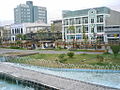 Downtown Iquique
 -
 Municipal Theater of Iquique
 -
 Iquique Municipal Theatre at night
 -
 Plaza Prat
 -
 Mall Zofri at Night
 -
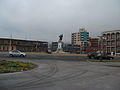 21-May Square
 -
 Trans-Atacama Tour Train
 -
 Arturo Prat University (Main campus from Chile)
 -
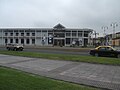 Arturo Prat University's Architecture-Faculty campus.
 -
 Santo Tomas University Iquique campus.
 -
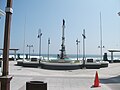 Slava Square .
 -
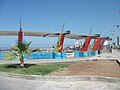 Iquique Skatepark.
 -
 Cavancha Beach's Craft Market.
 -
 Cavancha beach at the end of Cavancha peninsula
 -
 The underwater-themed mural situated in Cavancha Peninsula
 -
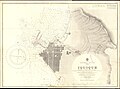 1934 nautical chart of Iquique


.jpg)


References
[edit]- ^ a b "Municipality of Iquique" (in Spanish). Archived from the original on September 13, 2008. Retrieved October 31, 2010.
- ^ a b c d e f "National Statistics Institute" (in Spanish). Retrieved September 9, 2010.
- ^ "Extracts". Sydney Gazette and New South Wales Advertiser. 1842. p. 3.
- ^ Mars 96 timeline Archived August 8, 2012, at the Wayback Machine, NASA
- ^ "React App". adalytics.cl. Retrieved September 3, 2020.[dead link]
- ^ "Migrant Offices Adhered to the Migrant Seal". geonodo.ide.subdere.gov.cl. Retrieved February 21, 2025.
- ^ Internacionales, Dirección General de Vinculación con el Medio y Relaciones. "Arturo Prat University". Arturo Prat University, a State, Regional University (in Spanish). Retrieved February 21, 2025.
- ^ a b c "Territorial division of Chile" (PDF). Archived from the original (PDF) on March 8, 2013. Retrieved October 31, 2010.
- ^ http://latercera.com/contenido/680_194898_9.shtml Archived July 13, 2011, at the Wayback Machine Iquique has almost 10% of its foreign population.
- ^ Cereceda, P.; Larrain, H.; osses, P.; Farias, M.; Egaña, I. (2008). "The climate of the coast and fog zone in the Tarapacá Region, Atacama Desert, Chile". Atmospheric Research. 87 (3–4): 301–311. Bibcode:2008AtmRe..87..301C. doi:10.1016/j.atmosres.2007.11.011. hdl:10533/139314.
- ^ "Datos Normales y Promedios Históricos Promedios de 30 años o menos" (in Spanish). Dirección Meteorológica de Chile. Archived from the original on May 21, 2023. Retrieved May 20, 2023.
- ^ "Temperaturas Medias y Extremas en 30 Años-Entre los años: 1991 al 2020-Nombre estación: Diego Aracena Iquique Ap" (in Spanish). Dirección Meteorológica de Chile. Archived from the original on May 21, 2023. Retrieved May 21, 2023.
- ^ "Temperatura Histórica de la Estación Diego Aracena Iquique Ap. (200006)" (in Spanish). Dirección Meteorológica de Chile. Archived from the original on May 21, 2023. Retrieved May 20, 2023.
- ^ "Estadistica Climatologica Tomo I" (PDF) (in Spanish). Dirección General de Aeronáutica Civil. March 2001. Archived from the original (PDF) on June 30, 2017. Retrieved January 4, 2013.
- ^ "Diego Aracena Aeropuerto Iquique Climate Normals 1991–2020". World Meteorological Organization Climatological Standard Normals (1991–2020). National Oceanic and Atmospheric Administration. Archived from the original on August 4, 2023. Retrieved August 4, 2023.
External links
[edit]
 Iquique travel guide from Wikivoyage
- Portal with useful information about Iquique.
- . . 1914.


| International | |
|---|---|
| National | |
| Geographic | |
| Other | |
