Gyroelongated pentagonal pyramid
| Gyroelongated pentagonal pyramid | |
|---|---|
 | |
| Type | Johnson J10 – J11 – J12 |
| Faces | 15 triangles 1 pentagon |
| Edges | 25 |
| Vertices | 11 |
| Vertex configuration | 5(33.5) 1+5(35) |
| Symmetry group | |
| Properties | composite, convex |
| Net | |
 | |


In geometry, the gyroelongated pentagonal pyramid is a polyhedron constructed by attaching a pentagonal antiprism to the base of a pentagonal pyramid. An alternative name is diminished icosahedron because it can be constructed by removing a pentagonal pyramid from a regular icosahedron.
Construction
[edit]The gyroelongated pentagonal pyramid can be constructed from a pentagonal antiprism by attaching a pentagonal pyramid onto its pentagonal face.[1] This pyramid covers the pentagonal faces, so the resulting polyhedron has 15 equilateral triangles and 1 regular pentagon as its faces.[2] Another way to construct it is started from the regular icosahedron by cutting off one of two pentagonal pyramids, a process known as diminishment; for this reason, it is also called the diminished icosahedron.[3] Because the resulting polyhedron has the property of convexity and its faces are regular polygons, the gyroelongated pentagonal pyramid is a Johnson solid, enumerated as the 11th Johnson solid .[4] It is an example of composite polyhedron.[5]

Properties
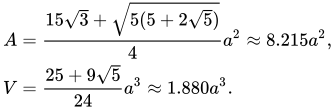
[edit]The surface area of a gyroelongated pentagonal pyramid can be obtained by summing the area of 15 equilateral triangles and 1 regular pentagon. Its volume can be ascertained either by slicing it off into both a pentagonal antiprism and a pentagonal pyramid, after which adding them up; or by subtracting the volume of a regular icosahedron to a pentagonal pyramid. With edge length , they are:[2]


It has the same three-dimensional symmetry group as the pentagonal pyramid: the cyclic group of order 10.[6] Its dihedral angle can be obtained by involving the angle of a pentagonal antiprism and pentagonal pyramid: its dihedral angle between triangle-to-pentagon is the pentagonal antiprism's angle between that 100.8°, and its dihedral angle between triangle-to-triangle is the pentagonal pyramid's angle 138.2°.[7]
According to Steinitz's theorem, the skeleton of any convex polyhedron can be represented as a planar graph that is 3-vertex connected. A planar graph is one that can be drawn on a flat sheet with no edges crossing. A -connected graph is one that remains connected whenever vertices are removed. This graph is obtained by removing one of the icosahedral graph's vertices, leaving 11 vertices, an odd number, resulting in a graph with a perfect matching. Hence, the graph is a 2-vertex connected claw-free graph, an example of factor-critical.


Appearance
[edit]The gyroelongated pentagonal pyramid has appeared in stereochemistry, wherein the shape resembles the molecular geometry known as capped pentagonal antiprism.[8][6]
See also
[edit]References
[edit]- ^ Rajwade, A. R. (2001), Convex Polyhedra with Regularity Conditions and Hilbert's Third Problem, Texts and Readings in Mathematics, Hindustan Book Agency, pp. 84–89, doi:10.1007/978-93-86279-06-4, ISBN 978-93-86279-06-4.
- ^ a b Berman, Martin (1971), "Regular-faced convex polyhedra", Journal of the Franklin Institute, 291 (5): 329–352, doi:10.1016/0016-0032(71)90071-8, MR 0290245.
- ^ Hartshorne, Robin (2000), Geometry: Euclid and Beyond, Undergraduate Texts in Mathematics, Springer-Verlag, p. 457, ISBN 9780387986500.
- ^ Uehara, Ryuhei (2020), Introduction to Computational Origami: The World of New Computational Geometry, Springer, p. 62, doi:10.1007/978-981-15-4470-5, ISBN 978-981-15-4470-5, S2CID 220150682.
- ^ Timofeenko, A. V. (2009), "Convex Polyhedra with Parquet Faces" (PDF), Doklady Mathematics, 80 (2): 720–723, doi:10.1134/S1064562409050238.
- ^ a b Cheng, Peng (2023), Lanthanides: Fundamentals and Applications, Elsevier, p. 166, ISBN 978-0-12-822250-8.
- ^ Johnson, Norman W. (1966), "Convex polyhedra with regular faces", Canadian Journal of Mathematics, 18: 169–200, doi:10.4153/cjm-1966-021-8, MR 0185507, Zbl 0132.14603; see table III, line 11.
- ^ Kepert, David L. (1982), "Polyhedra", Inorganic Chemistry Concepts, vol. 6, Springer, p. 14, doi:10.1007/978-3-642-68046-5_2, ISBN 978-3-642-68048-9.