Giannitsa
Giannitsa
Γιαννιτσά | |
|---|---|
 The Church of the Dormition of the Theotokos in Giannitsa | |
 Location within the regional unit | |
  Giannitsa | |
| Coordinates: 40°47′N 22°24′E / 40.783°N 22.400°E | |
| Country | Greece |
| Administrative region | Central Macedonia |
| Regional unit | Pella |
| Municipality | Pella |
| Area | |
| • Municipal unit | 208.1 km2 (80.3 sq mi) |
| Elevation | 42 m (138 ft) |
| Population (2021)[1] | |
| • Municipal unit | 32,410 |
| • Municipal unit density | 155.7/km2 (403.4/sq mi) |
| • Community | 30,498 |
| Time zone | UTC+2 (EET) |
| • Summer (DST) | UTC+3 (EEST) |
| Postal code | 581 00 |
| Area code | 23820-2 |
| Vehicle registration | EE |
| Website | www.giannitsa.gr/ |
Giannitsa (Greek: Γιαννιτσά [ʝaniˈt͡sa], in English also Yannitsa, Yenitsa) is the largest city in the regional unit of Pella and the capital of the Pella municipality, in the region of Central Macedonia in northern Greece.[2]
The municipal unit Giannitsa has an area of 208.105 km2.[3] Its population is 32,410 people (2021 census). It includes a few outlying villages (Mesiano, Melissi, Pentaplatanos, Archontiko, Ampelies and Damiano). The municipality Pella as a whole includes many villages and has 57,039 inhabitants. The city is located in the center of Macedonia between Mount Paiko and the plain of Giannitsa, and is the economic, commercial and industrial center of the Pella regional unit. European route E86 (Greek National Road 2) runs along the south of the city.
The former shallow, swampy, and variable-sized Giannitsa Lake or (ancient) Loudias Lake, fed by the Loudias River and south of the city, was drained in 1928-1932 by the New York Foundation Company.[4] It or the surrounding marshland were sometimes called Borboros 'slime' or Borboros Limen.[5]
About 7 km (4 mi) from Giannitsa are the ruins of ancient Pella, birthplace of Alexander the Great and capital of ancient Macedonia. The city is 48 km (30 mi) from Thessaloniki.[6]
Name
[edit]The city was founded as Yenice-i Vardar Ottoman Turkish يڭيجۀ واردار 'new (town) of Vardar' c. 1383–1387.[7] It was sometimes called Evrenos Beg yöresi 'Evrenos Bey's town'.[8]
The Turkish name, in the form Yenitsa (Γενιτσά), was used until February 1926 when its name was Hellenized as Giannitsa (Γιαννιτσά).[9] In other languages, the city is called: Ottoman Turkish Yenice-i Vardar ('new-town of Vardar', as opposed to Yenice-i Karasu, modern Genisea, near Xanthi and known for tobacco), Turkish Yenice or Vardar Yenicesi, Bulgarian: Енидже Вардар, Enidzhe Vardar or Пазар Pazar, Macedonian: Ениџе Вардар, Enidzhe Vardar.
Population
[edit]| Year | Population |
|---|---|
| 2021 | 30,498 |
| 2011 | 29,789 |
| 2001 | 29,364 |
| 1991 | 22,504 |
| 1981 | 23,966 |
| 1971 | 21,188 |
| 1961 | 19,693 |
| 1951 | 16,640 |
| 1940 | 12,964 |
| 1928 | 9,128 |
| 1913 | 7,167[10] |
History
[edit]Prehistoric
[edit]In the area of "Old Market", on the southern hill of the city, there was an Early Neolithic settlement (late 7th to early 6th millennium BC). Giannitsa was also inhabited through the Bronze and Iron Ages. Incidental findings, such as coins, inscriptions, and sculptures indicate that the area was inhabited during the Hellenistic period (323-30BC). In ancient times, the area was called Bottiaea.[11] In the vicinity of the city ancient towns of Pella and Kyrros and medieval metropolitan centre of Giannitsa were presented.[12]
Early Ottoman
[edit]Though there was probably a pre-existing Byzantine castle in the vicinity, the importance of the city of Giannitsa begins with its foundation by Gazi Evrenos c. 1383–1387. Giannitsa became the base of the ghazi followers of Evrenos who took Macedonia and later Albania. The city (known as Vardar Yenicesi or Yenice-i Vardar under the Ottomans) was an important Ottoman cultural center and sacred area in the 15th and 16th centuries. Starting in the mid-15th century, Giannitsa became a center of literature and the arts. Under Ahmet Bey, a descendant of Gazi Evrenos, many mosques, schools, workhouses and charitable projects were founded.[13] In 1519 (Hijri 925), its population consisted of 793 Muslim, 25 Christian and 24 Jewish households and it was a zeamet of Mevlana Ahmet Çelebi.[14]
Although Persian was widely studied in the Ottoman-held Balkans (Rumelia), Vardar Yenicesi differed from other localities in the Balkans insofar as that it was a town where Persian was also widely spoken.[15] However, the Persian of Vardar Yenicesi and of the rest of the Ottoman-held Balkans was different from formal Persian both in accent and vocabulary.[15] The difference was apparent to such a degree that the Ottomans referred to it as "Rumelian Persian" (Rumili Farsisi).[15] As learned people such as students, scholars and literati often frequented Vardar Yenicesi, it soon became the site of a flourishing Persianate linguistic and literary culture.[15] The 16th-century Ottoman Aşık Çelebi (died 1572), who hailed from Prizren in modern-day Kosovo, was galvanized by the abundant Persian-speaking and Persian-writing communities of Vardar Yenicesi, and he referred to the city as a "hotbed of Persian".[15]

Late Ottoman
[edit]
According to the Ottoman general census of 1881/1882–1893, the district of Giannitsa (Yenice) had a total population of 42,209, consisting of 22,573 Muslims, 18,155 Greeks, 1,368 Bulgarians, and 573 Jews.[16]

In the early 20th century, Giannitsa became a battleground in the Macedonian Struggle. This multi-sided guerilla war was the result of dissatisfaction with Ottoman rule as well as the schismatic conflict within the Orthodox Christian community, seeing the Bulgarian Exarchate against the Greek Patriarch of Constantinople. Giannitsa quickly became an epicentre of violence due to its diverse ethnic character and strategic importance, with strong Greek and Bulgarian committees, and significant Ottoman Army and government presence. The Greeks of Giannitsa became heavily targeted by the Bulgarian komitadjis who would operate from within the swamp before the Greek Makedonomachoi could take control. These years were also marred with the high-profile murders of the Giannitsa Greek Defense Committee leadership. These murders included chairman Antonios Kasapis (1904; his daughter also murdered in 1903), treasurer Christos Didaskalou (1907), and secretary Dimitrios Oikonomou (1909).[17] There were also many murders of lower level Greek Committee members, including Dionysios Samoladas (1904), Christos Hatzidimitriou (17 July 1905; in the market square), Aristeidis Douvantzis and Dionysios Tsakmakis (1905), Ioannis Karabatakis and his neice (1906), Stavros Mitzouris (1906), Athanasios Oikonomou (1906), and Athanasios Organtzis (1906).[18][19]
-
 Christos Didaskalou
 -
 Christos Hatzidimitriou
 -
 Athanasios Oikonomou
.png)


Cousins Gonos Yiotas and Apostol Petkov were among the most well known guerilla leaders of the Giannitsa area, each fighting for an opposing faction. Yiotas was a Greek Patriarchist who once fought the Turks alongside Petkov as a komitadji under the Internal Macedonian Revolutionary Organization during the Ilinden Uprising, though he broke ranks soon after due to IMRO's violence against Greek civilians. He joined the Greek efforts as soon as they began to organize and was instrumental in protecting the Greek population and maintaining the influence of the Greek Patriarchate. Yiotas was such an effective guerilla fighter in the swamp around Giannitsa that he earned the nickname 'Ghost of the Lake'. Apostol Petkov remained in the service of IMRO and continued his violent means of spreading the influence of the Bulgarian Exarchate, erecting a gallows in Giannitsa to spread fear among the Greek population. Both Gonos Yiotas and Apostol Petkov would meet their deaths due to betrayal in 1911, and both would be laid to rest in Giannitsa.


The Young Turk Revolution of 1908 brought about new hopes in Giannitsa and the surrounding region with new promises of equality and freedoms. The Young Turks amnestied all combatants of the Macedonian Struggle if they were to cease activity and turn in their arms. Many obeyed, but violence soon returned after the Young Turks' promises fell flat, though this time not as intense as before.
Penelope Delta's novel Secrets of the Swamp (referring to the shores of Giannitsa Lake) is a romanticised account of this from the Greek point of view.[20]
Balkan Wars
[edit]By late 1912, when the First Balkan War broke out, Giannitsa was still very much an Ottoman town, both in administration and in character. The town had continuously been ruled by the descendants of Gazi Evrenos, with Emin Bey being the final Ottoman ruler, living with his family in a neoclassical home in the town centre.[21] 74 men of the Giannitsa's Bulgarian community enlisted in the Macedonian-Adrianopolitan Volunteer Corps of the Bulgarian Army on the onset of war.[22] One of the war's most important battle was the Battle of Giannitsa. From 19–20 October 1912, the Hellenic Army clashed with the Ottoman forces in defensive positions around Giannitsa, and ultimately liberated the town. The Turkish quarter was severely damaged by the shelling of Greek artillery, resulting in many becoming homeless. This battle not only led to the liberation of a regional hub in the form of Giannitsa, but more importantly, it opened the way for the liberation of Thessaloniki.
-
 Greek lithograph depicting the Battle of Giannitsa
 -
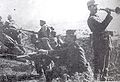 Greek infantry during the Battle of Giannitsa, 1912
 -
 Greek infantry at the banks of the Lake of Giannitsa, 1912
 -
 Muslims leaving Giannitsa post-battle, 1912


German occupation
[edit]
The German army invaded Giannitsa on 11 April 1941. On 20 April 1941, some Austrian forces arrived. The municipal registry of Giannitsa confirms four random killings in various parts of the city. On 16 September 1943, the Municipality of Giannitsa, headed by the Mayor Thomas Magriotis, and the help of local soccer teams, organized a demonstration in the city against the intention of the Germans to surrender Central Macedonia to the Bulgarians. According to oral testimony, on 13 November 1943, the Germans arrested around 50 people, whom they transferred to the camp of "Pavlos Melas" at Thessaloniki, and they killed thirteen. At the same time, the Germans invaded for the first time the village Eleftherohori 7 km (4 mi) away from the city. In this attack, there were no casualties. On 23 March 1944, the village was burned, and the place deserted. Eleftherohori lost 19 lives.

On 5 August 1944, the Austrian soldier Otmar Dorne left the German occupation army and joined the 30th Constitution of the ELAS, based in Mount Paiko. The defection of Dorne, and the presence of the Wehrmacht sergeant Schubert, led to mass reprisals on 14 September 1944 in Giannitsa: about 120 residents were executed by forces of the Jagdkommando Schubert with the collaboration of Greek units under the command of Georgios Poulos. Among those executed was the Mayor, Thomas Mangriotis. The Swedish ambassador, Timberg, indicated that one third of the city was destroyed by fire. The citizens left the city. Emile Wenger visited Giannitsa a few days after the mass execution, as a representative of the International Red Cross, and wrote "Giannitsa is already a dead city". On 20 September 1944, a citizens' committee sent a message to the National Government stating the facts and asking for weapons. The Germans left Giannitsa on 3 November 1944.[23]
During this period, the Bulgarian minority collaborated with the German occupiers and was permitted to form an irredentist 'action committee' and later Central Bulgarian-Macedonian Committee, headed by the local citizen Georgi Kayafov.[24][25][26]
Landmarks
[edit]Historical monuments
[edit]Given the importance of Giannitsa in the Ottoman era, many structures of the period still stand and have been declared historical monuments by the Greek Archaeological Service.[21] These monuments include:
- Baths of Evrenos, c. 1385–1395
- Mausoleum of Gazi Evrenos, 1417
- Mausoleum of Ahmet Bey, c. 15th century
- Yakup Bey Mosque, now St. Paraskevi Church, c. 15th century
- Ahmet Bey Mosque, c. 15th century
- Iskender Bey Mosque, c. 1481–1512
- Ottoman Market Building, c. 16th to 17th century
- Ottoman Clock Tower, 1668
- House of Emin Bey, c. 1900–1910
-
 Baths of Evrenos
 -
 Mausoleum of Gazi Evrenos
 -
 Mausoleum of Ahmet Bey
 -
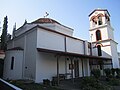 Yakup Bey Mosque, now St. Paraskevi Church
 -
 Ahmet Bey Mosque
 -
 Side view of Iskender Bey Mosque
 -
 Ottoman Market Building
 -
 Ottoman clock tower
 -
 House of Emin Bey at EPON Square


There are also several non-Ottoman points of interest both, in the town and just outside, including:
- Ancient Pella, c. 400 B.C.
- Ancient Macedonian Tombs, c. 400–300 B.C.
- St. Athanasios Church, c. 1700
- The Church of the Dormition of the Theotokos, c. 1858–1860
- Catholic Church of Sts. Peter and Paul, 1861
- Neoclassical Multicentre
- Filippeio Park and Tourist Centre
-
 Church of the Dormition of the Theotokos
 -
 Catholic church of Sts. Peter and Paul


Museums
[edit]- The Folklore Museum of Giannitsa (opened in October 1977) by the "Philippos" History and Folklore Association to promote local history and traditions.
- The Military Museum of Giannitsa (opened 24 February 2012), displays photographs, texts, weapons, uniforms, medals and other materials, with a particular emphasis on the Macedonian Struggle and the Balkan Wars.
-
 Folklore Museum of Giannitsa
 -
 Traditional costumes exhibit
 -
 Macedonian Struggle exhibit


Statues
[edit]- Alexander the Great, near the Cultural Centre, unveiled on 20 October 2009, the anniversary of the liberation of the city and the Day of the Macedonian Struggle.[27]
- Philip II of Macedon, located in the "Filippio" park and tourist centre. Near the statue, there is a relief depicting the Macedonian phalanx.
- Busts of the Makedonomachoi Gonos Yiotas, Konstantinos Boukouvalas, and Ioannis Demestichas in Gonou Yiota Square
- A bust of Constantine I of Greece in St. George Park
- A bust of Eleftherios Venizelos in EPON Square
-
 Statue of Alexander the Great
 -
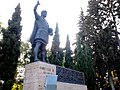 Statue of Philip of Macedon
 -
 Bust of Konstantinos Boukouvalas
 -
 Bust of Constantine I


Memorials
[edit]- Black Statue – The Memorial of Giannitsà, by sculptor Gregory Zevgolis, erected at the eastern entrance to the town in 1926 in honor and remembrance of the Battle of Giannitsa
- Mass Grave, a list of the residents who were executed at the 1st Primary School on 14 September 1944 by German troops
- Memorial of EOKA fighters Michalis Karaolis and Andreas Dimitriou, executed by the British during the Cyprus Emergency
- Memorial to the Greek resistance of World War II in EPON Square
- A bust in memory of Cpl. Georgios T. Rousis, killed in the Turkish invasion of Cyprus
-
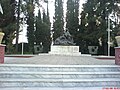 The Black Statue
 -
 Mass grave memorial
 -
 Greek Resistance memorial


Aravissos
[edit]
About 10 km (6 mi) northwest of the city is the spring of Aravissos, which produces drinking water. The surrounding grove and creek include a popular park.
Economy
[edit]Giannitsa is predominantly a rural area. The draining of the Lake Giannitsà left fertile soil for agriculture, leading to population growth in the region.[citation needed]
Entertainment
[edit] |
The focus of the social life of the city is at the central pedestrian street, where people gather to eat and drink, or to take a walk. Giannitsa was one of the first cities that had an open theatre (3000 seats). Also various theatrical and musical events take place in a closed theater located inside the Cultural Centre. In the first days of September there is a big market for about a week. The DI.K.E.P.A.P. (ΔΗ.Κ.Ε.Π.Α.Π) is a charitable non-profit cultural organization founded in 1996 that develops music, visual arts, dance, film and other arts. Seven kilometers (4.3 miles) south of the center is the Loudias River, which has a sailing centre, where the Nautical Club of Giannitsa (NOG) teaches canoeing, kayaking, and rowing.[28] There are also several sports facilities, including soccer fields, basketball courts, tennis courts, and a track.
Districts
[edit]
- Centre
- St. George
- Ayía Paraskeví
- Sfageia
- Sinoikismos
- Mitropoli
- St. Konstantinos
- Tsali (Nea Trapezounta)
- Filippeio
- Kapsali
- Palaia agora
Local media
[edit]Newspapers
[edit]TV station
[edit]Online newspapers
[edit]- Pella24
- Pellanet
- Giannitsa City news
- Logos Pellas
Sports
[edit]The most popular team is the Anagennisi Giannitsa football team which plays at the Municipal Stadium.
There is a motocross track northwest of the city, in the foothills of Mount Paiko, where local, Greek, and European races are run.
At the river Loudias, there are rowing races in which the Nautical Club participates.
Twin towns and sister cities
[edit]Giannitsa is twinned with three cities:
 Larnaca, Cyprus, since 2003[29]
 Crotone, Italy, since 2010[30]
 New Britain, Connecticut, United States, since 2010[31]


Notable people
[edit]- Gazi Evrenos (died 1417), founder of the Ottoman city, whose mausoleum is in the center of town
- Yakup Ağa, Ottoman soldier and Sipahi, took part in the capture of Lesbos from the Genoese
- Hayreddin Barbarossa (1478-1546) his father Yakup Ağa is from Giannitsa, was appointed Kapudan Pasha (Grand admiral) of the Ottoman Navy by Suleiman the Magnificent
- K̲h̲ayālī (died 1556), Ottoman poet
- Āgehī (died 1577), Ottoman poet and historian
- Georgios 'Gonos' Giotas (1880–1911), revolutionary in the Macedonian Struggle
- Ahmet Derviş (1883–1932), military officer in the Ottoman and Turkish armies
- Sotirios Gotzamanis (1884-1958), physician and National Reform Party politician, accused of treason
- Ioannis Kourkourikis (born 1971), Greek Olympic rower
- Theofilos Karasavvidis (born 1971), former soccer player
- Melina Aslanidou (born 1974), singer born in Germany, but raised in Giannitsa
- Elisavet Mystakidou (born 1977), Greek Olympic silver medalist in taekwondo
- Monsieur Minimal (born 1980), indie pop music composer
- Effie Achtsioglou (born 1985), SYRIZA politician
- Dimitrios Karadolamis (born 1987), basketball player for OFI Crete
- Andreas Varsakopoulos (born 1990), Television personality, personal trainer, Lecturer currently living in South Korea
- Dimitris Pelkas (born 1993), soccer player playing as an attacking midfielder for İstanbul Başakşehir
- Alexandros Varitimiadis (1994-2023), basketball player for Raiffeisen Dornbirn Lions
- Ioanna Chamalidou (born 1996), soccer player playing as a forward for Panathinaikos
- Giannis Michailidis (born 2000), soccer player playing as a centre-back for PAOK
References
[edit]- ^ "Αποτελέσματα Απογραφής Πληθυσμού - Κατοικιών 2021, Μόνιμος Πληθυσμός κατά οικισμό" [Results of the 2021 Population - Housing Census, Permanent population by settlement] (in Greek). Hellenic Statistical Authority. 29 March 2024.
- ^ "ΦΕΚ A 87/2010, Kallikratis reform law text" (in Greek). Government Gazette.
- ^ "Population & housing census 2001 (incl. area and average elevation)" (PDF) (in Greek). National Statistical Service of Greece. Archived from the original (PDF) on 2015-09-21.
- ^ Eugene N. Borza, In the shadow of Olympus: the emergence of Macedon (1992) ISBN 0-691-00880-9, p. 289; Matthieu Ghilardi et al., "Human occupation and geomorphological evolution of the Thessaloniki Plain (Greece) since mid Holocene", Journal of Archaeological Science 35:1:111-125 (January 2008)
- ^ Ghilardi; Théophile Alphonse Desdevises-du-Dezert, Géographie ancienne de la Macédoine (A. Durand, 1863)
- ^ "Macedonia - Perfecture [sic] of Pella". Archived from the original on 4 March 2016. Retrieved 13 January 2016.
- ^ M. Kiel, "Yenice-i Vardar. A forgotten Turkish cultural center in Macedonia of the 15th and 16th century", Studia Byzantina et Neohellenica Neerlandica 3 (1971): 311–316.
- ^ Encyclopedia of Islam, 2nd edition, s.v. Ewrenos
- ^ Institute for Neohellenic Research, "Name Changes of Settlements in Greece" Genitsa/Giannitsa
- ^ Anastassios Hadjicrystallis - Consultant and developer of Internet and cell phone technology services. "Εργαστήριο Δημογραφικών και Κοινωνικών Αναλύσεων Πανεπιστημίου Θεσσαλίας - Εργο e-Demography - Εκδόσεις ΕΛΣΤΑΤ - Απογραφές - 1928". Retrieved 13 January 2016.
- ^ "Ο ΝΕΟΛΙΘΙΚΟΣ ΟΙΚΙΣΜΟΣ ΤΩΝ ΓΙΑΝΝΙΤΣΩΝ". Retrieved 13 January 2016.
- ^ Христосков, Радослав (2019). "Крепостите на Енидже Вардар в пътеписа на Евлия Челеби – "просто легенда" или наследство от Античността и Средновековието". „Македонски преглед“. XLІI (1). София: МНИ: 41–42, 44, 47–48.
- ^ "Ιστορία Γιαννιτσών". PellaNet Online. Retrieved 13 January 2016.
- ^ Gökbilgin, M. Tayyib (1956). "Kanuni Sultan Süleyman Devri Başlarında Rumeli Eyaleti, Livaları, Şehir ve Kasabaları". Belleten. 20 (78): 264. eISSN 2791-6472. ISSN 0041-4255.
- ^ a b c d e Inan, Murat Umut (2019). "Imperial Ambitions, Mystical Aspirations: Persian learning in the Ottoman World". In Green, Nile (ed.). The Persianate World The Frontiers of a Eurasian Lingua Franca. University of California Press. p. 86.
- ^ Karpat, Kemal Haşim (1985). Ottoman Population, 1830–1914, Demographic and Social Characteristics. University of Wisconsin Press. p. 134.
- ^ Mavrokefalidou, Eleni (2007). Giannitsa: Historical Photographic Album (in Greek and English). Giannitsa, Pella, Greece: Municipality of Giannitsa (published October 2007). p. 11.
- ^ "Ο Μακεδονικός Αγώνας και η λίμνη των Γιαννιτσών". Ypodomi. Archived from the original on 25 Feb 2025. Retrieved 2 Nov 2025.
- ^ Παπανικολάου, Κωνσταντίνος; Μιχαηλίδης, Ιάκωβος (2008). Αφανείς γηγενείς μακεδονομάχοι (1903–1913) [Invisible Native [Greek] Macedonian Fighters] (in Greek). Thessaloniki: University Studio Press. ISBN 978-960-12-1724-6. Retrieved 2 Nov 2025.
- ^ Roudometof, Victor (2002). Collective Memory, National Identity, and Ethnic Conflict: Greece, Bulgaria, and the Macedonian Question. Greenwood Publishing Group. p. 82. ISBN 978-0-275-97648-4.
- ^ a b Vasilis Demetriades, "The Tomb of Ghāzī Evrenos Bey at Yenitsa and Its Inscription", Bulletin of the School of Oriental and African Studies (University of London) 39 (1976), 2: 328–332; Eleni Kanetaki, "The Still Existing Ottoman Hamams in the Greek Territory", Middle East Technical University Journal of the Faculty of Architecture 21 (2005), 1–2: 81–110, citing M. Kiel, "Yenice-i Vardar. A forgotten Turkish cultural center in Macedonia of the 15th and 16th century", Studia Byzantina et Neohellenica Neerlandica 3 (1971): 300–329.
- ^ Pindikova, Galina; Bulgaria; T︠S︡entralen voenen arkhiv, eds. (2006). Makedono-odrinskoto opŭlchenie, 1912-1913: lichen sŭstav po dokumenti na Direkt︠s︡ii︠a︡ "T︠S︡entralen voenen arkhiv". Arkhivni spravochnit︠s︡i (1. izd ed.). Sofii︠a︡: Glavno upravlenie na arkhivite pri Ministerskii︠a︡ sŭvet. ISBN 978-954-9800-52-4.
- ^ "Τα Γιαννιτσά στα χρόνια της κατοχής / Eλευθεροχώρι, 23 Μαρτίου 1944". Retrieved 13 January 2016.
- ^ Мичев, Добрин. Българските акционни комитети в Македония – 1941 г., МНИ, София, 1995, с.44
- ^ Даскалов, Георги. Участта на българите в Егейска Македония, 1936–1946, Политическа и военна история, София, 1999, с.279
- ^ Мичев, Добрин. Българското национално дело в Югозападна Македония (1941–1944 г.)
- ^ ioakim-makedonas (macedonian) (20 October 2009). "Macedonian News M-N Μακεδονικά Νέα". Retrieved 13 January 2016.
- ^ "History – Nautical Club of Giannitsa". Archived from the original on 2014-03-24. Retrieved 2014-03-24.
- ^ "Αδελφοποιήσεις". Archived from the original on 2018-08-14. Retrieved 2019-01-19.
- ^ Grecia e Magna Grecia: incontro Giannitsa e Crotone Archived 2013-11-12 at the Wayback Machine(in Italian)
- ^ "- - - CTNow.com". Archived from the original on 24 December 2013. Retrieved 13 January 2016.
External links
[edit]
- Δήμος Πέλλας, official site of the municipality of Pella
- Google Earth view of Giannitsa and the drained lakebed

Administrative division of the Central Macedonia Region | ||
|---|---|---|
| ||
| Regional unit of Chalkidiki |  | |
| Regional unit of Imathia | ||
| Regional unit of Kilkis | ||
| Regional unit of Pella | ||
| Regional unit of Pieria | ||
| Regional unit of Serres | ||
| Regional unit of Thessaloniki | ||
| ||
