Felix Fechenbach
Felix Fechenbach | |
|---|---|
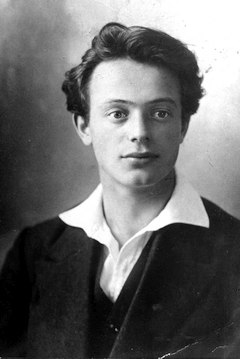 | |
| Born | 28 January 1894 |
| Died | 7 August 1933 (aged 39) Kleinenberg forest |
| Cause of death | shot extrajudicially |
| Occupation | Journalist |
Felix Fechenbach (28 January 1894 – 7 August 1933) was a German journalist, author, and political activist. He served as state secretary in the government of Kurt Eisner, who overthrew the Bavarian Wittelsbach Monarchy. After its overthrow, he worked as a newspaper editor during the Weimar Republic. After the Nazi seizure of power, he was arrested and later shot extrajudicially while being transported to Dachau concentration camp.
Early life
[edit]He was born in Mergentheim, the son of a lower-middle-class Jewish family.[1] Fechenbach was the son of Noe and Rosalie Fechenbach. He grew up in poverty. He had five brothers: Max, Siegbert, Mortiz, Abraham, and Jackob Fechenbach. Fechenbach's first job was delivering bread with his older brother Abraham in the town of Würzburg. His first best friend was Stoffele, the girl next door; after she died at age 7, he would burst into tears anytime her name was mentioned.[2] He started his very first apprenticeship at age 13 at a shoe store.[3][2]
He took vocational education in Würzburg until 1910. Later, he worked in a shoe store. In 1911 he secured work in Frankfurt but was later fired for union activity and because of a strike he led.[1]
Political career
[edit]_mit_Eisner_beri_einer_Demonstration_am_16._Februar_1919.jpg)
From 1912 until 1914, he was a party secretary of the Social Democratic Party of Germany (SPD) in Munich. During World War I, Fechenbach was wounded, causing him to become a pacifist. He later served as private secretary for Kurt Eisner, the prime minister of Bavaria, shortly after the war.[1][4]
Fechenbach married Martha Fechenbach on 27 April 1894 and Irma Epstein on 16 October 1895. He had a total of three children. After he was killed by a Sturmabteilung commando on his way to the Dachau concentration camp, his wife, Irma Epstein, was able to escape with their children.[3][2]
He was jailed in 1922 for publishing secret diplomatic telegrams while state secretary under Eisner, before the Bavarian Soviet Republic. He was charged with high treason on 22 October 1922.[5] The decision was a scandal because the court at that time had no standing under the Weimar Constitution. He was pardoned in 1924.[1] He thereafter travelled to Berlin and worked for Kinderfreunde (Friends of Children) and criticised the SPD in his children's stories while still a member of the party.[1]
.jpg)
In 1929, he became the editor in chief of the SPD newspaper Volksblatt in Detmold.[1] On 11 March 1933, he was jailed by the new Nazi government for his anti-fascist activities. On 7 August 1933, members of the Schutzstaffel (SS) and SA who were transporting Fechenbach to Dachau concentration camp stopped and ordered him out of the vehicle in a forest between Detmold and Warburg. He was beaten and then shot by the Nazi officers present.[6]
There are two schools named after Fechenbach: the Felix-Fechenbach Gesamtschule in Leopoldshoehe and the Felix-Fechenbach Berufskolleg in Detmold.[7] A street in Detmold and in Oerlinghausen was also named after him.
Works
[edit]- Fechenbach, Felix, Frank Meier, ed. (2009). Felix Fechenbach Lesebuch. Köln: Nyland-Stiftung
- Fechenbach, Felix (1925). Im Haus der Freudlosen, J. H. W. Nachfolger, Berlin. Revised edition edited by Roland Flade, Koenigshausen & Neumann, Wuerzburg
- Fechenbach, Felix (1929). Der Revolutionär Kurt Eisner. Aus persönlichen Erlebnissen, J.H.W. Diez, Berlin
- Fechenbach, Felix (1936). Mein Herz schlaegt weiter: Briefe aus der Schutzhaft, Kulturverlag, St.Gallen. Revised edition with a foreword by Heinrich Mann, a contribution by Robert M.W. Kempner and a postscript by Peter Steinbach, Andreas-Haller-Verlag, Passau 1987.
- Fechenbach, Felix (1937). Der Puppenspieler, Verlag E. & K. Scheuch, Zuerich. Revised edition edited by Roland Flade and Barbara Rott, Koenigshausen & Neuman, Wuerzburg 1988.
References
[edit]- ^ a b c d e f Zipes, Jack David (1997). Fairy Tales and Fables from Weimar Days. University of Wisconsin Press. p. 195. ISBN 0-299-15744-X.
- ^ a b c Mooney, Patrick; Burne, Geoffrey. "The Beginnings of the Fechenbach Family". Hermann Fechenbach. Wood Engravings, Lino Cuts and Print. Retrieved 24 November 2019.
- ^ a b Tuchel, Johannes. "Felix Fechenbach". German Resistance Memorial Center. Retrieved 24 November 2019.
- ^ Flade, Roland (2023). Fechenbach, Felix" in: NDB-online.
- ^ Eyck, Erich (1970). A history of the Weimar Republic. New York : Atheneum. p. 219.
{{cite book}}: CS1 maint: publisher location (link) - ^ Pöppmann, Dirk (2007). "Rechtsstaat und Gerechtigkeit. Der Mord an Felix Fechenbach im Spiegel seiner juristischen Aufarbeitung vor dem Schwurgericht Paderborn". Westfälische Zeitschrift. 157: 287–309.
- ^ Felix-Fechenbach-Gesamtschule Leopoldshöhe
Further reading
[edit]- Felix Fechenbach 1894–1933: Journalist, Schriftsteller, Pazifist. Symposium zum 100. Geburtstag am 28. Und 29. Januar 1994 in Detmold,Landesverband Lippe, Institut für Lippische Landeskunde Kreis Lippe.
- Das Felix Fechenbach-Buch, Eichenverlag, Arbon 1936.
- Hermann Schueler, Auf der Flucht erschossen: Felix Fechenbach 1894–1933, Kiepenheuer & Witsch, 1981.
- Peter Steinbach, Das Schicksal bestimmt, dass ich hierbleibe, Wissenschaftlicher Autoren Verlag, Berlin 1983.
- Herrmann Fechenbach, Die letzten Mergentheimer Juden: und die Geschichte der Familie Fechenbach mit Holzschnittillustrationen von Herrmann Fechenbach, Kohlhammer Verlag, Stuttgart 1972.
- Douglas Morris, Justice Imperiled: The Anti-Nazi Lawyer Max Hirschberg, The University of Michigan Press, Ann Arbor 2005.
- Wolfgang Mueller, Juden in Detmold, Gesammelte Beitraege zur juedischen Geschichte in Detmold, Lippe Verlag, Lage 2008.
- Andreas Ruppert, Felix Fechenbach, translated by Katrin von Keitz, lecture given in Detmold, 6 August 2003.
- Irma Fechenbach-Fey: Juedin, Sozialistin, Emigrantin 1895–1973. Landesverband Lippe, Institut fuer Lippische Landeskundde, Lemgo 2003.
- Auf der Flucht erschossen – Felix Fechenbach, Videotape of Bayerischer Rundfunk Production der Media 3, Muenchen 1989. Videotape.
- Felix Fechenabach-Preisverleihung Fernsehbericht 8/6/2003, Bayerischer Rundfunk, Muenchen 2003. Videotape.
External links
[edit]- Felix Fechenbach at Library of Congress, with 5 library catalogue records
- Felix Fechenbach at the Internet Speculative Fiction Database
| International | |
|---|---|
| National | |
| Academics | |
| People | |
| Other | |
