The cyclotomic fast Fourier transform is a type of fast Fourier transform algorithm over finite fields.[1] This algorithm first decomposes a discrete Fourier transform into several circular convolutions. This then derives the discrete Fourier transform results from the circular convolution results. When applied to a discrete Fourier transform over  , this algorithm has a very low multiplicative complexity. In practice, since there usually exist efficient algorithms for circular convolutions with specific lengths, this algorithm is very efficient.[2]
The discrete Fourier transform over finite fields finds widespread application in the decoding of error-correcting codes such as BCH codes and Reed–Solomon codes. Generalized from the complex field, a discrete Fourier transform of a sequence  over a finite field
  is defined as
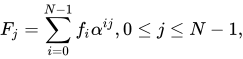 where
where  is the N-th primitive root of 1 in . If the polynomial representation of can defined as
 it is easy to see that
  is simply
  . That is, the discrete Fourier transform of a sequence converts it to a polynomial evaluation problem.
Written in matrix format,
![{\displaystyle \mathbf {F} =\left[{\begin{matrix}F_{0}\\F_{1}\\\vdots \\F_{N-1}\end{matrix}}\right]=\left[{\begin{matrix}\alpha ^{0}&\alpha ^{0}&\cdots &\alpha ^{0}\\\alpha ^{0}&\alpha ^{1}&\cdots &\alpha ^{N-1}\\\vdots &\vdots &\ddots &\vdots \\\alpha ^{0}&\alpha ^{N-1}&\cdots &\alpha ^{(N-1)(N-1)}\end{matrix}}\right]\left[{\begin{matrix}f_{0}\\f_{1}\\\vdots \\f_{N-1}\end{matrix}}\right]={\mathcal {F}}\mathbf {f} .}](https://wikimedia.org/api/rest_v1/media/math/render/svg/f1265f79edbfdbf2be3624afc83b9a95fdee874f)
Direct evaluation of the discrete Fourier transform has an  complexity. Fast Fourier transforms are just efficient algorithms evaluating the above matrix-vector product.
First, define a linearized polynomial over as
 Here
Here  is called linearized, because
  , which comes from the fact that for elements
  and
and  .
.
Notice that  is invertible modulo
  because must divide the order
  of the multiplicative group of the field . So, the elements
  can be partitioned into
  cyclotomic cosets modulo :
 where
where  . Therefore, the input to the Fourier transform can be rewritten as

In this way, the polynomial representation is decomposed into a sum of linear polynomials. Hence, is given by
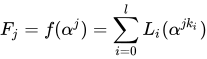 .
Expanding
.
Expanding 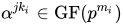 with the proper basis
  yields
 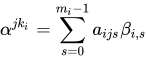 , where
 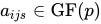 . By the property of the linearized polynomial
  , this yields

This equation can be rewritten in matrix form as  , where
  is an
is an  matrix over
  that contains the elements
  ,
,  is a block diagonal matrix, and
  is a permutation matrix regrouping the elements in
  according to the cyclotomic coset index.
Note that if the normal basis  is used to expand the field elements of
  , the i-th block of is given by:
 which is a circulant matrix. It is well known that a circulant matrix-vector product can be efficiently computed by convolutions. Hence, it is successful to reduce the discrete Fourier transform into short convolutions.
When applied to a characteristic-2 field , the matrix is just a binary matrix. Only addition is used when calculating the matrix-vector product of  and
and  . It has been shown that the multiplicative complexity of the cyclotomic algorithm is given by
 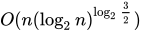 , and the additive complexity is given by
 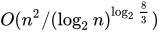 .[2]
.[2]