Cavity ring-down spectroscopy
Cavity ring-down spectroscopy (CRDS) is a highly sensitive optical spectroscopic technique that enables measurement of absolute optical extinction by samples that scatter and absorb light.[1] It has been widely used to study gaseous samples which absorb light at specific wavelengths, and in turn to determine mole fractions down to the parts per trillion level. The technique is also known as cavity ring-down laser absorption spectroscopy (CRLAS).
A typical CRDS setup consists of a laser that is used to illuminate a high-finesse optical cavity, which in its simplest form consists of two highly reflective mirrors. When the laser is in resonance with a cavity mode, intensity builds up in the cavity due to constructive interference. The laser is then turned off in order to allow the measurement of the exponentially decaying light intensity leaking from the cavity. During this decay, light is reflected back and forth thousands of times between the mirrors giving an effective path length for the extinction on the order of a few kilometers. CRDS is traditionally conducted with monochromatic laser sources resulting in restricted spectral coverage. Recent efforts have demonstrated the use of broadband laser frequency comb sources for significantly broader spectral coverage.[2]
If a light-absorbing material is now placed in the cavity, the mean lifetime decreases as fewer bounces through the medium are required before the light is fully absorbed, or absorbed to some fraction of its initial intensity. A CRDS setup measures how long it takes for the light to decay to 1/e of its initial intensity, and this "ringdown time" can be used to calculate the concentration of the absorbing substance in the gas mixture in the cavity.
Detailed description
[edit]Cavity ring-down spectroscopy is a form of laser absorption spectroscopy. In CRDS, a laser pulse is trapped in a highly reflective (typically ) detection cavity. The intensity of the trapped pulse will decrease by a fixed percentage during each round trip within the cell due to absorption, scattering by the medium within the cell, and reflectivity losses. The intensity of light within the cavity is then determined as an exponential function of time.


The principle of operation is based on the measurement of a decay rate rather than an absolute absorbance. This is one reason for the increased sensitivity over traditional absorption spectroscopy, as the technique is then immune to shot-to-shot laser fluctuations. The decay constant, , which is the time taken for the intensity of light to fall to of the initial intensity, is called the ring-down time and is dependent on the loss mechanism(s) within the cavity. For an empty cavity, the decay constant is dependent on mirror loss and various optical phenomena like scattering and refraction:


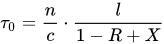
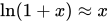
where is the index of refraction within the cavity, is the speed of light in vacuum, is the cavity length, is the mirror reflectivity, and takes into account other miscellaneous optical losses. This equation uses the approximation that for close to zero, which is the case under cavity ring-down conditions. Often, the miscellaneous losses are factored into an effective mirror loss for simplicity. An absorbing species in the cavity will increase losses according to the Beer-Lambert law. Assuming the sample fills the entire cavity,



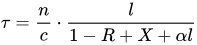
where is the absorption coefficient for a specific analyte concentration at the cavity's resonance wavelength. The decadic absorbance, , due to the analyte can be determined from both ring-down times.


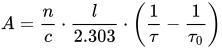
Alternatively, the molar absorptivity, , and analyte concentration, , can be determined from the ratio of both ring-down times. If can be neglected, one obtains



When a ratio of species' concentrations is the analytical objective, as for example in carbon-13 to carbon-12 measurements in carbon dioxide, the ratio of ring-down times measured for the same sample at the relevant absorption frequencies can be used directly with extreme accuracy and precision.
Advantages of CRDS
[edit]There are two main advantages to CRDS over other absorption methods:
First, it is not affected by fluctuations in the laser intensity. In most absorption measurements, the light source must be assumed to remain steady between blank (no analyte), standard (known amount of analyte), and sample (unknown amount of analyte). Any drift (change in the light source) between measurements will introduce errors. In CRDS, the ringdown time does not depend on the intensity of the laser, so fluctuations of this type are not a problem. Independency from laser intensity makes CRDS needless to any calibration and comparison with standards.[3]
Second, it is very sensitive due to its long pathlength. In absorption measurements, the smallest amount that can be detected is proportional to the length that the light travels through a sample. Since the light reflects many times between the mirrors, it ends up traveling long distances. For example, a laser pulse making 500 round trips through a 1-meter cavity will effectively have traveled through 1 kilometer of sample.
Thus, the advantages include:
- High sensitivity due to the multipass nature (i.e. long pathlength) of the detection cell.
- Immunity to shot variations in laser intensity due to the measurement of a rate constant.
- Wide range of use for a given set of mirrors; typically, ±5% of the center wavelength.
- High throughput, individual ring down events occur on the millisecond time scale.
- No need for a fluorophore, which makes it more attractive than laser-induced fluorescence (LIF) or resonance-enhanced multiphoton ionization (REMPI) for some (e.g. rapidly predissociating) systems.
- Commercial systems available.
Disadvantages of CRDS
[edit]- Spectra cannot be acquired quickly if monochromatic laser source is used. To resolve this issue, latest research has demonstrated the use of broadband frequency comb source for significantly larger spectral coverage.
- Analytes are limited both by the availability of tunable laser light at the appropriate wavelength and also the availability of high reflectance mirrors at those wavelengths.
- Expense: the requirement for laser systems and high reflectivity mirrors often makes CRDS orders of magnitude more expensive than some alternative spectroscopic techniques.
- Dynamic range is limited. As the absorber concentration increases, the ring-down time decreases, thus detectors must be fast enough to record sufficient data points for a desired uncertainty.
Applications
[edit]Greenhouse Gas Measurement
[edit]CRDS is widely used for high-precision measurement of greenhouse gases such as carbon dioxide (CO2), methane (CH4), and nitrous oxide (N2O). By measuring absorption over an optical cavity with extremely high effective path lengths, CRDS can achieve sensitivities in the parts-per-billion (ppb) to parts-per-trillion (ppt) range.
Portable and field-deployable CRDS analyzers are now used in global atmospheric monitoring networks (e.g., NOAA, ICOS) for studying carbon fluxes, ocean–atmosphere CO2 exchange, and long-term climate trends.
Because of its high sensitivity and long-term stability, CRDS has become a preferred method for calibration-free greenhouse gas monitoring and isotope ratio measurements (e.g., δ13C in CO2, δD in CH4).
Air Quality Analysis
[edit]CRDS instruments are used in environmental and industrial settings to quantify trace gases such as ammonia (NH3), nitrogen oxides (NO and NO2), sulfur dioxide (SO2), and hydrogen sulfide (H2S). These compounds are key indicators of air pollution and industrial emissions.
The high time resolution and low detection limits of CRDS make it valuable for monitoring fast-changing processes like combustion chemistry, atmospheric reactions, or livestock emissions.
For example, CRDS-based NH3 analyzers are commonly deployed near agricultural sites to quantify ammonia volatilization, while NO2 and SO2 measurements are used to track vehicular and power plant emissions.
Explosives Detection
[edit]Thermal dissociation cavity ring-down spectroscopy (TD-CRDS) has emerged as an important method for detecting trace levels of explosive vapors and residues. In this technique, thermally decomposed explosive compounds are converted into characteristic gas-phase species such as NO2, which are then quantified using CRDS.
The method offers parts-per-trillion sensitivity and molecular selectivity, making it effective for detecting nitrate-containing explosives, including nitroaromatic (e.g., TNT), nitramine (e.g., RDX, HMX), and nitrate ester (e.g., PETN) compounds.
Because CRDS is an optical method, it is also well-suited to remote or standoff detection, potentially useful in security screening and forensic applications.
See also
[edit]- Absorption spectroscopy
- Laser absorption spectrometry
- Noise-Immune Cavity-Enhanced Optical-Heterodyne Molecular Spectroscopy (NICE-OHMS)
- Tunable Diode Laser Absorption Spectroscopy (TDLAS)
References
[edit]- ^ Lehmann, Kevin K.; Berden, Giel; Engeln, Richard (2009). "An Introduction to Cavity Ring-Down Spectroscopy". In Berden, Giel; Engeln, Richard (eds.). Cavity Ring-Down Spectroscopy: Techniques and Applications. John Wiley & Sons. pp. 1–3. ISBN 978-1-4443-0824-2.
- ^ Liang, Q; Bisht, A; Scheck, A; Schunemann, P. G.; Ye, J (2025). "Modulated ringdown comb interferometry for sensing of highly complex gases". Nature. 638 (8052). doi:10.1038/s41586-024-08534-2.
- ^ Soran Shadman; Charles Rose; Azer P. Yalin (2016). "Open-path cavity ring-down spectroscopy sensor for atmospheric ammonia". Applied Physics B. 122 (7): 194. Bibcode:2016ApPhB.122..194S. doi:10.1007/s00340-016-6461-5. S2CID 123834102.
- Anthony O'Keefe; David A.G. Deacon (1988). "Cavity ring-down Optical Spectrometer for absorption measurements using pulsed laser sources". Review of Scientific Instruments. 59 (12): 2544. Bibcode:1988RScI...59.2544O. doi:10.1063/1.1139895. S2CID 6033311.
- Piotr Zalicki; Richard N. Zare (15 February 1995). "Cavity ring-down spectroscopy for quantitative absorption measurements". The Journal of Chemical Physics. 102 (7): 2708–2717. Bibcode:1995JChPh.102.2708Z. doi:10.1063/1.468647.
- Giel Berden; Rudy Peeters; Gerard Meijer (2000). "Cavity ring-down spectroscopy: Experimental schemes and applications". International Reviews in Physical Chemistry. 19 (4): 565–607. Bibcode:2000IRPC...19..565B. doi:10.1080/014423500750040627. S2CID 98510055.
- Crosson, E. R. (2008). A cavity ring-down analyzer for measuring atmospheric levels of methane, carbon dioxide, and water vapor. Applied Physics B, 92(3), 403–408.
- Chen, H., Winderlich, J., Gerbig, C., Hoefer, A., Rella, C. W., Crosson, E. R., et al. (2010). High-accuracy continuous airborne measurements of greenhouse gases (CO2 and CH4) using the cavity ring-down technique. Atmospheric Measurement Techniques, 3, 375–386.
- Gherman, T., & Romanini, D. (2002). Mode-locked cavity-enhanced absorption spectroscopy. Optics Express, 10(19), 1033–1042.
- Furlani, C., Liu, D. Y., & Worsnop, D. R. (2018). Ammonia detection by cavity ring-down spectroscopy for agricultural emissions monitoring. Atmospheric Environment, 182, 331–339.
- Thoma, E. D., et al. (2009). Development of mobile laboratory CRDS instruments for environmental and industrial monitoring. Environmental Science & Technology, 43(15), 5628–5634.
- Stromer, B., Bednar, A., Janjic, M., Becker, S., Kylloe, T., Allen, J., Trapani, M., Hargrove, J., & Hargrove, J. (2021, August). Trace explosives detection by cavity ring-down spectroscopy (CRDS) (ERDC/EL TR-21-5). U.S. Army Engineer Research and Development Center. https://doi.org/10.21079/11681/41520[1]
- Zhao, W., & O'Keefe, A. (2001). Thermal dissociation cavity ring-down spectroscopy for sensitive detection of NO2 and explosive vapors. Applied Physics B, 72(7), 843–847.
- Gmachl, C., Capasso, F., Sivco, D. L., & Cho, A. Y. (2002). Recent progress in quantum cascade lasers and applications for chemical sensing. Reports on Progress in Physics, 64(11), 1533–1601.
- Thorpe, M. J., Moll, K. D., Jones, R. J., Safdi, B., & Ye, J. (2006). Broadband cavity ringdown spectroscopy for sensitive and rapid molecular detection. Science, 311(5767), 1595–1599.
| Vibrational (IR) | |||||||
|---|---|---|---|---|---|---|---|
| UV–Vis–NIR "Optical" | |||||||
| X-ray and Gamma ray | |||||||
| Electron | |||||||
| Nucleon | |||||||
| Radiowave | |||||||
| Others |
| ||||||


- ^ Stromer, Bobbi S.; Janjic, Milo; Becker, Scott; Kylloe, Tamara; Trapani, Matt; Allen, John; Bednar, Anthony J.; Hargrove, John; Hargrove, James (August 2021). "Trace explosives detection by cavity ring-down spectroscopy (CRDS)". doi:10.21079/11681/41520.