Caucasian War
 | This article needs additional citations for verification. (March 2023) |


The Caucasian War (Russian: Кавказская война, romanized: Kavkazskaya voyna) or the Caucasus War was a 19th-century military conflict between the Russian Empire and various peoples of the North Caucasus who resisted subjugation during the Russian conquest of the Caucasus. It consisted of a series of military actions waged by the Russian Imperial Army and Cossack settlers against the native inhabitants such as the Adyghe, Abazins, Ubykhs, Chechens, and Dagestanis as the Tsars sought to expand.[10]
Russian control of the Georgian Military Road in the center divided the Caucasian War into the Russo-Circassian War in the west and the conquest of Chechnya and Dagestan in the east. Other territories of the Caucasus (comprising contemporary eastern Georgia, southern Dagestan, Armenia and Azerbaijan) were incorporated into the Russian Empire at various times in the 19th century as a result of Russian wars with Persia.[11] The remaining part, western Georgia, was taken by the Russians from the Ottomans during the same period.
History
[edit]The war took place during the administrations of three successive Russian Tsars: Alexander I (reigned 1801–1825), Nicholas I (1825–1855), and Alexander II (1855–1881). The leading Russian commanders included Aleksey Petrovich Yermolov in 1816–1827, Mikhail Semyonovich Vorontsov in 1844–1853, and Aleksandr Baryatinskiy in 1853–1856. The famous Russian writer Leo Tolstoy, who gained much of his knowledge and experience of war for his book War and Peace from these encounters, took part in the hostilities. The Russian poet Alexander Pushkin referred to the war in his Byronic poem The Prisoner of the Caucasus (Кавказский пленник, Kavkazskiy plennik), written in 1821. Mikhail Lermontov, often referred to as "the poet of the Caucasus", participated in the battle near the river Valerik which inspired him to write the poem of the same name. In general, the Russian armies that served in the Caucasian wars were very eclectic. They included ethnic Russians from various parts of the empire, as well as Cossacks, Armenians, Georgians, Caucasus Greeks, Ossetians, and even soldiers of Muslim background like Tatars, Bashkirs, Kazakhs, Uyghurs, Turkmen.[citation needed] Some Caucasian Muslim tribes[which?] also sided with the Russians against fellow Muslims of the Caucasus. Muslim soldiers of the Imperial Russian Army had played a role in religious discussion and wooing allies for Russia against their Muslim counterparts in the Caucasus.[citation needed]
The Russian invasion encountered fierce resistance. The first period of the invasion ended coincidentally with the death of Alexander I and the Decembrist Revolt in 1825. It achieved surprisingly little success, especially compared with the then recent Russian victory over the "Grande Armée" of Napoleon in 1812.
Between 1825 and 1833, little military activity took place in the Caucasus against the native North Caucasians as wars with Turkey (1828/1829) and with Persia (1826–1828) demanded the Empire's attention. After considerable successes in both wars, Russia resumed fighting in the Caucasus against the various rebelling native ethnic groups in the North Caucasus. This marked the beginning of what is now referred to as the Circassian genocide. Russian units again met resistance, notably led by Ghazi Mollah, Hamzat Bek, and Hadji Murad. Imam Shamil followed them. He led the mountaineers from 1834 until his capture by Dmitry Milyutin in 1859. In 1843, Shamil launched a sweeping offensive aimed at the Russian outposts in Avaria. On 28 August 1843, 10,000 men converged from three different directions, on a Russian column in Untsukul, killing 486 men. In the next four weeks, Shamil captured every Russian outpost in Avaria except one, exacting over 2,000 casualties on the Russian defenders. He feigned an invasion north to capture a key chokepoint at the convergence of the Avar and Kazi-Kumukh rivers.[12] In 1845, Shamil's forces achieved their most dramatic success when they withstood a major Russian offensive led by Prince Vorontsov.
During the Crimean War of 1853–1856, the Russians brokered a truce with Shamil, but hostilities resumed in 1855. Warfare in the Caucasus finally ended between 1856 and 1859, when a 250,000 strong army under General Baryatinsky broke the mountaineers' resistance.
The war in the Eastern part of the North Caucasus ended in 1859; the Russians captured Shamil, forced him to surrender, to swear allegiance to the Tsar, and then exiled him to Central Russia. However, the war in the Western part of the North Caucasus resumed with the Circassians (i.e. Adyghe, but the term is often used to include their Abaza kin as well) resuming the fight. A manifesto of Tsar Alexander II declared hostilities at an end on June 2 (May 21 OS), 1864.
Aftermath
[edit]One of the most dramatic consequences was the mass forced emigration, or muhâjirism, of predominantly Muslim mountain populations from their homeland to the territories of the Ottoman Empire, and to a lesser degree Persia.[13][14][15]
According to one source, the population in Kabardia decreased from 350,000, before the war, to 50,000 by 1818.[16] According to another version, in 1790 the population was 200,000 people and in 1830 30,000 people.[17] As a percentage of the total population of the North Caucasus, the number of the remaining Circassians was 40% (1795), 30% (1835) and 25% (1858). Similarly: Chechens 9%, 10% and 8.5%; Avars 11%, 7% and 2%; Dargins 9.5%, 7.3% and 5.8%; Lezghins 4.4%, 3.6% and 3.9%.[18]
These demographic losses were accompanied by the confiscation of lands, resettlement of Cossack and Russian military colonists, and the re-organisation of the region’s ethnic composition in ways favourable to the imperial authorities.[19][20] In the Ottoman territories, the exiled Circassians found themselves in a precarious survival situation. Many landed via Black Sea ports such as Trabzon, Samsun, and Varna, and were placed in camps or transit settlements under extremely harsh conditions of overcrowding, disease, hunger and exposure. For example, in Samsun alone, up to 110,000 refugees were gathered and more than 200 people died each day during certain phases of the transit.[21] The Ottoman state sometimes used the Circassian newcomers for strategic settlement, such as establishing them as militia along border zones in the Danubian and Anatolian provinces.[21]
Small numbers of the exiled did return, under conditional or partial circumstances. Documentation shows that in 1861-67 a few thousand individuals or families applied to return from exile to the Terek or Caucasus region, but the numbers were greatly reduced compared to the scale of the original movement.[19][22]
Gallery
[edit]-
 Map of the Caucasus isthmus. Created and drawn by J. Grassl, 1856.
 -
 Construction of the Georgian Military Road through disputed territories was a key factor in the eventual Russian success
 -
 Assault of Gimry, by Franz Alekseyevich Roubaud
 -
 Caucasian tribesmen fight against the Cossacks, 1847
 -
 Storm of the fortress of Akhty in 1848
 -
 Circassians by Theodor Horschelt
 -
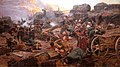 Battle in the mountains, by Franz Roubaud, 1890.
 -
 Mountaineers leave the aul, by Pyotr Gruzinsky
 -
 Russian medal for subjugation of Western Caucasus 1859–1864
 -
 Murid with the naib banner, by Theodor Horschelt 1858–1861.
 -
 Officer of the Separate Caucasian сorps by A. L. Zisserman
 -
 Artillery fireworker of the Separate Caucasian сorps
 -
 Caucasian horseman warrior, by Oskar Schmerling 1893.
 -
 Fight with the сhechens under Akbulat-Urt, by D. Koenig (1849)
 -
 Naibs of Imam Shamil, by Giorgio Corradini 19th century.
 -
 Circassian warrior, by Alfred Kowalski, 1895.
 -
 Caucasian rider in fight with Russian soldier, by Roubaud. F. (1892)
 -
 Soldiers of the Shirvan regiment on Gunib, by Bogdan Willewalde (1870).
 -
 Assault of Gunib, by Pyotr Gruzinsky 1862.
 -
 Battle of Ghunib, painting by Theodor Horschelt 1867.
 -
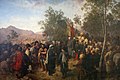 Capture of Shamil, painting by Theodor Horschelt 1859.
 -
 Shamil (front page). Illustrated London News of December 24, 1859.
 -
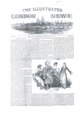 Article of Illustrated London News about Russo-Circassian War.


.jpg)


.jpg)


.png)
See also
[edit]Notes
[edit]- ^
- Бушуев 1941: "В организации борьбы за независимость ему приходилось по несколько раз принуждать одни и те же «вольные общества» Дагестана, а затем Чечни и Ингушетии, к борьбе против русского царизма."
- Тезисы докладов и сообщений 1989, p. 106: "Известно, что оформление военно-теократического государства по праву называемого имаматом Шамиля, и его расцвет пришлись на 1840—1850-е гг. В этот период в состав имамата входили практически весь Нагорный Дагестан, вся Чечня (за исключением междуречья Терека и Сужни), большая часть Карабулака («вилайет Арштхой»), ряд обществ Ингушетии («вилайет Калай»), некоторые аулы цоринцев и галгаевцев."
- Шамиль: Иллюстрированная энциклопедия 1997, p. 211: "Известно, что оформление военно-теократического государства по праву называемого имаматом Шамиля, и его расцвет пришлись на 1840—1850-е гг. В этот период в состав имамата входили практически весь Нагорный Дагестан, вся Чечня (за исключением междуречья Терека и Сужни), ряд обществ Ингушетии, некоторые аулы цоринцев и галгаевцев."
- Дадаев 2006, p. 223: "Пятый многолюдный съезд был созван 26 сентября 1841 г. в столице Имамата Дарго, где обсуждался вопрос о мерах борьбы с русским царизмом. Это было время, когда началась блистательная эпоха Шамиля, в состав Имамата вошли земли ликвидированного Аварского ханства, множество союзов сельских общин горного и предгорного Дагестана, почти вся Чечня, Ингушетия, отдельные аулы Хевсуретии и Тушетии."
References
[edit]- ^ Clodfelter 2017, p. 231.
- ^ a b À la conquête du Caucase: epopée géopolitique et guerres d'influence
- ^ Krugov & Nechitailov 2016, p. 105.
- ^ Gisetti 1901, p. 129.
- ^ Krivosheev 2001, p. 568.
- ^ Vedeneev 2000, p. 123.
- ^ Uralanis 1960, p. 362.
- ^ "Victimario Histórico Militar".
- ^ Richmond, Walter. The Circassian Genocide. ISBN 9780813560694.
- ^ King, Charles (2008). The Ghost of Freedom: A History of the Caucasus. New York City, NY: Oxford University Press. ISBN 978-0-19-517775-6.
- ^ Dowling, Timothy C., ed. (2014). Russia at War. Santa Barbara, California: ABC-CLIO. pp. 728–730.
In 1801, Russia annexed the Georgian Kingdom of Kartli–Kakheti.
- ^ Robert F Baumann and Combat Studies Institute (U.S.), Russian-Soviet Unconventional Wars in the Caucasus, Central Asia, and Afghanistan (Fort Leavenworth, Kan: Combat Studies Institute, U.S. Army Command and General Staff College, n.d.)
- ^ Yale University paper Archived December 29, 2009, at the Wayback Machine
- ^ "The Circassian Diaspora: Genocide, Exile and Return". The Circassian Genocide. Retrieved 2025-11-08.
- ^ JAMnews (2024-06-14). "Mahajirs in Abkhazia: 1.5 million Circassians and Abkhazians were deported during the 1817-1864 Russo-Caucasian War. Video". Jamnews in English. Retrieved 2025-11-08.
- ^ Jaimoukha, A., The Circassians: A Handbook, London: RoutledgeCurzon; New York; Routledge and Palgrave, 2001., page 63
- ^ Richmond, Walter. The Circassian Genocide, Rutgers University Press, 2013., page 56
- ^ Кабузан В.М. Население Северного Кавказа в XIX - XX веках. - СПб., 1996. С.145.
- ^ a b Boldyrev, Dr. Andrei. "NORTH-WESTERN CAUCASUS IN THE POLICIES PURSUED BY RUSSIA AND THE OTTOMAN EMPIRE AT THE FINAL STAGE OF THE CAUCASIAN WAR". Dergi Park. Retrieved 8 November 2025.
- ^ Kelbaugh, Matthew (29 April 2025). "Ukraine's and Georgia's Recognition of the Circassian Genocide: Strategic Engagement with North Caucasian Causes". Dergi Park. Retrieved 8 November 2025.
- ^ a b "The Chamber of Commerce and Industry of the Republic of Abkhazia". www.tppra.org. Retrieved 2025-11-08.
- ^ Gegechkori, Irakli. "Russian Expansion in the Caucasus and Georgia" (PDF). Rondeli Foundation. Retrieved 8 November 2025.
Bibliography
[edit]- Krugov, Alexei; Nechitailov, Maxim (2016). Вооруженные силы иммамата горцев Северного Кавказа (1829-1859 гг.) [Armed forces of the Immamat of the Highlanders of the North Caucasus, 1829-1859]. Ратное дело (in Russian). Moscow: Русские витязи. ISBN 978-5-9906037-3-8.
- Бушуев, С. (1941). "К биографии Шамиля" [To the biography of Shamil]. Красный архив (in Russian). 2 (102). Москва: ОГИЗ; Госполитиздат: 115–139.
- Дагестанский филиал АН СССР (1989). Народно-освободительное движение горцев Дагестана и Чечни в 20-50-х годах XIX в: Всесоюзная научная конференция, 20-22 июня 1989 г.: тезисы докладов и сообщений [The people's liberation movement of the highlanders of Dagestan and Chechnya in the 1820s–1850s: All-Union Scientific Conference, June 20–22, 1989: abstracts of reports and messages]. Makhachkala: Дагестанский филиал АН СССР. pp. 1–190.
- Казиев, Ш. М., ed. (1997). Шамиль: Иллюстрированная энциклопедия [Shamil: Illustrated Encyclopedia] (in Russian). Москва: Эхо Кавказа. pp. 1–220. ISBN 5-900054-01-2.
- Дадаев, Ю. У. (2006). Государство Шамиля: социально-экономическое положение, политико-правовая и военно-административная система управления [State of Shamil: socio-economic situation, political-legal and military-administrative system of government] (PDF) (in Russian). Махачкала: «Ихлас». pp. 1–491.
- Baddeley, John F. (1908). The Russian Conquest of the Caucasus. London: Longmans, Green and Co.
- Pokrovsky N. I. Caucasian Wars and the Imamate of Shamil / Foreword. N. N. Pokrovsky, introduction. and approx. V. G. Gadzhiev. — M.: ROSSPEN, 2000. — 511 p. — ISBN 5-8243-0078-X.
- Bell, J.S Journal of a residence in Circassia during the years 1837, 1838, and 1839 (English)
- Dubrovin, N. Russian: (Дубровин Н.Ф.) История войны и владычества русских на Кавказе, volumes 4–6. SPb, 1886–88.
- Kaziev, Shapi. Imam Shamil, Molodaya Gvardiya publishers: Moscow, 2001, 2003, 2006, 2010
- Kaziev, Shapi. Akhoulgo. Caucasian War of 19th century.
- The historical novel Epoch Publishing house. Makhachkala, 2008. ISBN 978-5-98390-047-9
- Gammer, Moshe. Muslim Resistance to the Tsar: Shamil and the Conquest of Chechnia and Daghestan. Frank Cass & Co. Ltd., 1994. 247 p. — ISBN 978-0714634319.
- Gisetti, Anton L. (1901). "Потери в период Кавказско-горской войны 1801-1864" [Losses during the Caucasian-Mountain War of 1801-1864]. In Potto, Vasily A. (ed.). Сборник сведений о потерях Кавказских войск во время войн Кавказско-горской, персидских, турецких и в Закаспийском крае [Collection of information about the losses of the Caucasian troops during the wars with the Highlanders, Persians and Turks and in the Transcaspian region] (in Russian). Составлен по документам, хранящимся в Кавказских архивах (Compiled according to documents kept in the Caucasian Archives). Tiflis (modern Tbilisi): Типография Либермана.
- Uralanis, Boris (1960). Войны и народонаселение Европы: людские потери вооруженных сил Европейских стран в XVII-XX веках [Wars and the population of Europe: human losses of the armed forces of European countries in the XVII-XX centuries] (in Russian). Moscow: Социально-экономическая литература.
- Vedeneev, Dmitry (2000). 77 тысяч [77 thousands]. Rodina (in Russian). Moscow.
- Krivosheev, Grigori (2001). "Вооруженные конфликты на Северном Кавказе" [Armed conflicts in the North Caucasus]. Россия и СССР в войнах 20 столетия [Russia and USSR in war of 20 century] (in Russian). Moscow: Олма-Пресс.
- Clodfelter, M. (2017). Warfare and Armed Conflicts: A Statistical Encyclopedia of Casualty and Other Figures, 1492–2015 (4th ed.). Jefferson, North Carolina: McFarland. ISBN 978-0786474707.
