 | This article has multiple issues. Please help improve it or discuss these issues on the talk page. (Learn how and when to remove these messages)
|

 | |
| Media type | Memory card |
|---|---|
| Standard | CFexpress standard |
| Developed by | CompactFlash Association |
| Dimensions |
|
| Extended from | XQD card |
| Released | 2017 |
CFexpress is a standard for removable media cards by the CompactFlash Association (CFA) most used in digital cameras. The standard uses the NVM Express protocol over a PCIe interface. 3 different form factors are available, with 1 to 4 PCI-E lanes available.[1][2]
History
[edit]CFexpress versions
[edit]On 7 September 2016, the CompactFlash Association announced the CFexpress standard, with specifications based on the PCI Express interface and NVM Express protocol.[1]
On 18 April 2017 the CompactFlash Association published the CFexpress 1.0 specification.[3] Version 1.0 used the XQD form-factor (38.5 mm × 29.8 mm × 3.8 mm) with two PCIe 3.0 lanes for speeds up to 2 GB/s. NVMe 1.2 is used for low-latency access, low overhead and highly parallel access.
The CFexpress 2.0 standard was announced on 28 February 2019. It featured two new card formats - a more compact Type A with one lane, and a larger Type C with four lanes. Existing cards were designated as Type B. The NVM Express protocol was upgraded to 1.3.[4]
The CFexpress 4.0 standard was announced on 28 August 2023. CFexpress 4.0 supports up to four PCIe 4.0 lanes, at 2 GB/s per lane - twice as fast as CFexpress 2.0. The NVM Express protocol was upgraded to 1.4c.[5]
Products
[edit]The standard itself is included in a variety of digital cameras, memory cards and memory card readers.
The first memory card using the CFexpress standard was introduced by Delkin on 13 June 2017 and were based on the CFexpress 1.0 specification.[6]
The first consumer camera was announced by Nikon on 23 August 2018. Nikon announced their new mirrorless cameras, the Z6 and Z7, both using a single slot for either a CFexpress Type B or an XQD card. At launch the cameras only supported XQD cards, but added support for CFexpress cards with a firmware update.[7][8][9] The firmware update was released on 16 December 2019 (firmware version 2.20) adding support for CFExpress over a year after the cameras launch.[10] On 13 February 2019, Nikon further confirmed that CFexpress support would also be added via a firmware update to the D5, D500 and D850 where a CFexpress Type B card could be used in the camera's XQD slot. All three cameras were announced before (D5 and D500: January 2016) or right after (D850: August 2017) the CFexpress standard was published, making this addition a rather unusual tech upgrade for older hardware in the industry.[11]{{[12]
Other companies followed with cameras supporting CFexpress cards in the following years:
- Phase One — XF IQ4 series, 2018, CFexpress support added in later firmware update[13]
- Canon — EOS-1D X Mark III, 2019, using dual CFexpress slots with no option for using non-CFexpress cards[14][failed verification]
- Sony — α7S III, 2020, using dual CFexpress Type A and SD cards [15]
-
 A CFexpress by Delkin
 -
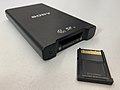 A Sony CFexpress Type A reader and card
 -
 CFexpress Type B and SD slots on a Nikon Z8 camera


Derivatives
[edit]The CFexpress card standard was also used to adapt it to other products that are not compatible with other photographic equipment.
On November 10, 2020, Microsoft launched the Xbox Series X and Series S with a slot for semi-proprietary Expansion Cards based on a CFexpress Type B form factor.[16][unreliable source?] These Cards only support PCIe Gen4. [17][better source needed]
Comparison
[edit]| Standard | Version | Launched | Bus | Speed (full-duplex) |
|---|---|---|---|---|
| CFexpress | 1.0 | 2017 Q2 | PCIe 3.0 x2 | 2.0 GB/s |
| 2.0 | 2019 Q1 |
|
| |
| 4.0 | 2023 Q3 |
|
| |
| SD | 3.0 | 2010 Q2 | UHS-I | 0.1 GB/s |
| 4.0 | 2011 Q1 | UHS-II | 0.3 GB/s | |
| 6.0 | 2017 Q1 | UHS-III | 0.6 GB/s | |
| 7.0 | 2018 Q2 | PCIe 3.0 x1 | 1.0 GB/s | |
| 8.0 | 2020 Q2 | PCIe 4.0 x2 | 4.0 GB/s | |
| UFS Card | 1.0 | 2016 Q2 | UFS 2.0 | 0.6 GB/s |
| 2.0 | 2018 Q4 | UFS 3.0 | 1.2 GB/s | |
| CFast | 1.0 | 2008 Q3 | SATA-300 | 0.3 GB/s |
| 2.0 | 2012 Q3 | SATA-600 | 0.6 GB/s | |
| XQD | 1.0 | 2011 Q4 | PCIe 2.0 x1 | 0.5 GB/s |
| 2.0 | 2014 Q1 | PCIe 2.0 x2 | 1.0 GB/s |
Form factors
[edit]CFexpress supports the following card sizes.[18]
| Form Factor |
Dimensions (mm) |
PCIe Lanes |
|---|---|---|
| A | 20.0 × 28.0 × 2.8 | 1 |
| B | 38.5 × 29.8 × 3.8 | 2 |
| C | 54.0 × 74.0 × 4.8 | 4 |
The larger form factors have more electrical contacts, allowing more PCIe lanes to be used.
Type A is similar in size to an SD card. As of 2023, Sony is the only camera manufacturer that has adopted CFexpress Type A, using it in some of its Sony α and FX cameras. All Sony CFexpress slots also support UHS-II SD cards.[19]
Type B is the most popular CFexpress form factor, and is used by several camera manufacturers, including Canon, DJI, Nikon, Panasonic, and Red. It has the same size and contacts as an XQD card, allowing a single card slot to accept both XQD and CFexpress Type B cards. Some older cameras with XQD slots have received firmware updates to allow use of a CFexpress Type B card in its XQD slot.[19] As CFexpress uses the NVM Express protocol, adapters are available to convert M.2 2230 format solid-state drives into CFexpress Type B cards.[20]
As of 2023[update], no devices have implemented CFexpress Type C, and neither cards nor cameras are available.[19]
-
 CFexpress Type A (left) and Type B (right) cards
 -
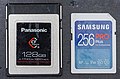 CFexpress Type B (left) next to an SD card (right)

_FRONT.jpg)
See also
[edit]
Notes
[edit]References
[edit]- ^ a b "CFA 5.1 Press Release" (PDF). 7 September 2016. Archived from the original (PDF) on 21 December 2016. Retrieved 12 April 2025.
- ^ Williams, Andrew (2 August 2020). "What is CFexpress? The new camera memory card format explained". Techradar. Retrieved 26 December 2025.
- ^ "CFexpress 1.0 Press Release" (PDF). 18 April 2017. Archived from the original (PDF) on 12 December 2017. Retrieved 12 April 2025.
- ^ "The CompactFlash Association Announces CFexpress® 2.0 Specification" (PDF). 1 March 2019. Archived from the original (PDF) on 19 May 2023. Retrieved 12 April 2025.
- ^ "2023-08-21 CFexpress 4.0 Press Release - FINAL CLEAN" (PDF). CompactFlash Association. The CompactFlash Association. 28 August 2023. Archived (PDF) from the original on 5 April 2025. Retrieved 12 April 2025.
- ^ "Industrial CFexpress 1.0 and Industrial CFX 1.0 Cards". Delkin Industrial. Retrieved 29 June 2017.
- ^ "Nikon announced the development of new firmware for the Z6, Z7, D5, D850 and D500 cameras". Nikon Rumors. 14 February 2019. Retrieved 12 April 2025.
- ^ "Nikon to add Eye AF, Raw video and CFexpress support to Z-series". DPReview. Retrieved 8 January 2019.
- ^ "Z 6 Firmware 3.00". Nikon. 17 February 2020. Archived from the original on 6 May 2020. Retrieved 10 November 2021.
- ^ "Nikon Z Series Evolves To Become Even More Powerful: Firmware Ver. 2.20 Released, Adds Support For CFexpress Memory Cards; Paid Service To Install RAW Video Output Function Also Begins". 23 December 2019. Archived from the original on 23 December 2019. Retrieved 23 December 2019..
- ^ "Nikon Z6/Z7 firmware update 2.0 with eye AF officially released". Nikon Rumors. 16 May 2019. Retrieved 12 April 2025.
- ^ "Nikon | Download center | D850". Retrieved 27 May 2021..
- ^ "XF IQ4 150MP Camera System". phaseone.com. 28 August 2018. Archived from the original on 23 October 2018. Retrieved 28 August 2018.
- ^ "Canon announces development of the new EOS-1D X Mark III flagship DSLR camera". Canon Global. Retrieved 12 April 2025.
- ^ Cade, DL (28 July 2020). "Sony Unveils the a7S III: 16-bit RAW Video, New Menus, and New AF System". Petapixel.
- ^ Mills, Matt (17 November 2020). "The Xbox Series X Expansion Card: a CFexpress? | ITIGIC". Retrieved 13 September 2021.
- ^ 华山论剑指定营养品 (13 September 2021). "自制次世代XBOX专用存储卡". Billibili user forums. Retrieved 13 September 2021.
- ^ "CFexpress 2.0 Specification Introduces two New Form Factors". Retrieved 23 August 2020.
- ^ a b c Williams, Matt (11 December 2023). "A Complete Guide to Memory Cards". PetaPixel. Retrieved 9 May 2025.
- ^ Gray, Jeremy (7 February 2022). "Make your own (cheaper) CFexpress Type B cards with this NVMe SSD to CFexpress Type B adapter". DPReview. Retrieved 26 December 2025.
| Main articles | .svg) | |
|---|---|---|
| Types |
| |